
Emmanuel Macron is increasingly reminiscent of Miloš Jakeš. As General Secretary of the Communist Party of Czechoslovakia, Jakeš stood in front of the party headquarters in Červený Hrádek in July 1989. His speech was intended to strengthen his authority, but ended up as an embarrassing example of how out of touch with reality those in power can be. It was at this very moment that Jakeš uttered the memorable phrase that he felt “like a stake in a fence.”
Like Jakeš, Macron refuses to acknowledge the inevitability of change. His perception of reality is so far removed from that of ordinary French people that his every action only deepens the divide between him and the public. Every political decision exacerbates the crisis rather than alleviating it.
Sad French record for the outgoing government
The record for the shortest term of office of a French cabinet was previously held by Georges Bidault, whose government lasted only one day in June 1953 because it failed to win the confidence of parliament. This government was symbolic of the crisis of the Fourth Republic and heralded the transition to today's Fifth Republic.
The rapid fall of Sébastien Lecornu's government is further proof that France is caught in an institutional trap.
Lecornu's record will be difficult to beat. His government lasted only 14 hours without a vote of confidence. The main reason for the collapse was Bruno Le Maire. The former finance minister, who served in the government for more than seven years, bears considerable responsibility for the current enormous public deficit.
During his tenure, public debt rose by more than one trillion euros. It would be more than naive to expect him to solve the current crisis. The only good news is that Prime Minister Lecornu did not appoint him finance minister, but defense minister. However, that is unlikely to bother Bruno Le Maire. Under French law, he is entitled to three months' severance pay, which will probably be the best-paid “Sunday job” of his life. Outgoing Prime Minister Lecornu will receive €48,000, which is also not insignificant.
At a time when France is facing tough budget cuts—whether voluntary or forced—such “royal” salaries for politicians only deepen their alienation from the reality of ordinary people, including the upper classes.
A game of delay
Macron's strategy is reminiscent of a game of delay. Lecornu took an unusually long 26 days to form a government, prompting constitutional lawyers to question whether this situation could continue indefinitely and whether it was possible to express no confidence in the prime minister alone, or whether the government as a whole was also required. It was obvious that Lecornu would not be able to gain the confidence of parliament, as he relied on the same members as his predecessors Barnier and Bayrou. The result could not have been otherwise—parliamentary mathematics is relentless.
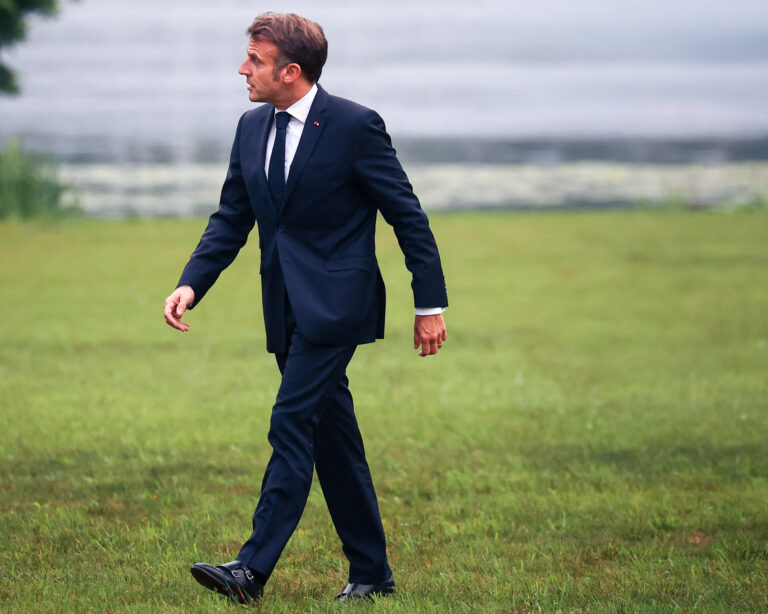
However, Macron is not giving up. Instead of appearing on television and clearly explaining to the nation what he plans to do and what political responsibility he intends to take on, he has opted for silence. Only “by chance” did a strange message reach the media: footage of him walking alone and pensively along the Seine.
Démission de Sébastien Lecornu: Emmanuel Macron aperçu sur les quais parisiens pic.twitter.com/6ETECX96Co
— BFMTV (@BFMTV) October 6, 2025
It is difficult to say what Macron intended to achieve with this theatrical gesture, but he comes across as a lonely man fighting against everyone. Despite his isolation, however, he continues to make phone calls, suggesting that he is not giving up.
Lecornu's farewell
Macron did not appear in the media, but sent his popular Prime Minister François Lecornu, who had already resigned. During his speech, Lecornu emphasized several times that he was no longer making any decisions since he had resigned. At the same time, however, he hinted that there was a majority of deputies in the French parliament who did not want to dissolve parliament.
He is right—many French MPs are unsure whether they could defend their seats in early elections. The problem is that these MPs, who want to retain their “royal” privileges, come from different parties across the political spectrum. These parties despise each other for historical reasons.
Cooperation is therefore virtually impossible. Everyone knows this. Nevertheless, Macron is trying again to appoint a new prime minister. His name is likely to be announced in two days. There is speculation that this time it will be a politician from the left. But even the left does not have a majority in parliament, so this government will also be just another game to buy time, not a lasting solution.
Macron's efforts to extend his power
Macron's efforts to delay the inevitable are giving rise to numerous speculations. Why is he trying so hard to extend his power at any cost?
At this rate, he will not last until the end of his term in 2027. The conspiracy theories were reinforced by the resigned Prime Minister Lecornu himself, who answered “no” when asked if Macron should resign, adding mysteriously: “As a former defense minister, I can assure you that now is not the right time to change presidents.”
This played into the hands of conspiracy theorists who speculate that Macron's solution to the crisis is to activate Article 16 of the French Constitution, which allows the president to assume extraordinary powers.
For this to happen, Macron would need a strong pretext, such as a war.
Let's hope it doesn't come to that and that, after another unsuccessful attempt to form a government, Macron understands that the only real solution is his resignation.