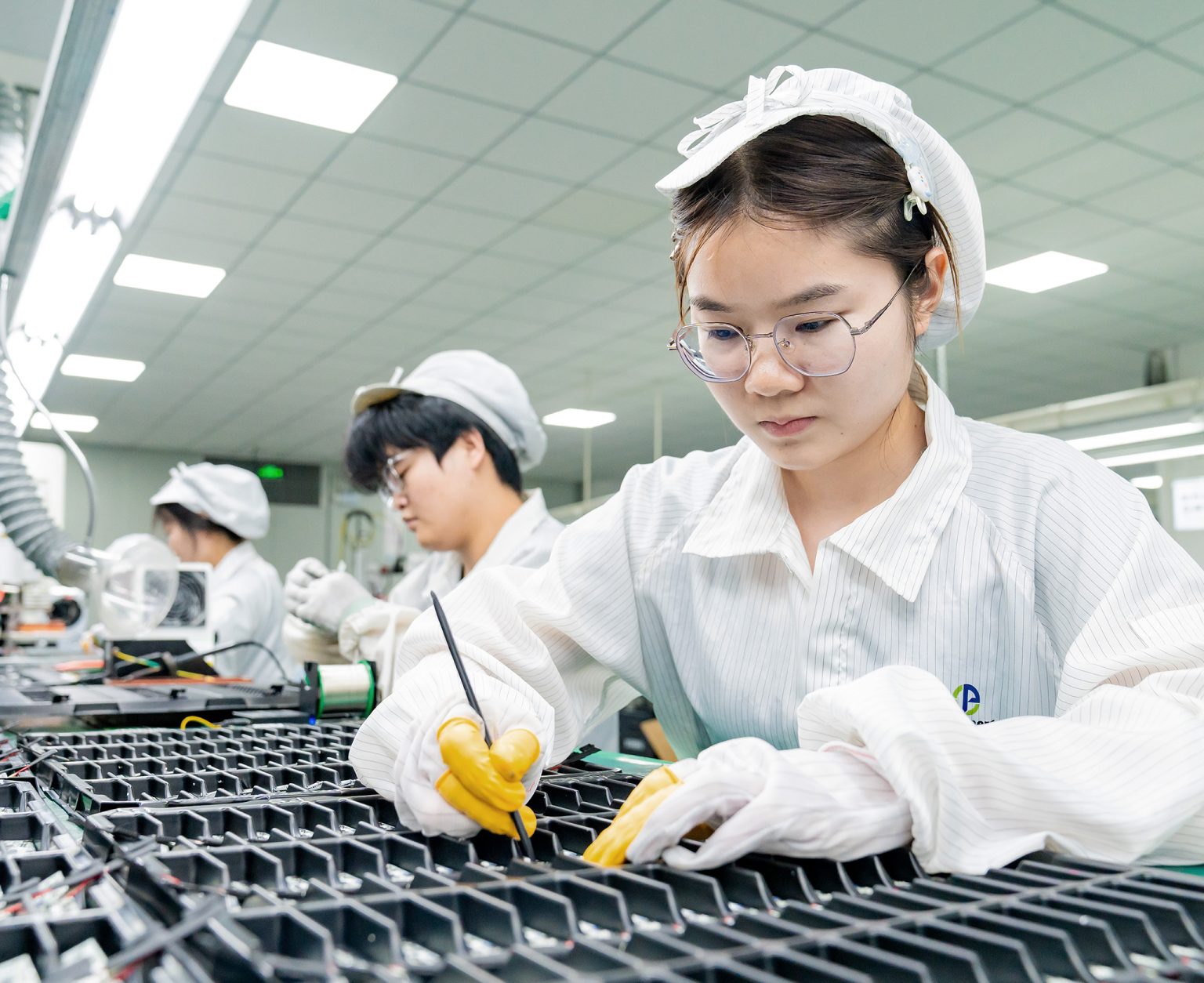
Workers produce lithium batteries for domestic and foreign clients. Photo: Zhai Weikai/VCG via Getty Images
Lithium's long journey to becoming a global commodity
In the summer of 2023, Elon Musk said aloud what commodity and stock traders had been whispering for years: lithium is the new oil.
This raw material has enormous investment potential, just like oil once did. The options for investing in lithium are similar. It is possible to trade the raw material on the commodity market or buy shares in companies operating in this field. However, this is where the similarity with black gold ends.
The lithium market is still in its infancy, and its development is not without its challenges. Uncertainty about its long-term prospects remains the main obstacle. While there is consensus that lithium is a strategic raw material for which there will be huge demand in the next five years, this certainty does not extend to the ten-year horizon.
Lithium may be replaced by a more readily available element or alloy that requires less pure lithium. Oil has never had such a competitor and remains a key source of global energy. With this uncertainty in mind, it makes sense to ask how investments in lithium actually work.
Lithium as a commodity
The first obstacle that a potential lithium investor encounters is the fact that there is no universally quoted commodity as there is for oil. Although there are two main types of oil markets—Brent and US light crude—they are interconnected. With lithium, the situation is much more complex.
Global trade in lithium is concentrated in three forms. Spodumene concentrate [spodumene is a lithium pyroxene mineral, ed.] forms the raw material basis of the entire chain. Lithium carbonate dominates the market as the most liquid commodity and determines world prices. Lithium hydroxide is a rapidly growing segment driven by demand for more powerful batteries.
However, investors face other problems. The largest market for lithium carbonate is in China and is largely inaccessible to foreign participants. Physical lithium is traded there, which is often subject to speculation.
It is not easy to estimate daily volumes, but simplified calculations show that approximately $50 million is traded there every day. This is a negligible amount compared to the oil market, where daily volumes reach $200 to $300 billion.
On the American CME exchange, volumes for lithium contracts are even smaller, as these contracts mainly serve as a hedging tool. Only a few million dollars are traded daily. The main weakness of the lithium market is therefore its very low liquidity.
Most companies therefore purchase this raw material directly from miners or through over-the-counter agreements, which leads to large price differences. The Chinese exchange thus provides only an inaccurate indicative indicator of lithium prices.
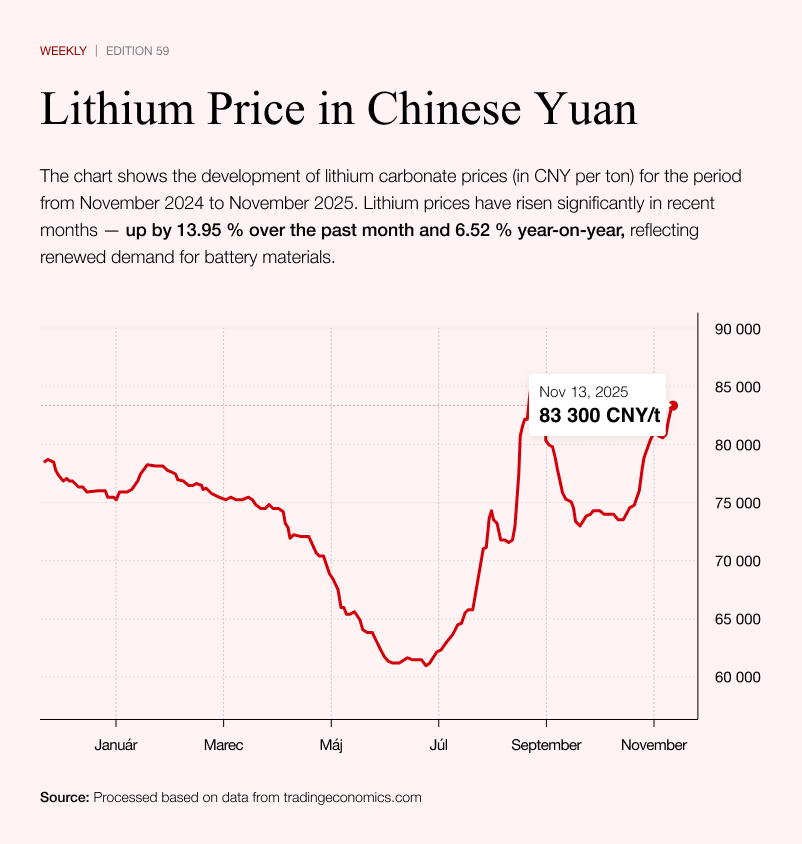
For the average investor, it is not the exact price that is decisive, but rather the direction of the trend. Current data show that the price of lithium has been rising again since the end of September. This trend partly mirrors Donald Trump's political interest in raw materials of strategic importance. Nevertheless, the price of lithium is still well below the levels seen in 2022 and 2023, when the market expected a permanent shortage, which ultimately did not materialize.
There is still a long way to go before lithium becomes a real commodity like oil or copper.
Lithium Price in Chinese Yuan
Investments in lithium mining: Australia versus Chile
The price of lithium is important, but for the reasons already mentioned, it is more indicative than decisive. The development of electromobility, technological progress, and strategic political interests are much more significant. Buying lithium itself on the stock market is not ideal for investors. It is more convenient and accessible to invest in companies that are directly involved in this sector.
However, when investing in lithium, a fundamental geopolitical question arises. We can choose between companies that mine lithium and those that process it. In the case of mining, the situation is clearer. The largest volumes of lithium come from Australia and Chile. Investors can therefore choose companies according to their geographical preferences.
Mining companies such as Pilbara Minerals and Liontown Resources operate in Australia. Chile is even more interesting from an investment perspective because geopolitical influences come into play here. The American company Albemarle Corporation operates in the region, as does Sociedad Química y Minera de Chile, in which the Chinese company Tianqi Lithium Corporation has a significant stake. This allows the country of the dragon to maintain control over this strategic raw material even on a continent that has traditionally fallen within the American sphere of influence.
Investors can therefore choose according to their geopolitical compass. Australian companies represent a stable mining base, while Chile remains an area where the interests of the United States and China converge.
China dominates processing, the US is catching up
The main problem with the lithium market is not mining, but processing. This is where China's geopolitical dominance is most evident. The country has more than 60% of the global share of lithium processing, and in some areas even more. This gives it a decisive influence on the production of lithium for industrial use.
The US is trying to catch up and is focusing primarily on developing its own processing capacities. There are two key companies on the US stock exchange that are involved in this effort.
The first is the aforementioned Albemarle Corporation, one of the world's largest producers of lithium chemicals. The second is Lithium Americas, which is developing the Thacker Pass project in northern Nevada. The project aims to secure the extraction of the largest lithium deposit in the US and build processing capacity. With this project, the US government is seeking greater self-sufficiency and less dependence on China.
The importance of the project is also demonstrated by the fact that the US government has acquired a five percent stake in Lithium Americas. However, many investors consider the project too ambitious and fear that its implementation will take several years. This skepticism was also reflected in the company's share price. After initial enthusiasm about the government's entry, the shares fell from $10 to $5.1. However, those who bought them at the beginning of this year could still have gained about two-thirds in value.
The United States is now trying to catch up, with President Donald Trump's political support playing a role. Investors can now bet that Chinese know-how in lithium processing will remain concentrated in Asia.
Shares in the Chinese company Ganfeng Lithium Group, a leader in processing, can be purchased on the Hong Kong Stock Exchange. Investor interest in this sector is also confirmed by the share price, which has doubled since the beginning of this year.
America is betting on technological self-sufficiency, China on control of supply chains. The lithium market is thus becoming a test of a new era of globalization, in which the biggest profits are made where business intersects with geopolitics.
Here is placeholder for Article excerpt Here is placeholder for Article excerpt Here is placeholder for Article excerpt Here is placeholder for Article excerpt
Here is placeholder for Article excerpt Here is placeholder for Article excerpt Here is placeholder for Article excerpt Here is placeholder for Article excerpt
Here is placeholder for Article excerpt Here is placeholder for Article excerpt Here is placeholder for Article excerpt Here is placeholder for Article excerpt
Welcome to the comments section of the Štandard daily. Please take note of our guidelines, comments are moderated by us. You can contact the moderators at [email protected].
Participate in the discussion
Comments are available to subscribers only. If you'd like to join the discussion, choose a subscription starting at €6.72 per month.
All comments 0
Register
Comments are available to registered users only. If you'd like to join the discussion, register here.