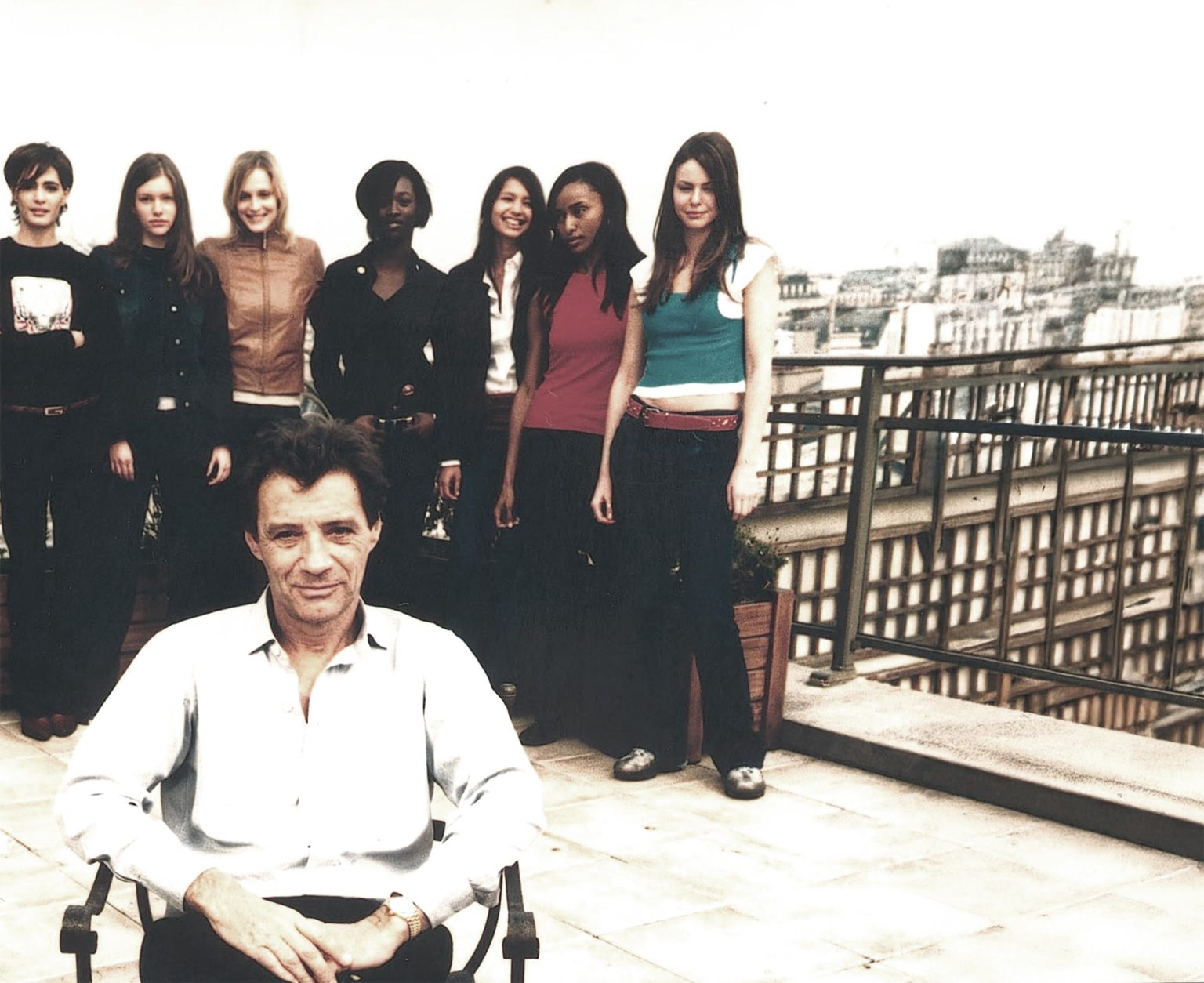
His rise was accelerated by his partnership with singer and dancer Claude François, nicknamed Cloclo. He was known for his magnetism and thousands of romantic relationships—an atmosphere in which the line between modeling and exploitation was not always clear to young women. Thanks to this, Brunel had no shortage of applicants and gradually became a prominent name in French modeling.
In 1995, he expanded to the US, where he founded Karin Models of America and briefly collaborated with the prestigious Ford agency. He brought names such as Christy Turlington, Sharon Stone, and Milla Jovovich to the industry. His career seemed to be growing without limits.
The turning point came in 1999. The CBS television program 60 Minutes published statements from models about rape and drug use. Brunel denied the allegations but admitted to cocaine addiction. The Ford agency immediately terminated its cooperation with him. With his reputation tarnished, he had less and less space in the industry and in 2000 he moved permanently from Europe to the US.
Maxwell and Epstein: back in the game
After leaving Europe, he turned to his old acquaintance Ghislaine Maxwell, whom he had known since the 1980s. She connected him with Jeffrey Epstein. Together, they founded the MC2 agency, which no longer sought models in the traditional sense, but primarily young girls for their business model.
Epstein invested considerable funds in Brunel's projects, and the two men became closely connected. Flight records show that Brunel was one of the most frequent passengers on Epstein's private flights between Paris, New York, and his Caribbean island.
Brunel's agency grew rapidly thanks to financial injections. He opened branches in New York, Miami, and Tel Aviv. All were closed in 2019. He later founded two more agencies: The Identity Models in New York and Mother Agency in Kiev.
Epstein couldn't praise his collaboration with Brunel enough. According to the testimony of Virginia Giuffre, a victim of sexual abuse (who allegedly committed suicide in April this year at the age of 41), Epstein claimed that he had more than a thousand girls from Brunel. Giuffre also stated that Brunel brought three French girls aged twelve as a "birthday present," allegedly through a modeling offer.
Brunel was a frequent participant in Epstein's flights and stays on the Caribbean island. However, their friendship eventually soured. In 2015, Brunel claimed that his association with Epstein had cost him several key contracts.
In 2019, French authorities began investigating Brunel in connection with Epstein. The Frenchman tried to disappear from view, and authorities searched for him for several months. He was finally arrested on December 17, 2020, at Paris airport while attempting to board a flight to Senegal.
Perfectly tidy
According to his lawyers, he found the situation in prison very difficult to cope with mentally. They leaned towards the official version that his death in La Santé prison was a suicide. Of course, the probability that two key players in a single court case would die by suicide in prison is at the level of statistical error. His death thus sparked a new wave of interest in the whole case.
In December 2021, Brunel was surprisingly released for four days under judicial supervision. However, the appeals court immediately overturned the decision and ordered his swift return to custody. The reason for the original release was never convincingly explained. Journalist Karl Zéro interpreted it as an attempt to facilitate a meeting with someone who could not come for an official visit to the prison.
The whole Epstein affair is a paradise for disinformers and hell for anyone who wants to find out the truth. Brunel's suicide, which came before the investigation and trial were over, cemented an epistemic paradox: the obsession with fact-checking means that without a verdict, every claim becomes "unverified" and therefore seemingly non-existent.
As a result, there is not only a void in justice, but also in truth itself. A system that cannot bring things to a conclusion becomes a factory of uncertainty. And it is in this fog that predators, but also their patrons, thrive best.