
The overall market sentiment remains unchanged in December. Optimism still reigns. The only change is that artificial intelligence has been overshadowed by the upcoming US Fed meeting.
Even here, however, no one is imagining a scenario other than another twenty-five basis point rate cut. The only risk, therefore, is an update of the Fed's macroeconomic projections. Here, however, optimistic investors and analysts are well armed.
And even if the projections were very bad and it turned out that the Fed was not counting on a big rate cut, nothing would happen. Because everyone knows that Jerome Powell will be out as Fed governor in May. We don't know the name of the new one yet, but that's not important.
Because what is certain is that the new Fed Governor will listen to US President Donald Trump, who wants to keep rates as low as possible. So the old Fed leadership can have whatever opinion it wants, but the new cards will be dealt in May. As we know from experience, Trump is not bothered by these big changes.
The limits of economic laws
The question is whether the economic laws will allow it, because it will be very difficult to cut rates significantly when inflation is above 2.5 per cent.
Of course, most proponents of cuts will argue that inflation is not such a problem anymore, it is the US labour market that is important. And therein lies the buried dog. Because if the US Fed is cutting rates, it means that something is not working. Most likely the US labour market.

Rejoicing in a rate cut is the same as rejoicing in the fact that we are sick and the doctor prescribes us strong medicine. So the markets operate in a perverse logic that when they interpret bad news as good news, it means that there is a reason to cut rates further. Markets can only rise. This theory was immediately tested in practice.
The Fed navigates in the dark
The announced Fed meeting will have one peculiarity. Thanks to the longest shutdown in history, the US statistics office did not have time to release the latest macroeconomic statistics. The Fed is thus navigating blindly. We will not know the important figures until after the meeting of the US central bank.
And so investors had to gratefully accept the ADP numbers in order to get an idea of the US labour market. This is a private firm that primarily analyses wage data.
Its figures show that the US labour market lost a total of 32 thousand jobs in November. Analysts, on the contrary, expected new jobs to be added. So it was unpleasant news. However, the markets reacted by rising because the US labour market is not working and so the Fed will have to cut its rates.
The second piece of very negative news is that most of the redundancies were in small firms focused on manufacturing or construction. It is the loss of jobs in these sectors that shows that this is not a random problem, but a structural one. Once again, however, the market is not bothered by this. If it is a structural problem, the more vigorously the US Federal Reserve will have to address it.
This virtually exhausts the macroeconomic news. From a geopolitical point of view, we have not seen any changes either. Negotiations on peace in Ukraine are now proceeding at a snail's pace. There has not been much on the artificial intelligence front either. And so we can look at the various corporate reports.
Netflix to gobble up HBO channels
The big news was Netflix's announcement that it has entered into a definitive agreement to take over some of the assets of Warner Bros. Discovery. It is to be primarily studio and streaming operations. The value of the entire transaction is expected to be $72 billion.
At the same time, Netflix will shoulder part of Warner Bros.' debt and thus, especially in the streaming market, will absorb its direct competitors in the form of HBO and HBO Max channels.
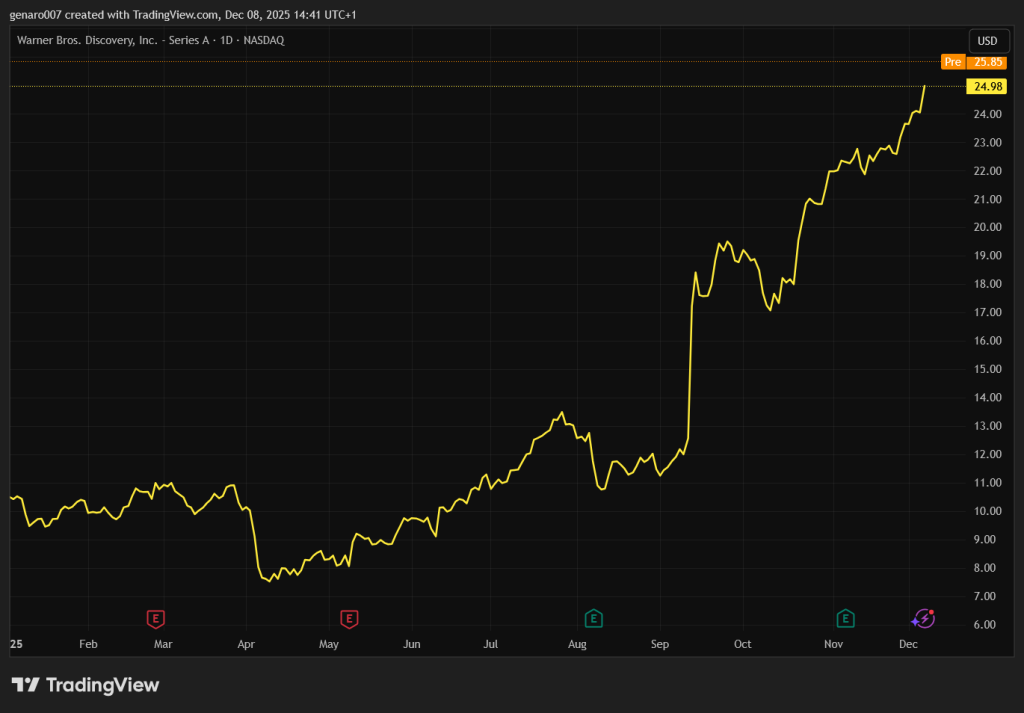
The reaction of the markets gave us a clear idea of how the operation was read by investors. While shares in debt-laden Warner Bros rose six per cent, Netflix shares weakened by more than three per cent. This made investors realise that the risk of the whole operation now lay with Netflix.
Despite being a highly profitable company, there is always the question of whether it has taken too big a bite this time. After all, the Warner Bros acquisition is not just about market share, but also about the capacity to manage such a vast content ecosystem.
For Netflix, however, the fundamental attraction is something else: control over Warner's vast archive. This would allow it to include a long list of iconic and historically significant titles in its subscription, as it is this depth of catalogue that has so far been the advantage of competitors such as Walt Disney or Paramount.
Netflix thus gains not only additional studios, but also what it has lacked compared to traditional media houses: a strong library portfolio that can increase user loyalty and drive growth. At the same time, this would reduce its dependence on licensing foreign content, which can make the service cheaper to run in the long run.
Presidential intervention?
Surprisingly, however, the whole deal has one strong opponent, and that is US President Donald Trump himself. Netflix will thus gain a large share of the US streaming market - around 30 percent, which Trump has identified as a potential problem.
That's enough for the antitrust authority to look into the deal. Netflix executives, however, defend themselves by saying that their share is actually smaller because YouTube or TikTok have to be counted among the streaming services.
The Wall Street Journal came up with a perhaps more prosaic explanation than the president's fear of making the US market competitive enough. The president's friendship with Paramount chief David Ellison may be behind the objection.
If the purchase of Netflix is approved by U.S. regulators, it will be very tough competition for that company in particular.
In the end, it may not just be about the market and regulation, but also about who the US President is rooting for in the behind-the-scenes battle over the future of streaming.