
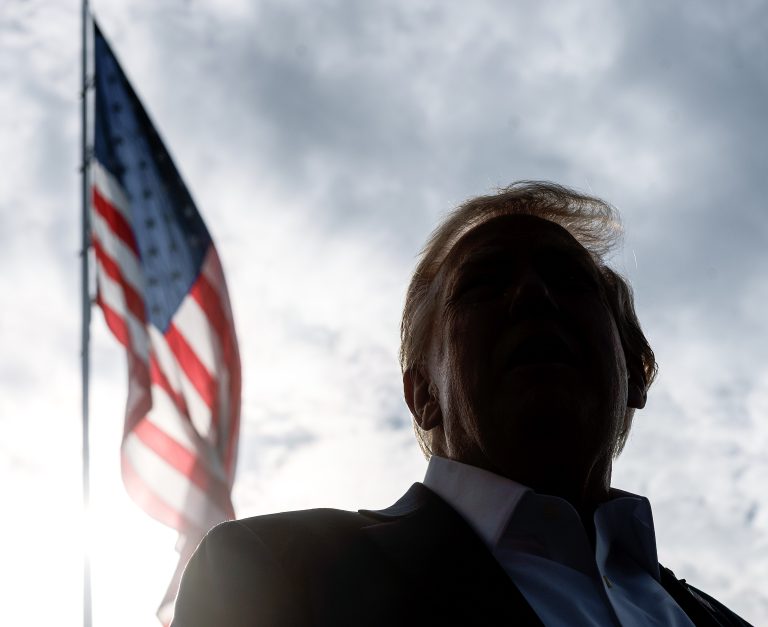
In an interview, Donald Trump called Europe a "declining group of states", which he said is led by "weak people". He claimed that European leaders had failed to manage migration or contribute to ending the Russia-Ukraine war.
He reiterated that Europe "does not know what to do" and criticised in particular the situation in the cities of London and Paris, which he said were burdened by migration from the Middle East and Africa.
In this context, he again attacked the Mayor of London, Sadiq Khan, whom he described as a "disaster", claiming that he had been elected because of the demographic changes caused by migration.
Ukraine
Trump said that Russia is now "clearly in a stronger position than Ukraine". He claimed to have prepared a new draft peace plan, which he said some officials in Kiev had seen but Ukrainian President Volodymyr Zelenskiy had "not yet read".
Trump also hinted that new elections should be held in Ukraine, although they are now blocked by martial law.
The president added that he is ready to support candidates in Europe who share his views. In this context, he mentioned Hungarian Prime Minister Viktor Orbán, whom he praised for his approach to migration and border protection.
Meanwhile, European Council President António Costa warned that allies should not interfere in other countries' political processes.
Domestic politics and Latin America
The conversation also touched on the US economy. Trump assessed its state as "A-plus-plus-plus-plus-plus-plus" and claimed that prices in the US are falling, although so far the latest figures show inflation rising by three per cent year-on-year. He confirmed that he would choose the new head of the Federal Reserve on the basis of whether he would support an immediate cut in interest rates.
On health care, he declined to disclose whether he would support a temporary extension of Obamacare's premium subsidies, which expire at the end of 2025. He stated only that he wants "a better system for less money."
The debate on Latin America was also a significant part of the conversation. Trump said he would not rule out the use of U.S. armed forces against drug cartels in Mexico and Colombia.
Nor did he rule out the possibility of sending ground troops to Venezuela, where his administration has already deployed a large naval force. At the same time, he defended the pardon of former Honduran President Juan Orlando Hernández, convicted of drug offences, while admitting that he knew little about his case.
Trump also commented on the US Supreme Court, which will rule on the constitutionality of birthright citizenship. He said it would be "destructive" for the court to block his effort to restrict the granting of citizenship to children born on US soil. He stated that he did not want conservative Justices Clarence Thomas and Samuel Alito to retire.
Kallas: U.S. should criticize Russia's freedom guarantees, not EU's
EU High Representative for Foreign Affairs and Security Policy Kaja Kallas said on Tuesday that criticism of freedoms on the continent should be directed elsewhere, "perhaps to Russia". She was reacting to the new US national security strategy published by Washington last week, which criticised Europe in several areas, Reuters reports.
"Criticism regarding freedoms should be directed elsewhere. Perhaps to Russia, where dissent is banned, where there is no free media, where political opposition or Platform X is banned," Kallas said in a speech to a European Parliament committee.
"The European Union is the very essence of freedom," the European diplomatic chief added.
In her own words, she sees the US criticism as a "provocation", but nevertheless reiterated that the United States remains Europe's greatest ally.
US President Donald Trump's administration published a new national security strategy on Friday. In it, it accused Europe of undermining political freedom and restricting freedom of expression. According to the US, the continent faces not only economic decline, but also "the far more ominous prospect of the disintegration of civilisation". If Europe continues on its present course, it is said to be "unrecognisable in 20 years or less".
(lud, politico, reuters)