
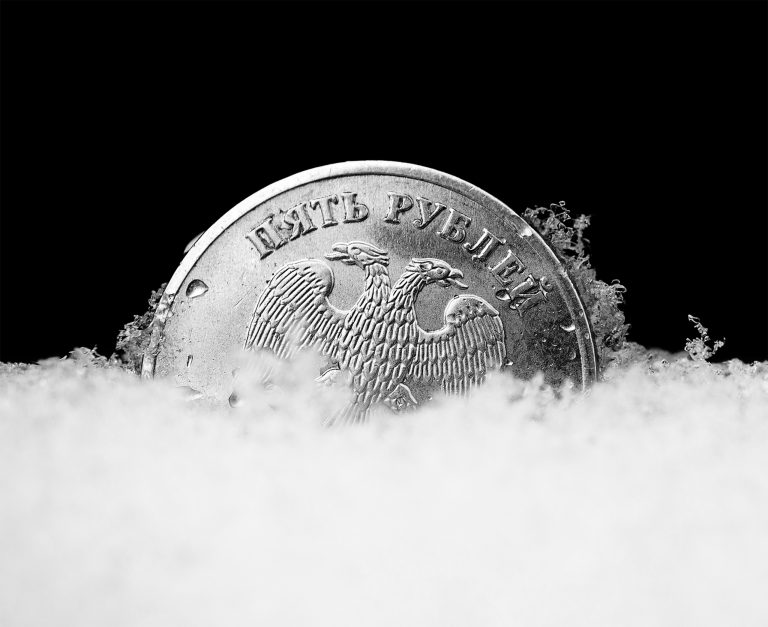
In Niall Ferguson's book The Ascent of Money: A Financial History of the World, we find two sentences that beautifully summarize the essence of money: "Money is not metal. It is engraved trust."
Trust is a very rare commodity because it can take years to build and yet can never be fully achieved. However, losing it can be a matter of a single moment, a single bad decision. Deciding what to do with frozen Russian assets in Europe is not just a political, geopolitical, legal, or moral issue.
It also has a fundamental financial dimension. This is often overlooked because it is largely technical in nature and, to put it simply, "complicates" the whole situation. It is precisely the financial dimension that best shows us the significant problems Europe finds itself in and how much further it could fall if it decides to seize Russian assets without the agreement of their owner.
Composition of Russian reserves
In February 2022, the European Union decided to freeze the foreign reserves of the Central Bank of the Russian Federation (CBR) held within the EU jurisdiction. On Friday, December 12, 2025, it even approved the indefinite freezing of Russian assets. This amounts to approximately €210 billion. The largest part of this – roughly €192 billion – is located in Belgium in the accounts of Euroclear, against which the Russian central bank has already filed a lawsuit.
This Belgian institution is one of the world's most important clearing houses for bonds and large-volume reserve transactions.
Another €18 billion is in France. It is estimated that 60 to 80 percent of these assets are held in the form of government bonds, mainly from Germany, France, and other European Union countries. Cash accounted for only ten to twenty percent.
A very legitimate question is why the Russian central bank had so many European bonds in its portfolio. The answer is simple: the main reason was the intense foreign trade between Russia and the European Union. Cutting off Nord Stream and subsequently Russian oil led to a sharp rise in energy prices and signed the death warrant for many energy-intensive sectors of European industry.
Why the Russians financed European debt
However, this was not the only consequence of the halt in trade between the EU and Russia. Europe has long paid for Russian gas and oil in euros. As the trade balance has long been in Russia's favor, significant euro surpluses have accumulated in the Russian central bank.
The Russian central bank has reinvested these euros in a standard manner, primarily in European government bonds and other safe assets. This is how almost all central banks around the world operate: they either use their foreign exchange reserves to balance foreign trade or diversify them by purchasing liquid and low-risk instruments.
The frozen reserves are therefore not "oligarchs' money," but primarily the result of a twenty-year energy partnership between the old continent and Russia. Europe, which itself has a huge amount of debt, welcomed a buyer willing to accept European bonds despite their very low yields. Russia held these bonds mainly to continue trading, even though from a purely economic point of view it did not make much sense at a time of low interest rates.
The departure of the Russian central bank as a stable buyer contributed to a slight increase in European bond yields of several tenths of a percentage point. Compared to inflation and the ECB's rate hikes, this was a negligible shift. However, the real problem is not just Russia. The freezing of its assets sent a signal to everyone else who wants to hold European bonds: if the geopolitical situation changes, your savings are at risk.
A precedent that changes the rules of the game
In the financial world, it has long been the case that central bank reserves enjoy a higher degree of immunity than ordinary state assets. Central banks' foreign exchange reserves are not just an investment portfolio. They are a means of protecting the monetary stability of the state. They serve as a guarantee in international trade and represent a last resort in the event of a domestic currency crisis.
Freezing such assets is therefore an openly hostile act, only one step less than a declaration of war. It is precisely the freezing of Russian reserves that is forcing other countries to seriously consider whether it still makes sense to hold European bonds.
According to the IMF, total euro reserves held outside the eurozone amount to around €2.2 to €2.4 trillion. Exact figures for individual countries are not readily available. However, it is estimated that China alone holds more than €250 billion.
Given the current geopolitical situation, it could become another candidate for freezing reserves, which would spell immediate disaster for the old continent. Europe is now heavily dependent on Chinese goods, and China remains a key market for Europe after the United States imposed high tariffs on Chinese products.
Arab petro-monarchies also hold a large share of European bonds, which they continue to buy from oil trade surpluses. It would be a big problem for Europe if these countries stopped buying or even decided to sell their positions. The consequences would be almost immediate and very painful.
On the other hand, Europe can rely on the geopolitical balance of power in this case. The petro-monarchies perceive Russian oil as cheap competition that undermines their prices in the long term, and therefore their strategic interests are generally closer to Europe and the West than to Moscow. They do not act as hostile actors, but as cautious players who carefully guard their own energy and security priorities.
Countries such as India, Brazil, and South Africa have used the euro primarily as a tool for diversification from the US dollar. This is precisely because they could hypothetically find themselves on the list of enemies of the United States one day.
Now, however, they see that holding reserves in euros will not protect them from having their assets frozen. This can also be seen as another victory for the US strategy. After the freezing of Russian reserves, it is clear that the euro cannot be a full-fledged alternative to the dollar.
Europe still pretends that the freezing of Russian reserves is an exceptional and isolated case, not a precedent that fundamentally changes the rules of the game for anyone holding euro assets.
If it fails to understand this, it may soon discover that the most vulnerable currency on the European continent is not the ruble, but the euro.