
2025 is the year of Central Europe's comeback. Today, it appears that, unlike their Western counterparts, voices in Central Europe have shown more common sense, whether we look at relations with Ukraine or, for example, the Green Deal and the introduction of ETS 2 emission quotas.
While in Western Europe any critical voices are silenced and a cordon sanitaire is created around the opposition, as is evident in the case of the French National Rally or the AfD (Alternative for Germany), the situation in Central Europe is different. Eurosceptic politicians in Central Europe now hold various government posts.
At the end of the year, US President Donald Trump also expressed interest in a broader Central Europe. His administration is gradually formulating a plan called Make Europe Great Again, which aims to weaken the cohesion of the European Union by removing selected member states from the core of the integration project and binding them more closely to the United States.
These countries include two of the Visegrad Four – Hungary and Poland – as well as Italy and Austria. Paradoxically, Trump's strategy thus follows the long-standing "Sorosian" interpretation of the importance of Central Europe: a region that is not only on the periphery of the West, but also geopolitically key to its future order.
Although the White House subsequently denied that Make Europe Great Again was part of the official national security doctrine, this does not change the fact that the spirit of this information corresponds to Trump's long-term policy towards Europe, i.e., the effort not to negotiate with the European Union as a whole, but with individual member states.
Whoever controls Central Europe not only determines its direction, but also the balance of power in the entire Euro-Atlantic region. Central Europe has thus once again found itself at the center of geopolitical interest, but in the Visegrad Group this means above all a political victory today and a demographic defeat tomorrow.
The revival of the V4
The new US president alone is not enough to revive the V4 model; parties that are inclined towards this closer cooperation must also win in each country. In practical terms, these are parties that are more nationalist and less "federalist" within the Union. So-called pro-European politicians did not see much point in V4 cooperation, as the countries already cooperate within the European Union.
The V4 alliance was perceived as problematic. At the beginning of 2025, only the Slovaks and Hungarians were seeking closer cooperation. A geopolitical shift came with the presidential elections in Poland. The winner was conservative candidate Karol Nawrocki, who narrowly defeated pro-European Rafał Trzaskowski in the second round. The new Polish president visited Prague and Bratislava in November.
Another geopolitical change was the elections in the Czech Republic. Immediately after the results were announced, the winning parties announced that they wanted to restore the closest possible relations within the V4 and, above all, to repair the damaged relations with Slovakia. The first foreign trip of the Czech Parliament's chairman, Tomio Okamura, was to Slovakia.
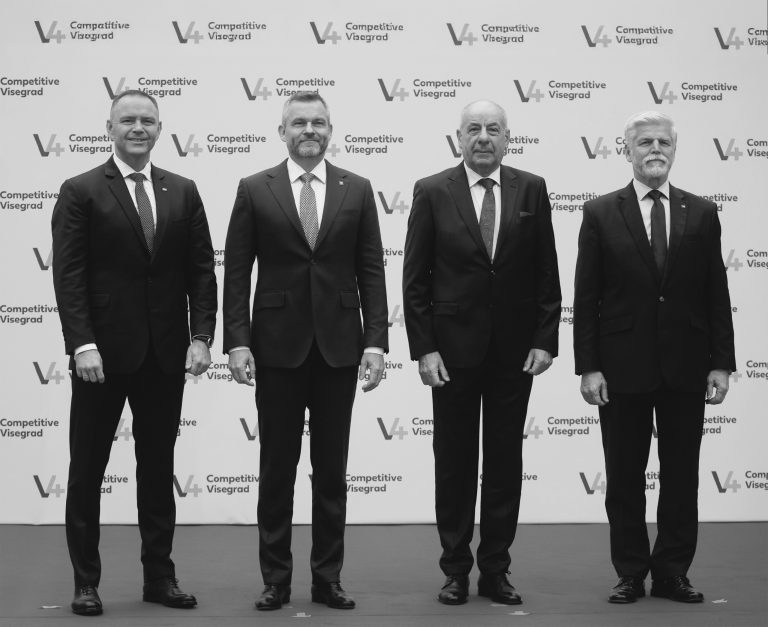
After a long period, a summit of the heads of state of the Visegrad Group was held on December 3, 2025, in Hungary. The year 2025 thus became a promise of possible closer cooperation. However, nothing is without risk.
The fate of the V4 will be in the hands of Hungarian voters, where important elections will take place in April 2026. These will not only be about the Hungarian domestic political scene, but a defeat for Viktor Orbán would mean a weakening of the entire Central European region from the point of view of its own interests.
Demographic threat
Even though the Visegrad Four are breathing new life into possible political beginnings, a major threat looms over the entire region, namely demographics. Surprisingly, the most affected country is Catholic Poland.
With a total fertility rate of 1.03 children per woman, it currently has the lowest birth rate on the continent. The Czech Republic is doing slightly better with 1.37 children per woman, but in 2024 only about 84,300 children were born, which is the lowest number since the time of Maria Theresa and the third decline in a row. However, this sad record will be broken in 2025. It is not certain that the number of newborns will start with an eight.
The situation is slightly better in Hungary and Slovakia, but even so, all countries are far from natural population replacement, which assumes 2.1 children per woman. In the case of Hungary and Poland, it appears that even massive generous support for family policy by the state does not significantly change the situation.
The problem is deeper than just a lack of money. Money is an important factor, but not a determining one. It is about a different overall mindset in society, which will no longer be focused on individual performance, but on a genuine pro-family policy. If the Visegrad Four have ambitions to play a long-term role in European politics, they must stop viewing demographics as a national problem for individual states and start addressing it jointly as a strategic issue for the region's survival.
Central Europe is back in the game in 2025, but time is of the essence. If the Visegrad Group fails to translate the current political momentum into demographic renewal, its newly acquired significance will be exhausted before it can be transformed into real and lasting power.