
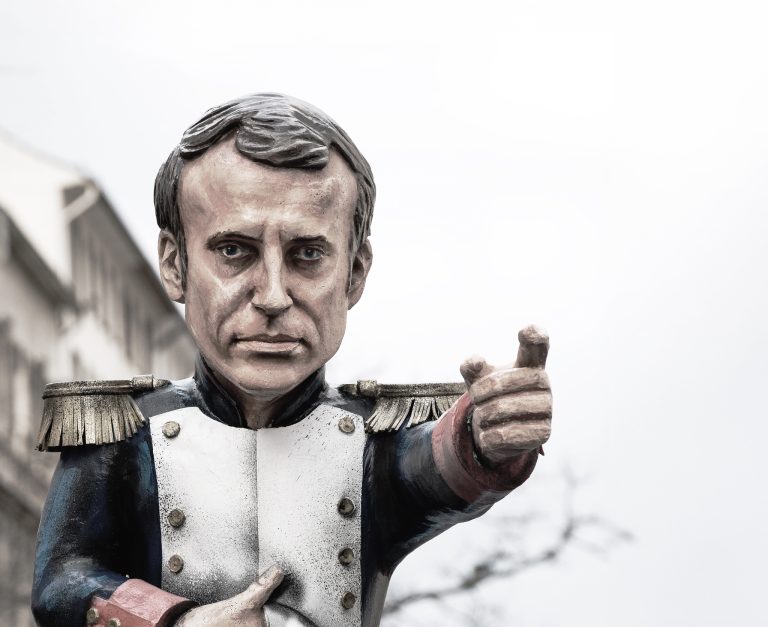
With the start of the new year, Emmanuel Macron began his last 500 days as French president. After eight years of government at the Élysée Palace, his popularity has literally plummeted. Only 18 percent of French people are satisfied with him. Immediately after his first election, his popularity was close to 50 percent.
Macron was supposed to be the prodigy of the financial world who would carry out the necessary reforms in France. The result of his government is sad. The reality of poor state management has become fully apparent with the arrival of COVID-19. Despite all the efforts of the current cabinet, the state budget deficit in 2026 will be around four to five percent. This is unsustainable in the long term.
However, it is not only his unpopularity with the people and poor economic results, but also his gradual isolation on home soil. The announcement of early parliamentary elections in 2024 was not a clear victory for Macron. His party, led by Gabriel Attal, lost the election. Attal belonged to President Macron's inner circle and had long been perceived as his preferred political heir. However, the grenade he threw, as Macron himself called his decision to call early elections, primarily damaged his loyal supporters. Since then, France has been ruled by chaos, with no clear idea of what each day will bring.
The only possible interpretation of Macron's contradictory actions is an attempt to retain his mandate at all costs. He reiterated this unwavering determination in his message to the French nation at the end of the year. Macron is prepared to serve until the very last second. In doing so, he sent a clear message to all his critics. He will remain in the Élysée Palace until the end. Regardless of the fact that the situation in France resembles the final moments of ancient Rome.
Managing through chaos
Paradoxically, Macron's plan to remain in the Élysée Palace is most threatened by the domestic scene. The budget for 2026 was not approved by the regular deadline at the end of the year. And so the battle for its approval will drag on until the end of January. It is such a complicated process that few people today understand it. It is not at all clear how and where the state wants to save money. Everything is being done to get the budget passed. Because if it doesn't pass, it will mean a new political crisis. And no one wants that.
Of course, French President Macron does not want it either. The fall of the new prime minister would remind everyone that appointing new prime ministers is just a game of time, and that the main problem is Macron himself. However, the majority of parliament does not want the prime minister to fall either, because no one knows who would be elected. For the MPs who support the current prime minister, this is probably their last 500 days in a well-paid position with many benefits.
In the case of the opposition National Rally (RN), new presidential elections would certainly strengthen it, but there is little time to change anything in France. Moreover, in the current situation, where an economic crisis could break out at any moment, it is not at all appropriate to take over the country. If any of the three rating agencies were to downgrade France's debt rating at any time, it would automatically complicate the situation for any government. Moreover, for these agencies, the National Rally in government would provide a ready excuse for downgrading the rating. For France's largest opposition party, participating in government before winning the presidential election would be a trap.
The test will be the two-round municipal elections to be held in March. The battles in large cities such as Paris, Marseille, and Lyon will be closely watched. This will be a very credible public opinion poll. While it cannot be assumed that these elections will threaten President Macron, they will show how strong the individual parties are.
For Macron, it is a game of time. If he can hold on until the summer, his chances of ending his lease at the Élysée Palace will increase significantly. Macron's repertoire includes, above all, the foreign policy card. The French president always resorts to foreign policy when faced with domestic problems.
Now he has been handed an opportunity on a silver platter in the form of France's presidency of the G7. The highlight will be a meeting of all heads of state on June 14-16, 2026, in Évian-les-Bains. We will see what the atmosphere will be like at this meeting if the US president carries out his plan to occupy Greenland.
Foreign policy as a refuge
In any case, Macron is not doing well in foreign policy either. The negotiations between Trump, Putin, and Zelensky have only shown that France is not playing second fiddle, which today belongs to Great Britain, but is watching events from the sidelines rather than from the stage.
The foreign policy capital on which Macron has long relied is slowly but surely turning against him. Each subsequent speech or initiative on the international stage serves as a reminder of how significantly France has lost its former influence.
While Jacques Chirac was able to say an open "no" to the United States and give it political weight, today's French president finds himself in a situation where his position is heard, but rarely changes anything.
Macron's future?
If Macron lives to see the end of his term, he will still only be 49 years old. He makes no secret of the fact that he does not feel ready for political retirement. However, with such low popularity, he will find it very difficult, if not impossible, on the domestic scene.
As a supporter of European federalism, Macron naturally has ambitions to join the leadership of the European Commission. Ursula von der Leyen's term ends in 2029, which gives Macron enough time to systematically prepare for this role or even take it over earlier in the event of her premature resignation. It is precisely the weakness of her mandate and fatigue with the continuation of the current leadership that could make Macron an acceptable compromise choice for part of the European elite.
Moreover, Macron has repeatedly demonstrated that he is capable of operating at the highest levels of power, even at the cost of a significant detachment from the everyday reality of ordinary voters, a trait that appears to be more of an advantage than a handicap for this position.