

When we add to this the Trump administration's statement that the list of countries in which the US may intervene if necessary is very long, we get a picture of a world that is significantly less stable than investors had recently assumed.
Moreover, the US intervention interrupts Venezuelan oil supplies to China and Cuba. In the case of Cuba, this is practically an economic disaster that could lead to the destabilization of the entire regime. In the case of China, it is a significant loss of a strategic raw material that the country does not have itself, as well as a threat to more than 600 projects in which it has invested long-term in the South American country.
For Beijing, this means having to replace approximately 4.5 percent of its oil supplies that came from Venezuela, while also writing off a loss of around $10 billion. This is the amount that China lent to Venezuela, which was to be repaid in oil. China thus has several reasons why it should not leave the US intervention in Venezuela unanswered.
Calm reaction of the markets
When we add to this the US's clear demand on Greenland, which could shake the foundations of NATO, we would expect the markets to react with panic in the face of an impending third world war. But the markets did nothing at all.
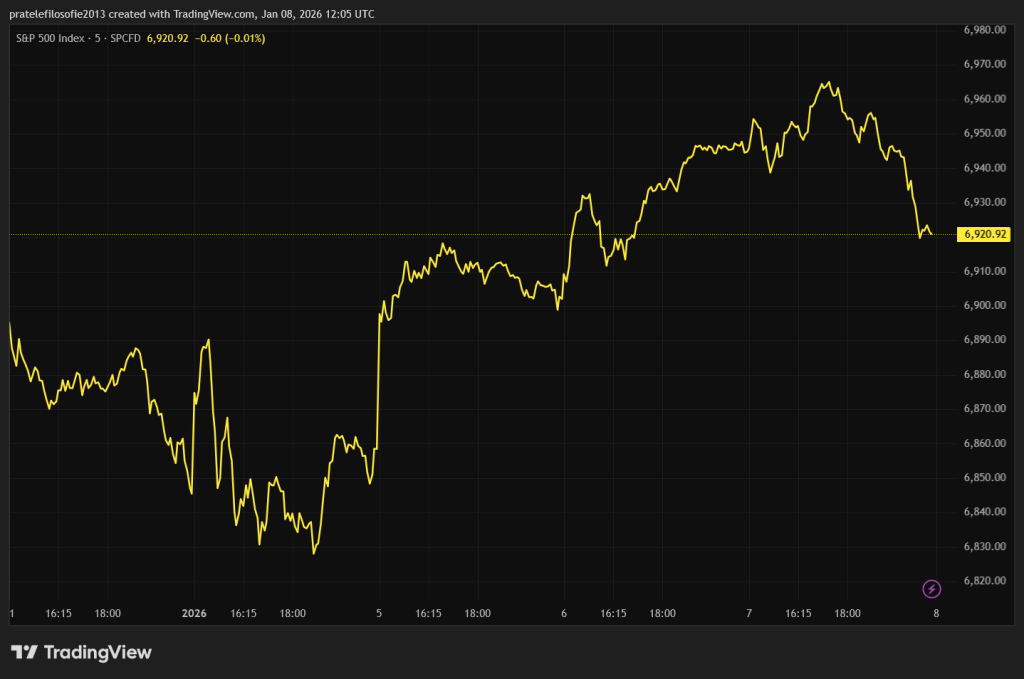
It was as if Trump's intervention in Venezuela was taking place in some parallel dimension. The US stock market grew, Asian markets even experienced euphoria, and the price of oil rose slightly, contrary to all predictions that Venezuelan oil would flood the market and thus reduce the price of black gold. Why did this not happen?
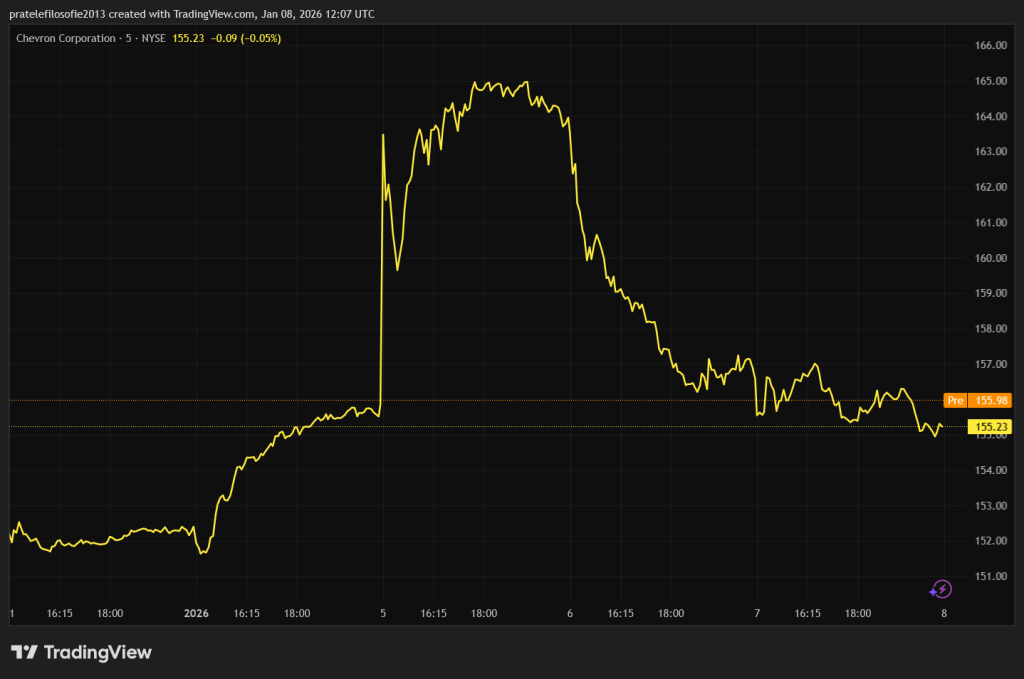
The answer to this question is provided by the price and reaction of Chevron shares. At first, they reacted strongly, with growth of more than six percent. The future looked bright. In addition, the American company Chevron still has one foot in Venezuela. The company received an exemption and remained in the country despite the nationalization of the oil industry.
Chevron produces approximately 150,000 to 200,000 barrels of oil per day in Venezuela, which corresponds to approximately 10 to 25 percent of the country's total production. The company's management has stated that it is still too early to talk about investments in resuming production. The company's shares reacted to this information with a sharp decline, practically returning to the price before the Venezuelan president was kidnapped to the US.
Oil industry representatives thus remained sober. It is well known that Venezuela produces heavy oil with a high sulfur content, which requires special refineries for processing. In addition, Venezuelan oil is difficult to transport. All things considered, restoring production to pre-nationalization levels will require investments of at least tens of billions of dollars.
In order for these investments to be made at all, the stability of the Venezuelan regime must be ensured. Today, no one can predict how the situation in this country will develop, let alone know what the situation will be like in a year's time.
When we add to this the fact that the price of oil fell by more than 18 percent in 2025 alone and that a larger amount of Venezuelan oil on the market would contribute to its further decline, oil companies are well aware that with the price of black gold between $50 and $60 per barrel, massive investments in Venezuela may not pay off.
And the final argument explaining the very moderate reaction of the financial markets is the historical experience with the US administration, which shows that interventions in foreign countries subsequently pay off economically.
Example: After the war in Kosovo, the country presented itself as the future mining El Dorado of the Balkans. The main argument was the Trepča complex, where deposits of lead, zinc, silver, and other metals were located. There was talk of mineral wealth worth tens of billions of euros.
In 2022, revenues from the Trepča mines reached €12.7 million. In 2024, it was only €8.7 million. It is very likely that a similar story could unfold in Venezuela. The only change in the story would be a significant increase in the price of oil. However, this is very unlikely, as Trump's plan to combat inflation was based precisely on low oil prices for American consumers.
The US president tried to mask the uncertain future of the economic success of the intervention in Venezuela by announcing that the country would hand over 50 million barrels of oil to the US. However, Trump will then oversee the fair distribution of profits between the US and Venezuela. The estimated amount could be around three billion dollars. But even if the entire amount were to go towards rebuilding Venezuela's oil industry, it would not solve the problem.
Nvidia's progress attracts attention
Jensen Huang presented the new generation of Vera Rubin AI server systems at the CES trade show in Las Vegas. This time, it was not just a presentation of a more powerful chip model that processes information faster than the previous version. Nvidia is betting that the future of artificial intelligence is no longer just about learning from data, but about realistic interactions with the world.
The Vera Rubin chip is designed to train giant models faster and much cheaper than before. According to Nvidia, the new generation of semiconductors can train models with up to 10 trillion parameters in a month, using only a quarter of the chips that would be needed with the previous Blackwell generation.
These new processors will include a new layer of storage technology to enable better learning. As a result, manufacturers of these technologies, such as SanDisk and Western Digital, have seen strong growth.

According to Jens Huang, these new chips open up the possibility of "physical AI," or the expansion of artificial intelligence into the everyday world. The first stage will be the faster introduction of self-driving cars. Nvidia does not want to miss out on this potential and is therefore developing an autonomous vehicle in collaboration with Mercedes.
It should be the safest car in the world. The first model should appear on American roads soon. Tesla shares reacted to this news with a decline. The next stage will be the advent of robots. Here, too, Nvidia wants to participate in the robotic revolution that is set to change everyone's lives.
The company is thus continuing its transformation from a supplier of chips for artificial intelligence to a conglomerate of services and products that are increasingly closer to the end customer.
Market developments this week sent us a clear signal. Financial markets are much more interested in a future influenced by technological advances than Donald Trump's geopolitical games.