
Donald Trump remains the main influencer of recent events on the financial markets. He has gone so far as to influence the markets even on weekends when they are closed. Financiers expected Trump to use the weekend break to carry out the expected intervention in Iran. However, this did not happen.
Trump, as is his custom, focused his attention on Greenland, more specifically on sending a few soldiers to Greenland. Their numbers were too small to have any impact on the security situation. It was a purely symbolic gesture.
However, he did not miss the opportunity to announce that all countries participating in this military mission would be subject to 10% tariffs from February 1, which could increase further in the summer. One Dutch soldier will thus cost the Netherlands dearly.
Europe's immediate response
The call had an almost immediate effect. Fifteen German soldiers immediately returned home on a civilian flight. Europe's combat cohesion was short-lived. We will see whether Donald Trump takes this gesture into account and forgives Germany its new obligations.
For now, the markets do not believe that this gesture by the US president will soften his stance. Both the German and French indices weakened significantly on Monday morning.
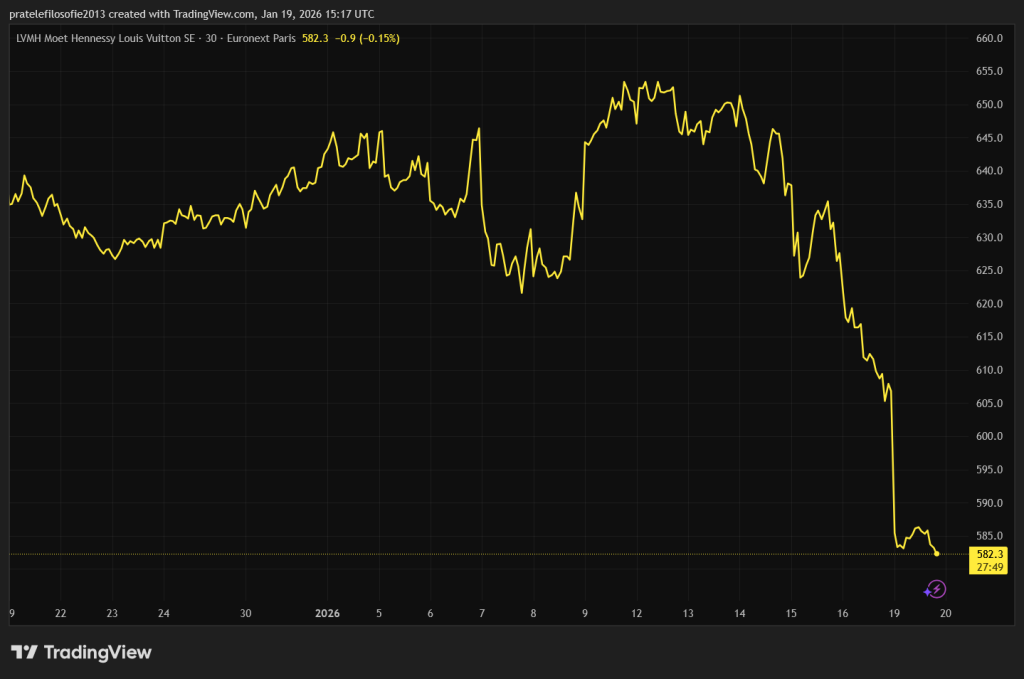
However, the French market is in a much worse situation, as the introduction of tariffs would particularly threaten companies in the luxury goods sector. The major company LVMH weakened by more than three percent during the day. The US market is key for it, as Chinese demand has been stagnating for several quarters.
Given the current political situation in France, a deterioration in the economic situation, and thus lower tax revenues and a subsequent increase in the public finance deficit, would automatically mean a new government crisis. From an economic point of view, the United States has the upper hand for now.
Earnings season and the dominance of US banks
The dominance of the US was confirmed last week, particularly by American investment banks, led by BlackRock. This was because the earnings season began in the US at that time, which has traditionally been opened by American banks for several years. However, as all media attention was focused on Donald Trump, investor interest was minimal.
Trump also disrupted the press conferences of US banks when he announced his idea to cap credit card interest rates at 10 percent. This will not please any traditional bank.
The results of traditional banks such as JPMorgan, Citigroup, and Wells Fargo were very good for the whole of 2025. Banks had a favorable year, but each of them pointed out partial problems.
Citigroup will have to write off more than $1 billion in assets related to Russia. Wells Fargo is struggling with declining margins. It was nothing tragic, but in a volatile environment, these minor problems became a reason to sell off shares. It was already looking like a big debacle.
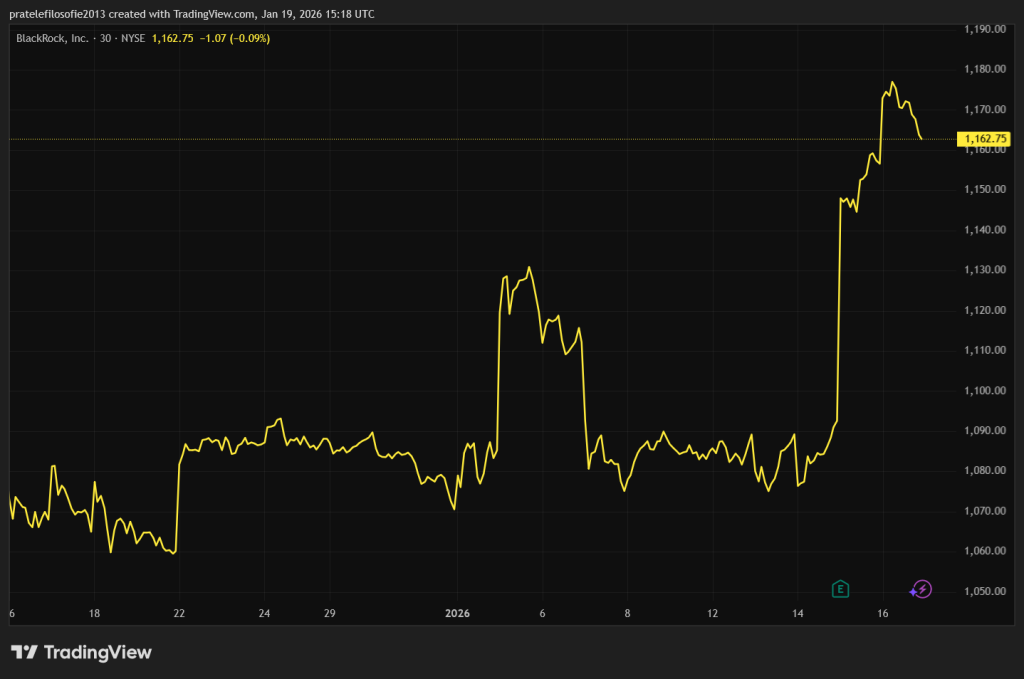
However, BlackRock fundamentally changed the situation. Although its fourth-quarter net profit of $1.13 billion represented a 33 percent year-on-year decline, earnings per share still exceeded analysts' estimates of $12.24 per share. The actual profit was $13.16.
This allowed the company to increase its quarterly dividend by 10 percent. BlackRock's shares responded to the results with a significant 5.9 percent increase. This growth then pulled up the entire banking sector.
Two main reasons for BlackRock's growth
BlackRock's shares grew mainly for two reasons. The first was exceeding the $14 trillion mark in assets under management. ETFs are hugely popular around the world, and interest in them does not seem to be waning.
In addition, BlackRock reported a net capital inflow of $342 billion in the fourth quarter, exceeding expectations of $311.6 billion. While this is excellent news for the company's shareholders, it may not be entirely positive for the wider investor community.
Overuse of ETFs as an easy investment vehicle carries certain risks. ETFs are quietly changing from a diversification tool to a collective action mechanism that works well in growth markets but can fail when the market is under stress.
The second reason was the excellent performance of Aladdin, a specialized platform using artificial intelligence that BlackRock uses to monitor market risks. This algorithm will soon be able to analyze financial assets that are outside the listed markets.
However, Aladdin does not only serve as an internal investment tool and know-how for the company, but also provides it to other financial institutions. Aladdin thus not only saves the company money and minimizes risks, but also improves economic performance.
The organic activity of this AI generated approximately $466 million in the fourth quarter of 2025. Year-on-year, this item increased by more than $103 million.
However, Aladdin faces the same problem as ETFs: if all the big players start following it and managing risk according to the same algorithm, there is a risk that the market will lose its plurality of views on risk and behave in an extremely synchronized manner in times of crisis.
What to watch this week?
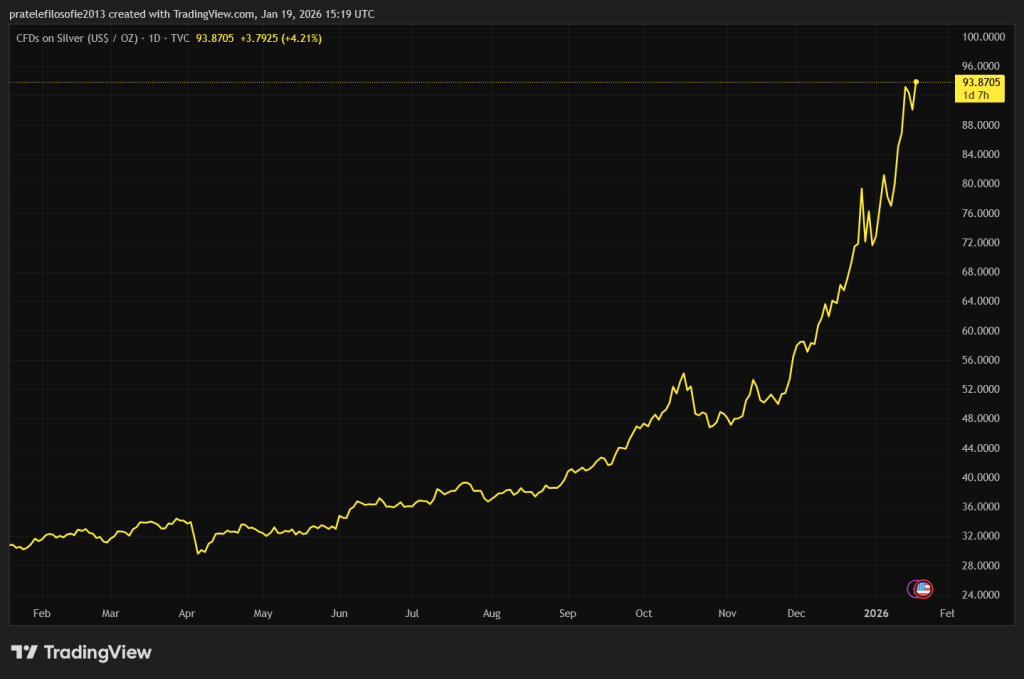
In addition to events in the White House, investors can mainly watch the development of gold and silver prices. On Monday morning, the price of gold was already clearly approaching $4,700 per ounce. Silver remains above $93.
The geopolitical context is driving up the prices of these metals. But why should we watch them more closely in the coming days than for the rest of the year? Silver is growing exponentially and should peak in the coming days. When that happens, we will witness an important moment.
Either there will be profit-taking and a slight correction of 10 to 20 percent, followed by a return to growth — a sign that the rise in silver prices is driven by continued strong demand — or we could see a further decline in silver prices and a return to the $50 to $60 range.
This would mean that speculative capital has primarily poured into silver. If this movement occurs, it could be good news for Bitcoin and other cryptocurrencies, which typically absorb speculative capital.
As for the earnings season in the US, investors will be watching Netflix closely, as subscriber numbers are a key indicator of revenue growth and its ability to maintain its dominant market position. Netflix is also in the spotlight for its planned acquisition of Warner Bros. Discovery, which could significantly redistribute power in the media and streaming industry.
The multi-billion-dollar deal is still subject to approval by antitrust regulators, making it one of the biggest transaction issues on the market.