
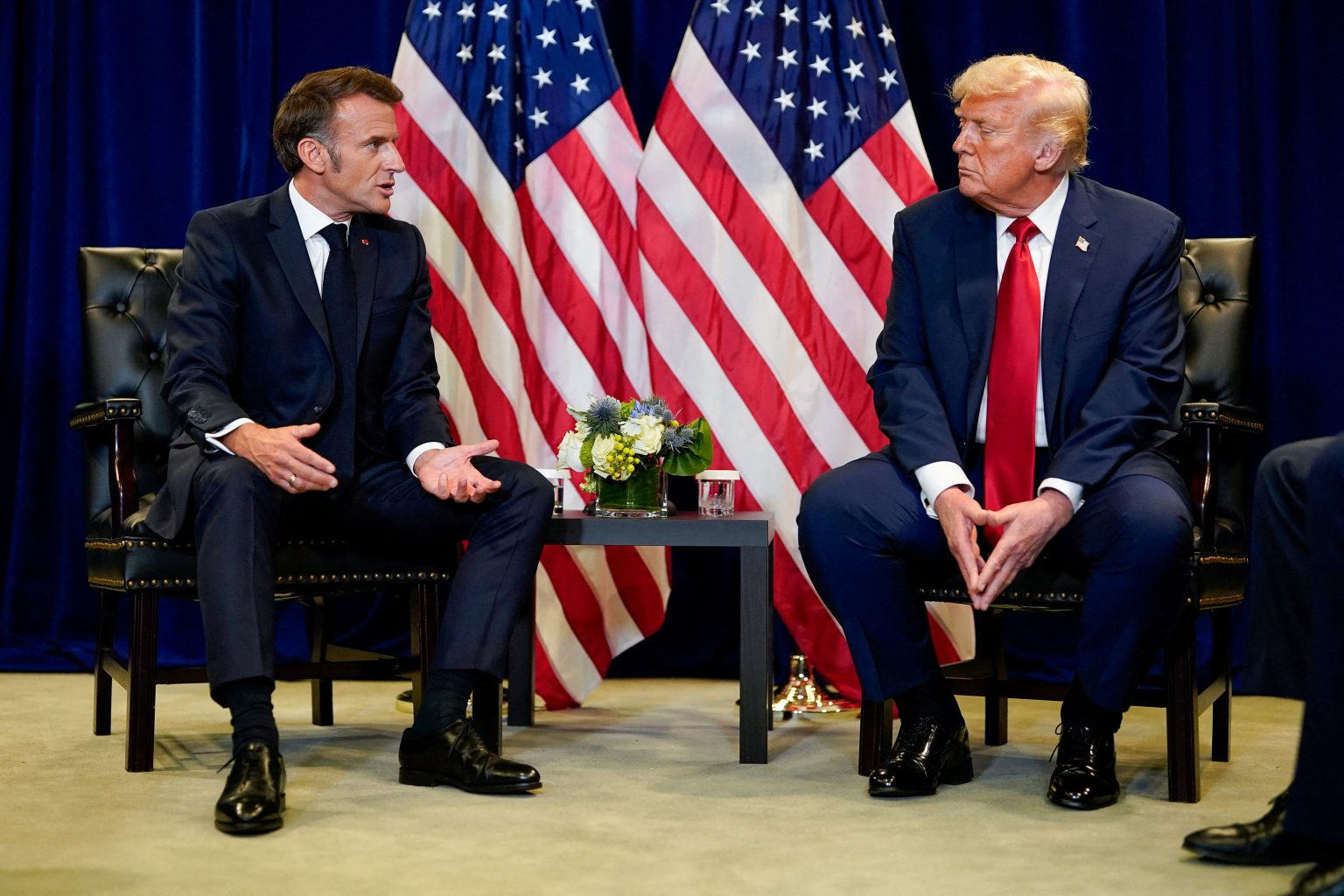
US President Donald Trump said on Tuesday that "it is essential to let the UN continue" when asked about his plans for the so-called "Peace Council."
According to the US president, this initiative aims to resolve conflicts on a global level. "Maybe," Trump replied on Tuesday when asked by a reporter if he wanted the Peace Council to replace the UN.
"The UN just hasn't been very helpful. I'm a big fan of the potential of the UN, but it has never lived up to its potential," Trump said during a briefing. "I think it's essential to let the UN continue because its potential is enormous," he added.
What it's about
The Peace Council was established in mid-November 2025 by a UN Security Council resolution. The countries involved in the initiative are to create an international stabilization force in the Gaza Strip, where a fragile ceasefire based on Trump's plan began in October. The plan was supported by both Israel and the Palestinian militant movement Hamas.
However, according to the US president, the Peace Council's remit should not be limited to the Middle East. Trump has openly said that the body should also be involved in resolving conflicts around the world in the future.
It is precisely this intention that is causing concern among several European leaders. Senior EU officials told Bloomberg and Reuters anonymously that they see the initiative as an attempt to create competition or even a replacement for the UN, as well as a tool through which Trump could gain greater influence on global affairs.
Many human rights experts criticize Donald Trump's oversight of foreign territory as reminiscent of a colonial model. Some recall Trump's recent words after he failed to win the Nobel Peace Prize, when the US president declared that he no longer thinks "purely about peace."
The situation in Gaza itself also contributes to the doubts. The truce that emerged from Trump's plan is extremely fragile. Since its inception in October, according to available data, more than 460 Palestinians have been killed, including about 100 children, and three Israeli soldiers have also died.
It is made up of people close to Trump
Last Friday, the White House announced the composition of the executive board of the new body. Its members include Secretary of State Marc Rubio, Trump's special envoy Steve Witkoff, former British Prime Minister Tony Blair, and Trump's son-in-law Jared Kushner.
Donald Trump is to be the chairman – for life.
Membership of states will be limited to three years, but countries can purchase permanent membership for one billion dollars. The money will reportedly be deposited in approved accounts at reputable banks with audited and transparent financial statements.
According to the Peace Council Charter, published by the Times of Israel website, each country will have one vote in the body, and decisions will be made by a majority of the members present, with the chair of the council having the final say. The chair may also vote in the event of a tie. The council will meet at least once a year. The agenda for the meetings will be prepared by the Executive Board, but member states will be able to submit comments. The Peace Council and its subsidiaries should have international legal personality.
Ukraine in the background
According to Bloomberg sources, Trump wants the full statute and mandate of the committee to be signed on Thursday in Davos. However, he has encountered obstacles.
While countries such as Belarus, Azerbaijan, Kazakhstan, Uzbekistan, Pakistan, the United Arab Emirates, and Israel have already pledged their participation, others—including India, Germany, and Turkey—are still considering their decision.
On the old continent, only Belarusian President Alexander Lukashenko and Trump's staunch ally , Hungarian Prime Minister Viktor Orbán, have pledged to participate.
Other European allies are very cautious for two reasons. First, Trump's threat to take over Greenland. Second, Europeans, led by the United Kingdom, are discouraged by the fact that Trump has invited Vladimir Putin to the Council. Moscow has already announced that it will clarify all the details of the proposal with the American side.
On Wednesday, the Financial Times, citing six sources, reported that disputes over Greenland and the Peace Council had disrupted preparations for an $80 billion economic package to support Ukraine's post-war reconstruction. It was supposed to be approved in Davos.
"No one is in the mood to make a big fuss about the agreement with Trump at the moment," the newspaper quoted one of the representatives as saying.
Macron does not want to participate, Trump threatens tariffs on wine
Italian media report that the country will not be part of the body. Sweden and Norway have directly rejected it, and French President Emmanuel Macron has expressed the same view.
Trump responded to Macron by stating indignantly that "nobody wants him anyway because he will soon be out of office." "I will impose a 200 percent tariff on his wines and champagne, and he will join, but he doesn't have to join," he added mockingly.
In Poland, the initiative even caused minor domestic political tension, as President Karol Nawrocki received an invitation. Prime Minister Donald Tusk emphasized on Platform X that Poland's entry into any international organization requires the consent of the government and ratification by parliament. The Polish prime minister said that the government would be guided solely by the interests and security of the Polish state and would not allow itself to be drawn into any political games.
(reuters, bloomberg, abc news, est)