
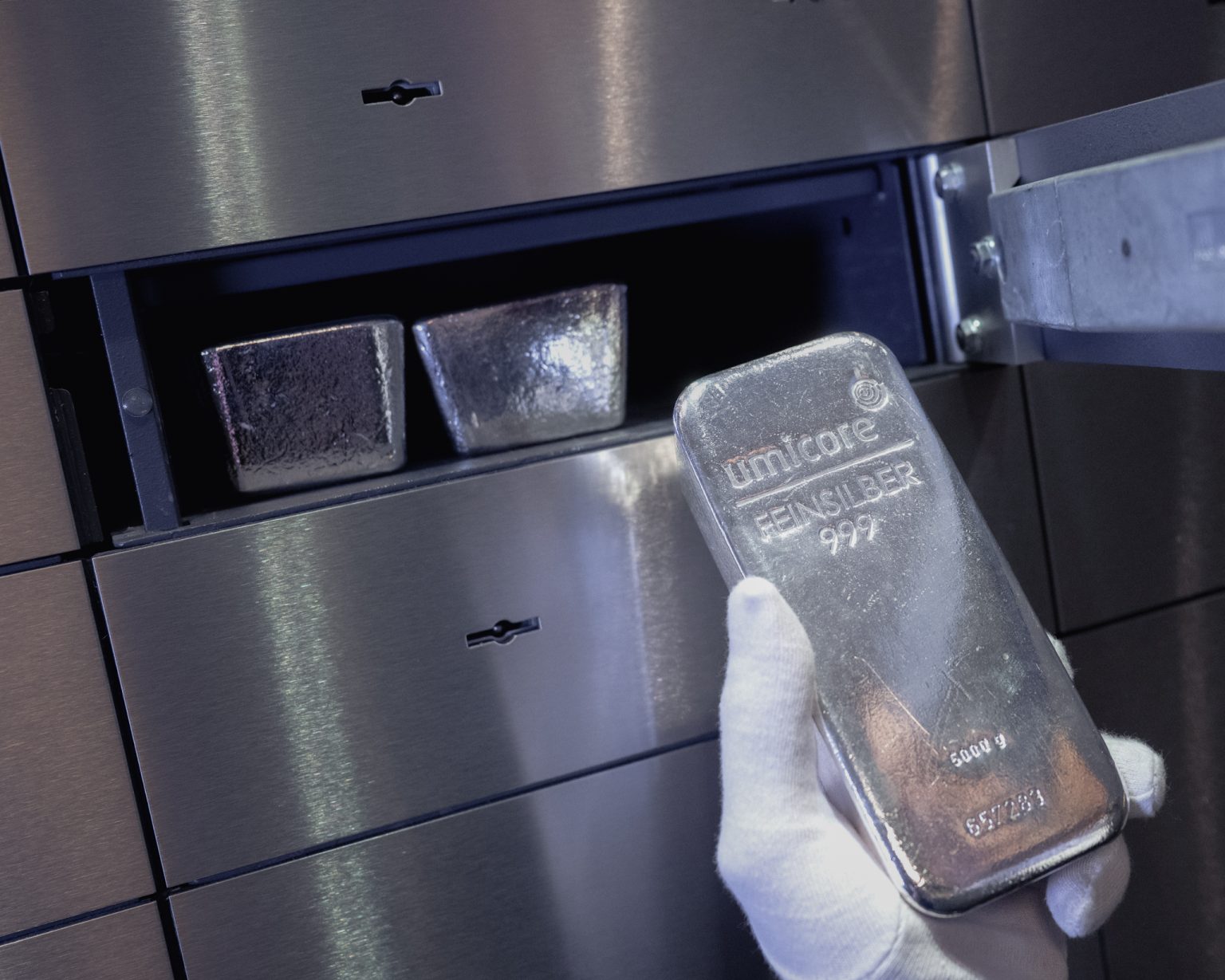
It is really difficult to find a topic in the financial markets that is not related to the US president. Fortunately, such topics still exist, but they rarely make the front pages of newspapers. Currently, silver seems to be breaking through to the forefront of media interest.
The great silver rush did not stop in 2026 either. In 2025, silver strengthened by more than 147 percent, clearly outperforming gold, whose price rose by "only" 64 percent. At the end of last week, both commodities broke through important psychological barriers.
Gold surpassed $5,000 per ounce, and the price of silver began to reach triple digits for the first time. However, it did not stop there and continues to rise towards $110.
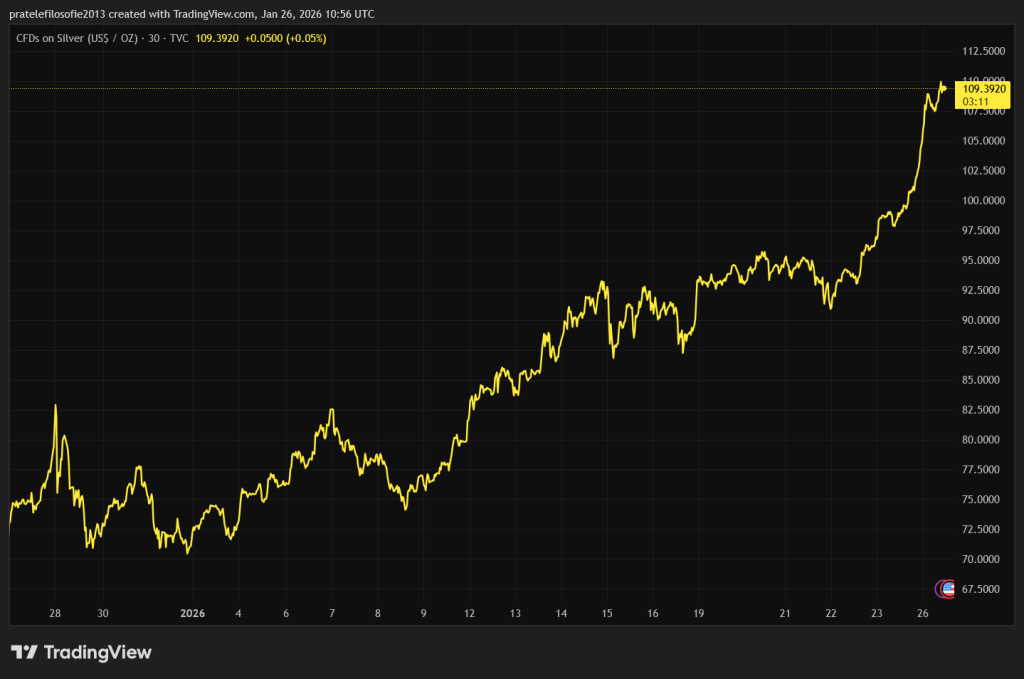
Since the beginning of this year, the price of silver has risen by an incredible 54 percent. The rise and chart of silver resemble the development of Bitcoin in its heyday. In the case of silver, however, this is not a purely speculative movement; there are several rational reasons behind it.
Long-term undervaluation and structural demand
The first reason is the long-term undervaluation of this precious metal. Its low price has been discussed for several years. Despite last year's massive growth, it still lags significantly behind gold.
While gold is currently at historic highs even after adjusting for inflation, silver still has a long way to go. Only at around $140 would it reach its true historic highs.
The second key reason is strong structural demand from industry. More than 60 percent of total demand for silver comes from this sector, primarily from the production of solar panels, electric vehicles, and electronics associated with the construction of data centers. The electric vehicle industry is growing rapidly, especially in China, and the popularity of solar panels is also rising sharply in Asia. This is a structural trend that will gradually push silver prices upward.
Why such rapid growth? Inelastic supply
The question is, why is silver growing so rapidly? The answer is quite simple. More than 75 percent of silver is mined as a by-product of copper, zinc, lead, and other metals. Pure silver mines account for only about a quarter of global production. This brings us to the main reason, namely the inelasticity of supply.
Unlike gold, silver miners cannot respond quickly to higher prices by opening new mines or increasing production. For silver production to increase significantly, copper, zinc, or lead must first become significantly more expensive so that it is profitable for miners to extract more of these metals. The silver market has therefore been in a permanent deficit since 2018, which amounted to 18 percent last year, for example.
Until now, these deficits have been covered mainly by strategic reserves and recycling. Now, reserves, especially in China, are practically exhausted. In a world where primary raw materials are becoming increasingly important, there will also be growing pressure to rebuild stocks. The price of silver may therefore continue to rise for a long time until strategic stocks are replenished. The rise in the price of silver is therefore not just a speculative bubble – on the contrary, that may still be to come.
A busy week on the Prague Stock Exchange
Last week was surprisingly busy on the Prague Stock Exchange. The reduction of the target price of ČEZ shares by the American bank Morgan Stanley, followed by the statement by Minister of Industry and Trade Karel Havlíček that the nationalization of ČEZ is back on the table, and, as a third factor, the arrival of Czechoslovak Group (Strnadova skupina CSG) on the Amsterdam Stock Exchange caused a significant drop in the energy giant's share price. The star of the Prague market has never experienced such a strong three-day sell-off before.
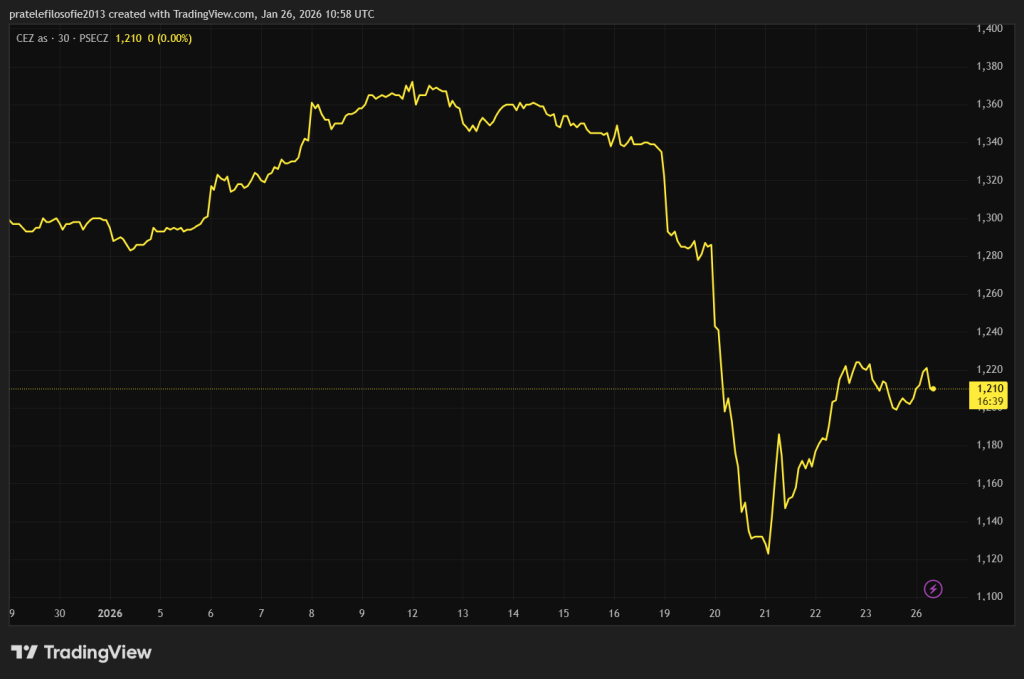
A theory has emerged that some large domestic players were taking profits from ČEZ in order to have cash to buy CSG shares in the IPO. It is difficult to say to what extent this hypothesis corresponds to reality.
In any case, Strnad's holding company's entry onto the stock exchange was extremely successful. The shares began trading at EUR 32, which is 28 percent higher than the subscription price of EUR 25. Financial institutions with access to the subscription price made particularly large profits on the primary offering. On the first day of trading, CSG's market capitalization surpassed that of energy giant ČEZ, and Michal Strnad cemented his position as the richest Czech.
In the second half of the week, ČEZ shares recovered from their slump and began to rise again. Perhaps last week presented an opportunity to buy ČEZ shares at bargain prices.
Nationalization of ČEZ: two main scenarios
There are basically two scenarios for how nationalization could proceed. The first is reminiscent of the French approach with EDF, where the state pays investors an acceptable premium above the current market price. There has been much speculation about a rounded level of CZK 1,500 per share (approximately EUR 62), which minority shareholders would probably accept. The problem is that the state treasury is practically empty and it is unclear how the transaction would be financed.
The second scenario is suggested by the words of Babiš's ANO movement: "We have a model ready that will not place a significant burden on either the state budget or ČEZ." This wording raises considerable concerns among minority shareholders.
The state could use various regulatory and political instruments to exert long-term downward pressure on the share price. The mere threat of such a development would save the state billions of crowns if the shares were purchased at the long-term average price. More specific proposals are unlikely to be made until 2027, so the government has a whole year to increase volatility in ČEZ shares.
What to watch this week
We are in for another very busy week. The US Fed will meet on Wednesday. The press conference will be particularly important, namely whether and how Jerome Powell will respond to pressure from President Donald Trump. The White House may also use the opportunity to announce a new Fed governor, which would immediately weaken Powell's position.
As soon as the name of his successor is known, the markets will automatically start listening more to him than to the outgoing governor, who will not be able to push through any major decisions in his last four months in office anyway.
In addition to the Fed, it is an intense earnings season. In Europe, the figures from France's LVMH, a key player in the luxury sector, which is currently practically Europe's only significant economic card, will be important. If there is a recovery here, there will at least be hope for European GDP growth.
In the United States, Microsoft, Meta, Tesla, IBM, Visa, Mastercard, Exxon, and Chevron are reporting. Investors will be watching closely to see if they learn anything more specific about US plans for oil production in Venezuela.