
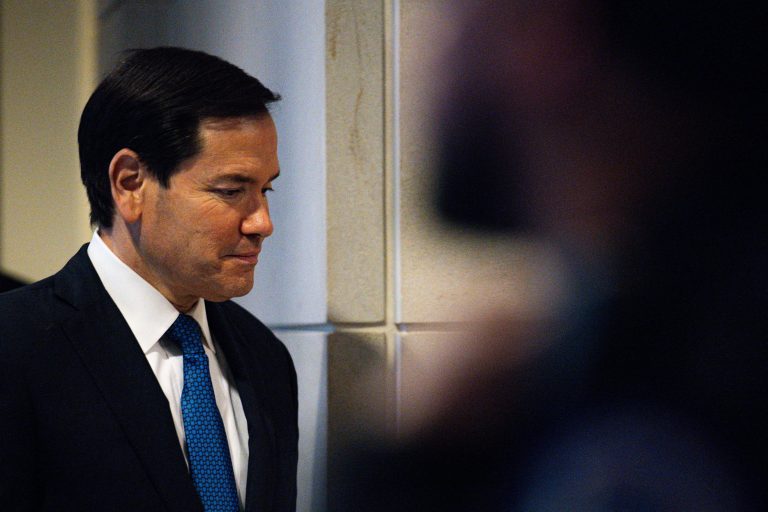
US Secretary of State Marco Rubio appeared before the US Senate Foreign Relations Committee on Wednesday. The topic of discussion with his former colleagues was the attack on Venezuela and the subsequent kidnapping of Chavista leader Nicolás Maduro on January 3.
In recent months, Rubio has been the target of jokes and memes highlighting his accumulation of positions. After the dismissal of National Security Advisor Mike Waltz in March 2025, he took over his role, and US President Donald Trump also taskedhim withconveying US demands to the government in Caracas.
The United States is "much further along in the Venezuela project" than it was in early January, Rubio told senators. He noted that Maduro's administration had repeatedly called on him to leave Venezuela voluntarily, but "he is not a man with whom one can negotiate," he said.
The US Secretary of State confirmed earlier reports that he was planning to reopen the embassy, which has not been operational in Venezuela since 2019. He added that both sides had begun "a very respectful and productive discussion."
The minister also touched on the topic of the short-term oil fund, into which profits from Venezuelan oil are to flow. He noted that the fund is "short-term" and that the Trump administration will have to find a permanent solution for managing oil revenues.
Of the promised $500 million, $200 million went to US government accounts, with the remaining $300 million "going to the Venezuelan government," Rubio continued. Apart from these funds, the US is not investing any money in Caracas, "except for the costs of establishing an embassy," he noted.
He announced that the Office of Foreign Assets Control (OFAC), which is in charge of sanctions, must begin issuing licenses to miners in order to start oil production in private hands and for the US to "help stabilize the Venezuelan economy."
The minister also touched on the topics of Greenland and Iran. According to him, the North Atlantic Treaty Organization (NATO) needs to be "reevaluated," adding that he was not referring to the purpose but rather the capabilities of the military alliance.
"We are on the right track with Greenland," Rubio assured, saying that the State Department has "a process in place that will bring us a good outcome for everyone."
When asked by senators how many people had died in anti-government protests in Iran, he replied that "certainly thousands." "The protests may have subsided a little, but they will flare up again in the near future," he noted.
"We are not prepared, nor do we have any intention or expectation of ever taking military action in Venezuela," Rubio reiterated. However, he added that Trump, as "commander-in-chief, never rules out options." He added that "the only military presence we are seeing right now is sailors at the embassy."
"For the first time in 20 years, we are having serious talks about weakening and eliminating the Iranian presence, Chinese influence, but also the Russian presence. In fact, I will tell you that there are many factors in Venezuela that welcome a return to establishing relations with the United States on several fronts," Rubio said.
Senate grilling
Senate Committee Chairman Jim Risch, a Republican from Idaho, praised Rubio for explaining the Trump administration's plans for Venezuela, despite "uncertainties about how they will be implemented." Senators recently voted to limit military powers, but after pressure from Trump and Rubio, Josh Hawley (Missouri) and Tod Young (Indiana) changed their votes, and the resolution did not pass.
"Today we have an opportunity to publicly explain the administration's plans for the future of Venezuela," Risch said, according to a copy of his opening remarks provided to reporters. "After our long engagements in the Middle East in recent years, many Americans are concerned about so-called 'endless wars'. I know that this administration is focused on avoiding such experiences," he said.
According to some members of Congress, Rubio "insisted" that the White House was not planning regime change — just days before U.S. special forces stormed the Miraflores presidential palace and kidnapped Maduro and his wife, Cilia Flores. Oil magnates were reportedly informed of the operation before the legislature.
Delaware Democratic Senator Chris Coons said he had "about 20 questions" on various topics, including Venezuela. According to him, the Trump administration never presented evidence linking drug trafficking to the United States that would justify military action without congressional approval.
"No evidence has been presented that would explain or justify urgent national security concerns under Article 2 that would justify the actions of the President of the United States without timely consultation with Congress, which the minister knows very well from his 15 years of service in the Senate should have happened," the senator said in a phone call before the hearing.
The media already knew Rubio's words
Some media outlets obtained a prepared speech in which Rubio allegedly warned interim President Delcy Rodríguez of "the same fate" if she did not meet Washington's demands. Maduro's vice president "is well aware of the fate" of her former boss, the AFP news agency quoted from the speech, asreported bythe Times of Israel.
"We believe that her own interests are aligned with the advancement of our key objectives," the agency continued. "Make no mistake, as the president has said, we are prepared to use force to ensure maximum cooperation if other methods fail."
"We hope it won't be necessary, but we will never shirk our duty to the American people and our mission in this hemisphere," the former Florida senator reportedly warned. However, the document, which was also quoted by the Washington Post, assured that the US is not at war with Venezuela and that Rodríguez has cooperated fully so far.
Proof of this cooperation is the process of reopening the embassy in Caracas, which Rubio mentioned before the committee, according to testimony. On Monday, the State Department also informed selected senators and congressmen that it was sending a regular contingent of temporary employees to the capital to perform "selected" diplomatic functions.
"We are writing to inform the committee of the State Department's intention to take a gradual approach to the potential reopening of the embassy in Caracas," the department said in separate but identical letters addressed to ten House and Senate committees.
PBS News also recalled Rodríguez's statement on Tuesday that the Chavista government had "established respectful and courteous channels of communication" with the Americans after Maduro's abduction.
The post noted that Democrats in Congress protested against the increase in military presence in the Caribbean Sea, which the Pentagon launched in late August 2025. The Navy gradually sent amphibious groups with two aircraft carriers to the shores of Venezuela.
At the end of November, the White House issued a new national security strategy, arguing for the strengthening of "hemispheric defense." The United States perceives the western hemisphere as "its" space, which was also reflected in recent statements about the need to acquire Greenland as a potential American territory.
At the beginning of the year, Democratic congressmen tried to push through a resolution on military powers (War Powers Act) that would prevent the president from sending the army to Venezuela and would also limit the presence of naval forces. However, the House of Representatives rejected the resolution on January 22.
According to the Post, Rubio told senators that despite the Democrats' efforts to pass the resolution, the Pentagon had no plans to deploy ground troops in Venezuela.
The Trump administration originally targeted Venezuela as a source of drug smuggling, with the Navy, in cooperation with the Dominican Republic and Trinidad and Tobago, destroying nearly a hundred vessels allegedly belonging to "narco-terrorist" organizations.
However, in mid-December, the White House chief changed his rhetoric and turned his attention to Venezuela's oil reserves, which Caracas nationalized in the 1970s. He accused Maduro's government of "stealing" US assets and presented an agreement to supply 50 million barrels of oil, the profits from which he plans to divide between Caracas and Washington, Bloomberg reported.
Since Maduro's overthrow, the US has detained at least seven tankers smuggling Venezuelan oil, some of which belonged to the Russian shadow fleet. On the domestic front, Rodríguez responded on Monday that Venezuela "has had enough" of US interference, thereby slightly appeasing left-wing parties opposed to oil industry reform.
On the issue of human rights, however, she yielded to US pressure when she released nearly 100 political prisoners over the weekend. This doubled the number of those released, although hundreds more detainees are still awaiting release.