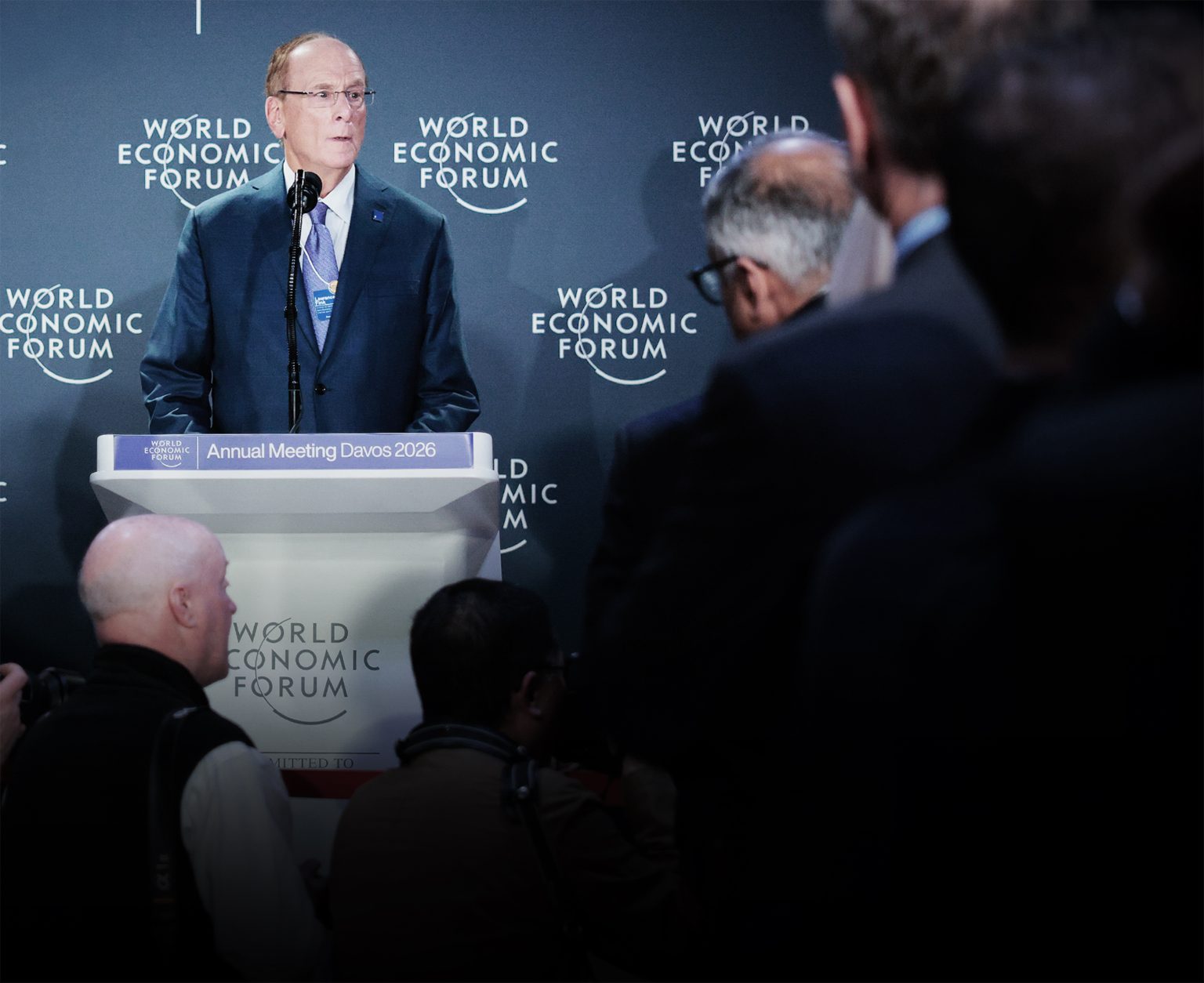
Silicon Valley has long been significantly progressive in its outlook. The public support for Trump from Peter Thiel and Elon Musk represents a real game changer. The financial world, whose most visible representative is Larry Fink, is now joining this change. A new connection between three groups that call themselves the elite is thus emerging on the scene.
Does this sound like a conspiracy theory? Perhaps at first glance. However, anyone who watched Larry Fink's opening speech knows that this was not some kind of coded conspiracy, but rather the open language of power. This time, however, it was not an authoritative speech, as Klaus Schwab suggested in his book COVID-19: The Great Reset.
Schwab based his argument on the idea that the intentions of the elites would be interpreted by a layer between the elites and the general public. The qualification of these interpreters was to be the ability to understand what the elites want without the need for lengthy explanations. However, this approach did not prove successful. In this context, Larry Fink's opening speech was a paradigm shift.
Lack of trust
Fink opened his speech with a clear division of society into elites and those who are not in Davos. In doing so, he was also able to appease Donald Trump, who had long been pointing out this elitism. Davos has often been associated with the idea of "globalists from nowhere" who fought against any use of the term national identity.
In this context, Trump was often caricatured as someone who exaggerates or is paranoid because, allegedly, no coordinated elite exists. However, Fink has no need to hide. Elites exist, and that is logical. In every society, even if it may not be obvious at first glance, there are centers of control. And these are in the hands of the elites.
This admission was actually very sophisticated on Fink's part, because he applied his own method of problem solving to himself. What, according to Larry Fink, is the main problem in today's world?
The fundamental problem is the loss of trust between the elites and the public. People simply do not trust their elites. The way the COVID crisis has been handled has undoubtedly played a large part in this. However, Fink, perhaps deliberately so as not to further distance himself from Klaus Schwab, did not go down this route.
He chose another example that works just as well: GDP growth. According to him, since the fall of the Berlin Wall, we have seen a huge increase in wealth, which is concentrated among the elites. However, prosperity is not reflected in the broader strata of society. The disappearance of the middle class in the Western world over the last twenty years is a sad but now completely visible fact.
Fink openly acknowledges the problem in this way. However, it is important to add that acknowledging the problem is not a weakness of the system, but a sign of its strength. As long as the system is able to detect its flaws and admit them, it is still strong enough to seek solutions. The real weakness would be the inability to reflect on these problems, because that would mean that no solution exists. So how can today's elites regain trust?
Changing the way elites communicate
On this point, too, Fink remains very cautious and surprisingly humble, which in itself indicates the depth of the problem. The key is to change one's own behavior and overall communication. It is not a matter of being right at all costs, but of being able to listen to and understand the other person.
If the elites ignore or despise their partners, there can be no restoration of trust. The elites must strive to understand the people. However, this understanding is not the result of philanthropy or the pursuit of abstract social justice, but stems from the purely practical interests of the elites. Why?
Artificial intelligence as a test of trust
This brings us to the heart of the problem. The world is facing the advent of artificial intelligence. Fink also points out that there is no point in discussing whether this advent will come, because it has already become a reality. According to him, it will be a revolution comparable to globalization.
At that time, production capacities and assembly halls moved from developed economies to countries with the cheapest labor. Now, a similar shift awaits management and administrative professions. This will inevitably lead to growing social discontent.
Wealth will shift even faster than in the past because the structure around artificial intelligence is much more centralized than in globalization. Language models, data centers, data, and infrastructure are in the hands of a few companies, and their number is significantly smaller than the number of players that dominated the era of globalization. This problem should be addressed now.
Fink's comparison with globalization is very apt and allows us to glimpse what the world will look like in the coming years. It is precisely from the way globalization developed, gradually but with constant intensity, that we can deduce how artificial intelligence will progress. Catastrophic scenarios of mass queues at employment offices will not come true, but administrative positions will gradually disappear.
Finally, let us add that Fink does not deny the problem of inequality. On the contrary, he emphasizes that the elites must change their approach to solving it. Marketing announcements and presentations claiming that living standards are rising every year based on Excel spreadsheets will no longer suffice. It is essential to at least show that the elites are trying to solve this problem as transparently as possible.
This is where Fink sees Davos's new role, namely, an attempt to restore trust through open discussions and speeches at the economic forum. Transparency is thus no longer just a supplement to legitimacy but a prerequisite for it. Without it, the World Economic Forum will not become a platform for solutions, but a reminder of why the public has lost faith in the elites.