
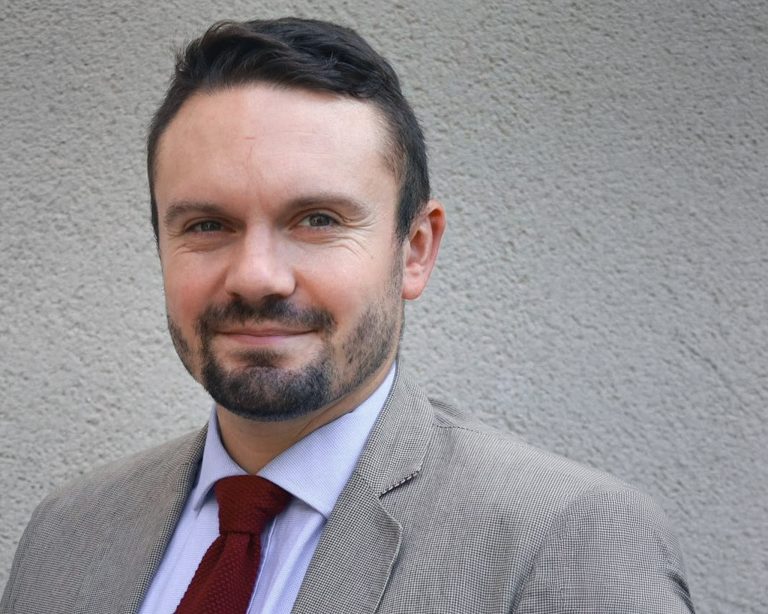
François-Xavier Gicquel is the director of operations for SOS Chrétiens d’Orient. Since its inception in 2013, he has coordinated missions and projects directly in the field in the Middle East and other crisis regions where the organization is active in the areas of humanitarian aid, reconstruction, healthcare, and education.
In an interview with Štandard, he explains why the association was founded, how it differs from other humanitarian actors, and what he considers to be the greatest threat to Christian communities in the East today [Christians living in the Middle East, editor's note].
How and why was SOS Chrétiens d’Orient founded?
The association was founded in 2013 by Charles de Meyer and Benjamin Blanchard. At that time, the Syrian village of Maaloula, one of the last in the world where ancient Aramaic was still spoken, had just fallen into the hands of al-Qaeda. This event coincided with France's announcement of its intention to bomb Syria in support of the revolution that had begun in the country.
At that moment, it was important to mobilize in order to show Eastern Christians that the response of Western Christians was not only war, but also a deep desire to provide concrete material aid to populations in great suffering. SOS Chrétiens d’Orient wanted to be a tangible sign of this solidarity and a testimony to the long-standing and enduring solidarity of the French people with Eastern Christians. Let us recall that Saint Louis (Louis IX) dedicated France to their protection.
At the same time, it was a question of showing the French government that it could not wage another devastating war like those waged by the United States in Iraq or France in Libya, with all the human and geopolitical consequences that we know today.
How does SOS Chrétiens d’Orient differ from other humanitarian organizations?
SOS Chrétiens d’Orient was founded primarily on the proximity between Western and Eastern populations. This closeness is very concretely manifested in the sending of volunteers on missions. In twelve years, nearly 3,500 volunteers have gone to live directly in the field. They live in the midst of Eastern Christian communities, sharing their joys, sorrows, hopes, and fears.
Their charitable work complements their daily coexistence, which includes shared meals, moments of celebration, and moments of sorrow. The volunteers carry a very powerful message to Eastern Christians: we have not forgotten you, we are with you, and we will remain. This continuous presence also allows us to develop real expertise in the areas where we work and to bring to the heart of the West the testimony that our Eastern brothers and sisters ask us to convey.
How has the association's work evolved over the years?
In the beginning, the association faced the advance of jihadist groups in Syria and Iraq and intervened mainly among affected or displaced populations. Gradually, the situation changed. We had to adapt to the liberation of towns and villages and the growing importance of rebuilding homes and infrastructure so that people could return and settle back home for the long term.
At the same time, we faced new types of crises, especially economic ones. It became essential to develop economic opportunities so that Eastern Christians could consider a sustainable future in their own country. Today, we continue to work in a wide variety of areas, including education, healthcare, heritage preservation, and humanitarian aid—in short, wherever the needs are greatest.
In which countries is SOS Chrétiens d’Orient present today?
We are currently active in Iraq, Syria, Lebanon, Jordan, Pakistan, Egypt, Ethiopia, and Armenia. We are also starting to work in Palestine. It is very difficult to say where the situation is most urgent or most worrying, because contexts are changing extremely rapidly.
We have experienced relatively peaceful post-war periods, but these have been marked by a catastrophic economic situation as a result of sanctions. Lebanon, once known as the Switzerland of the Middle East, has fallen into political and then economic crisis. Ethiopia, a true African gem and a major tourist destination, was ravaged by a civil war that claimed between 500,000 and 1 million lives.
In Iraq, the Islamic State has left behind an extremely tense political situation, accompanied by massive corruption and the influence of militias. In Egypt, the economic crisis is having a severe impact on monetary stability and the purchasing power of the population, which was already vulnerable. In Pakistan, we are helping people who have been enslaved, trying to restore their freedom and offer them a new start. In Armenia, we have gone from almost thirty years of peace to a forty-four-day war and then to the arrival of 120,000 displaced persons from Artsakh [a dissolved republic in the Nagorno-Karabakh region, editor's note]. Although Jordan is often perceived as stable, it remains fragile due to strong social and geopolitical pressures.
What are your main areas of work?
We work in six main areas. These include education, health care, economic development, emergency assistance when needed, reconstruction, and a wider range of activities that include heritage and monument preservation, youth support, cultural and sports activities, and church support.
Priorities always depend on the specific terrain and the situation at the time. However, our absolute priority remains the same. We want to build something lasting. We refuse to keep populations dependent on humanitarian aid in the long term and systematically think in the long term.
Was there a project that particularly affected you?
Urgent missions are particularly powerful, as they tend to be very intense, both in terms of work and emotionally. I am thinking, for example, of the first aid support during the battle for Mosul, the supply of gas and food to the inhabitants of Nagorno-Karabakh during the Azerbaijani bombing, the aid to those displaced by the Ethiopian civil war, or the support for the victims of the terrible floods in Pakistan.
But I was also very moved by longer-term projects. These include the opening of several essential health centers that cared for tens of thousands of people displaced by the Islamic State, the establishment of schools, and the liberation of slaves in Pakistan. I am also thinking of economic development projects, thanks to which we have often given entire families the opportunity to start over and given them concrete prospects for the future.
What are the main threats to Eastern Christians today?
The main threat today is demographics. The more Christians leave, the smaller a minority they become. Once their rights are weakened and their economic and cultural opportunities are reduced, it becomes increasingly difficult for them to obtain a quality education and imagine a future in their own country.
In war zones, some have recently theorized about the concept of cultural genocide. The classic legal definition of genocide could not always be applied to the situations Christians were experiencing, but it was necessary to name the reality. It was a systematic desire to make entire populations disappear through terror, destruction of homes, death threats, relegation to second-class citizenship, kidnappings, targeted killings, and assassinations.
Added to this are the economic crises we see particularly in Syria under embargo, in Lebanon, Egypt, and Ethiopia. Christians then leave not only to ensure their own safety, but mainly to protect their children and future generations.
Are identity and faith enough to ensure their long-term presence?
These factors are essential. These people have been living in these territories as Christians for two thousand years, but as nations they have been there even longer. They have undergone trials that are difficult for us to imagine, and they have remained faithful to their country and to their Christian vocation to work in the midst of their society, even though they are a minority.
However, history shows that in the face of persecution, there have always been mass departures. Identity and faith alone are not enough. It is essential to give people the material means to survive. If they do not have them, they will naturally seek safety for future generations, often in the West, whether justifiably or not.
What is the situation in Syria today?
The situation is no longer the same as it was a year ago. It is very difficult to determine what is still under government control. What is certain is that minorities are not doing well. After the large-scale massacres that struck the Alawites and later the Druze in early 2025, Christians face daily pressure. There are thefts, kidnappings, and murders, especially in the suburbs.
Since these acts of violence often appear to be isolated cases, the European Union prefers to speak of exceptional situations that should not be generalized. However, this is not true. Recently, a church in the heart of Damascus was attacked, and no one knows what tomorrow will bring. We remain determined to support these communities and bear witness to them, with the hope that is characteristic of Christians in troubled times.
Why has Syria disappeared from Western radar?
Just a few days ago, a European Union body explained that, in asylum matters, priority should be given to Islamic State fighters because they are considered persecuted for their views, which are interpreted as political. The admission of Christians, on the other hand, should only be exceptional, because their persecution is not considered to be widespread.
This reveals a deeply disturbing line of thinking. Above all, the West is seeking to re-establish relations with Syria in order to secure a place at the negotiating table on reconstruction and defend its diplomatic and economic interests. In this context, it has little incentive to highlight the collateral victims of these major maneuvers.
How would you describe the situation of Christians in the Holy Land?
I have just returned from the Holy Land myself, and the situation there is extremely complex. The problem is that many Western observers are unable to analyze the situation without polarizing the debate. Christians there face pressure from Islamist movements such as Hamas, which make long-term coexistence virtually impossible. At the same time, they face the policies of the State of Israel in Palestine, which often perceives them as Arab residents among others, and therefore as enemies.
As a result, they experience humiliation, confiscation, harassment, bombing, and sanctions. It is therefore essential to reject naive idealism, take an interest in the reality on the ground, and maintain sobriety in our geopolitical positions.