Japan faces a pivotal moment in its long struggle with public debt. Foto: Chris McGrath/Getty Images
Japan’s debt gamble
Japan's debt cannot be repaid. Prime Minister Takaichi refuses to make cuts and is increasing pressure. Could this trigger a global economic collapse?
Tokyo. For decades, Japan has defied conventional economic wisdom. Despite carrying the heaviest debt burden in the industrialised world, it has avoided the crises that brought other nations to their knees. Now, however, inflation, rising interest rates and an assertive prime minister are putting that fragile equilibrium to the test.
The contradiction is reflected in the figures. Japan consistently ranks first in terms of its debt-to-GDP ratio. As the world’s fourth-largest economy, the sheer scale of its liabilities is striking. Public borrowing is projected to reach 232 per cent of GDP in 2025. Faced with such levels, one might reasonably ask how the country has avoided default. As a rule of thumb, the 130 per cent threshold is often described as a “red line”, beyond which fiscal dynamics risk becoming unstable — a warning sign that public finances may come under severe strain.
The Greek debt crisis, which ultimately required sweeping austerity measures, remains a powerful reminder of how quickly market confidence can evaporate. So why has Japan not suffered a fate similar to that of Greece?
The open secret of Japanese debt
Anyone who looks beyond a simple cross-country comparison table quickly discovers that Japan’s public debt has several distinctive features. Above all, it is predominantly held by domestic institutions and households.
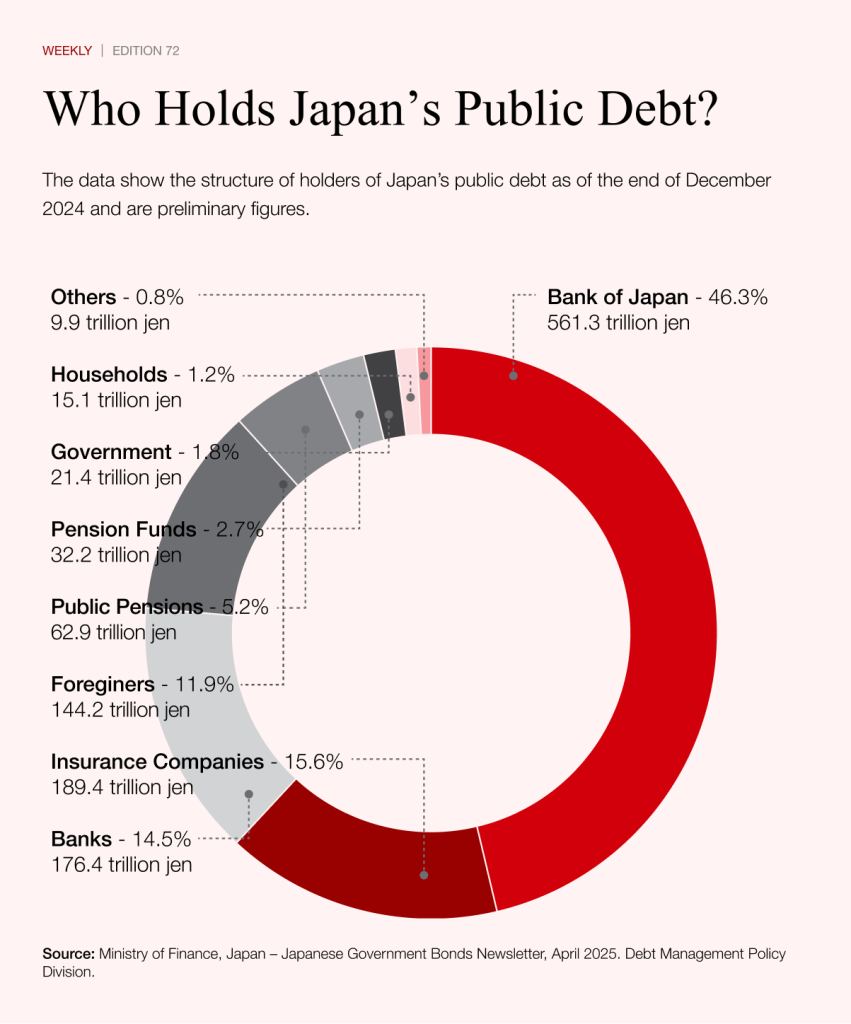
According to the latest available data, the Bank of Japan holds more than 46.3 per cent of outstanding government debt. A further 41 per cent is owned by Japanese banks and pension funds, meaning that the bulk of liabilities ultimately sits within the domestic financial system. Only 11.9 per cent is held by foreign investors. That share is crucial when assessing sustainability.
The difference can be illustrated with a simple example. For a private individual, there is a significant distinction between borrowing money to buy a flat from a wealthy uncle and taking out a loan from a bank. In the first case, the debt exists, but it remains within the family and does not create an external claim. Should difficulties arise, the consequences are typically less severe.
An uncle is unlikely to insist on the forced sale of the property if illness prevents repayment. A commercial bank, by contrast, may enforce its claims with little room for sentiment. That is the core difference between Greece and Japan. At the height of the Greek crisis, around 70 per cent of government debt was held by foreign creditors.
If one also considers that Japan’s foreign exchange reserves amount to roughly 1.2 to 1.3 trillion US dollars — a sum broadly comparable to the portion of debt held by foreign investors — it becomes clear that Tokyo could, in theory, meet those obligations. The country remains a highly creditworthy borrower and continues to enjoy strong demand for its bonds.
This is why Japan’s debt problem is not an immediate crisis, and why there is no realistic prospect of the International Monetary Fund stepping in to supervise its finances. The country retains considerable room for manoeuvre, and the responsibility for stabilising the situation lies primarily at home. How to defuse what some describe as a ticking time bomb is ultimately a matter for domestic political consensus.
Who holds Japan's public debt?
The end of the era of cheap money
For years, Japan’s strategy for managing its vast public debt rested on a straightforward assumption: that ultra-loose monetary policy would allow the government to borrow at close to zero interest. The underlying calculation was that even modest economic growth would exceed the interest paid on government bonds. Over time, this gap was expected to erode the debt burden relative to the size of the economy. Because most of the debt is held domestically, Japan was not exposed to the same pressure from jittery foreign creditors. For a long period, it appeared that time was on Tokyo’s side and that the problem could be deferred indefinitely.
After the pandemic, however, Japan — like much of the world — was confronted with a surge in inflation. While price growth did not reach the levels seen in parts of Central Europe, even inflation of four per cent represents a significant shock for a country accustomed to decades of deflationary pressures. This is particularly striking given that an ageing population would normally exert downward pressure on prices.
The central bank was eventually forced to respond. Japan has now brought its long-standing negative interest rate policy to an end. Although the tightening cycle since February 2024 has been gradual, with the policy rate rising to 0.75 per cent after two years, even such cautious steps have had a pronounced effect on a highly indebted economy.
Public debt has consequently returned to the forefront of the debate. The Bank of Japan faces a difficult balancing act: it must contain inflation, yet it cannot raise rates too aggressively without sharply increasing the cost of servicing government debt and putting strain on public finances.
In broad terms, a one-percentage-point rise in interest rates would add around 3.6 trillion yen — approximately 22 billion euros — to the state’s financing costs over three years. The result would be either automatic spending restraint or higher taxes.
The prime minister's gamble
However, Prime Minister Takaichi does not share that assessment. In her view, this is no time for restraint. On the contrary, she argues that Japan requires an even more expansionary stance than before. During her campaign, she pledged to cut food taxes — a promise that runs directly counter to the logic of fiscal consolidation.
She also enjoys a strong political mandate, which makes it difficult to attribute any future shortfall in support for tax or fiscal measures to parliamentary weakness. Many investors and commentators therefore expect tensions between the government and the central bank over how to address the debt burden. Few believe that the prime minister can ultimately prevail against fiscal arithmetic.
This opens the door to more far-reaching speculation. Takaichi is neither inexperienced nor politically naïve. She may well recognise a stark reality: that Japan’s debt, at current levels, cannot realistically be reduced through conventional means. Neither spending cuts nor higher taxes would fundamentally alter that trajectory.
The combined forces of demographic decline and compound interest leave little room for optimism. The logic is stark: if a ship is taking on water and the breach cannot be repaired, is it sensible to ask the passengers to bail it out with teaspoons?
Rather than easing off, the prime minister appears determined to press ahead. She is capitalising on Japan’s long-standing reputation as a disciplined and reliable economy, one from which such defiance might once have seemed unthinkable. Takaichi may have concluded that debt is ultimately managed not through immediate repayment but through time, and that Japan intends to make full use of what remains of its room for manoeuvre.
Either her strategy succeeds in reviving growth and restoring confidence after an initial period of turbulence, or events overtake her and rising interest rates constrain policy before she can adjust course. At that point, the consequences would extend beyond Japan. A severe loss of confidence in the world’s fourth-largest economy would reverberate globally — and it would raise uncomfortable questions about whether years of austerity elsewhere achieved anything lasting.
Here is placeholder for Article excerpt Here is placeholder for Article excerpt Here is placeholder for Article excerpt Here is placeholder for Article excerpt
Here is placeholder for Article excerpt Here is placeholder for Article excerpt Here is placeholder for Article excerpt Here is placeholder for Article excerpt
Here is placeholder for Article excerpt Here is placeholder for Article excerpt Here is placeholder for Article excerpt Here is placeholder for Article excerpt
Welcome to the comments section of the Štandard daily. Please take note of our guidelines, comments are moderated by us. You can contact the moderators at [email protected].
Participate in the discussion
Comments are available to subscribers only. If you'd like to join the discussion, choose a subscription starting at €6.72 per month.
All comments 0
Register
Comments are available to registered users only. If you'd like to join the discussion, register here.