
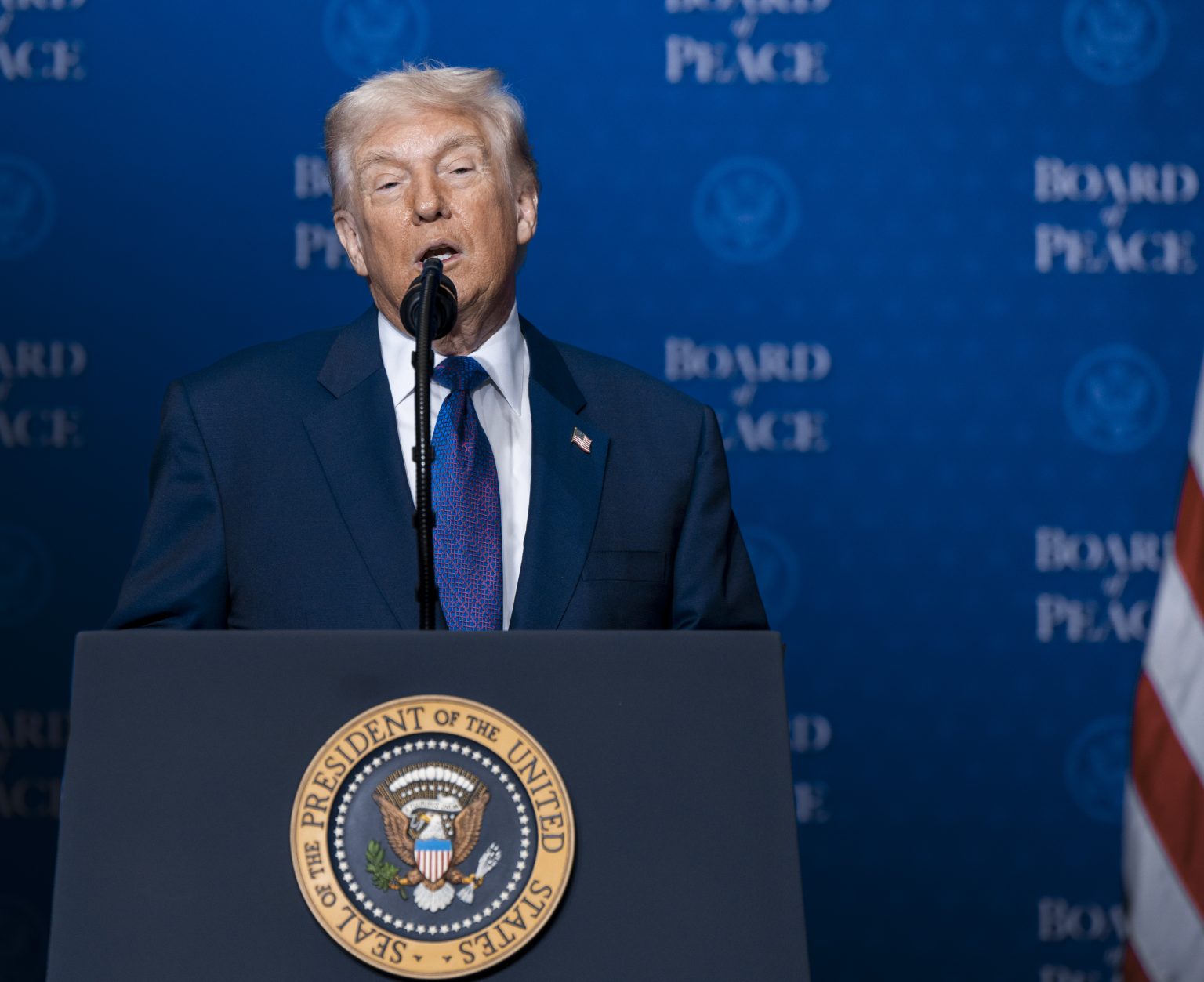
Washington. US President Donald Trump opened the first meeting of the Peace Council on Thursday. In his opening remarks, however, he toyed with the question of war, while a second aircraft carrier approaches the shores of Iran.
"It's a word that's easy to say but hard to implement—peace. But we will achieve it," said the White House chief, referring to the name of the international body. He originally established it with the aim of hosting peace talks between Israel and the militant movement Hamas, which have been fighting in the Gaza Strip since October 2023.
Addressing Iran, which has been negotiating its nuclear program with the United States since April 2025, he said that they may reach an agreement. "Now we may have to take another step—or maybe not. Maybe we'll reach an agreement. You'll probably find out in the next ten days," he said.
The White House chief reiterated that Tehran "must not have nuclear weapons." "There can be no peace in the Middle East if they have nuclear weapons," he added.
Reconstruction of Gaza
Another new development is the "technocratic" committee subordinate to the council, which is to administer the Palestinian enclave. Before the inaugural meeting of the Peace Council, it announced the opening of recruitment for a new police force, and according to a Reuters source, two thousand Palestinians have already applied.
The Peace Council was established at the end of January at a meeting of the World Economic Forum (WEF) with the aim of implementing the ceasefire agreement between Tel Aviv and Hamas, including the demilitarization of Palestinian nationalists and the withdrawal of Israeli troops.
Trump therefore declared that the war in Gaza "is over," although there are still "small flames" of local skirmishes. Since the beginning of the ceasefire, the Gaza Ministry of Health has recorded more than 570 deaths, with the Israel Defense Forces (IDF) taking action against "terrorists" "almost every day," as reported by the Times of Israel.
The US president is confident that Hamas will lay down its arms—even though the group itself has announced that it will not do so. "If they don't, they will face severe retaliation," Trump warned. However, he rejected the claim that the militants are "willing to die" in the fight against Israel. "Everyone was saying, 'Oh, they don't mind dying.' No, they don't want to die," he said.
At the beginning of the meeting, he also promoted his son-in-law Jared Kushner to "peace envoy." Ivanka Trump's husband has finally been given an official position—until now, he has participated in peace talks between Russia and Ukraine and between Israel and Hamas as a "private citizen" alongside special envoy Steve Witkoff.
Criticism of Europe
The European Union was particularly critical of Trump's council, but at least three representatives attended the meeting. Hungarian Prime Minister Viktor Orbán announced his participation back in January, saying that Hungary "needs peace in order to grow and develop," but Bulgaria also sent a delegate.
Interim Prime Minister Rosen Zhilyazkov announced at the forum in Davos, Switzerland, that he would send Nikolay Mladenov, who had been appointed by the US government as the council's "high representative." However, following criticism for postponing elections, the outgoing Bulgarian prime minister sent a diplomat of lower protocol rank.
Among the European countries outside the EU, Albania, unrecognized Kosovo, and Belarus, which is subject to European sanctions, also joined the council. However, European Commissioner for the Mediterranean Dubravka Šuicová also participated as an observer on behalf of the Commission, which was met with criticism from Paris.
The old continent's concerns are also caused by the fact that, according to the founding charter of the Peace Council, Trump is its president for life.
Who's who in the Peace Council
In addition to Mladenov, Witkoff, and Kushner, the members of the council's presidency include Foreign Minister Marco Rubio, former British Prime Minister Tony Blair, World Bank President Ajay Banga, and Marc Rowan, director of the investment company Apollo Global Management.
The latter is the heir to a financial empire founded by investor Leon Black, a long-time client and associate of the notorious New York financier and convicted pedophile Jeffrey Epstein.
The council also includes international stabilization forces to oversee compliance with the ceasefire. As Trump announced, Indonesia, Morocco, Albania, Kosovo, and Kazakhstan will participate.
"Egypt and Jordan are providing very substantial assistance, troops, training, and support for a very reliable Palestinian police force," Trump added, saying that he would allocate $10 billion for their operation, as well as for the management of the entire council and the relevant National Committee for the Administration of Gaza.
Saudi Arabia, Qatar, and Kuwait also contributed one billion dollars each to the Peace Council's account. The United Arab Emirates donated $1.2 billion. The FIFA football alliance announced a contribution of $75 million for "football projects" in Gaza. Its president, Gianni Infantino, also attended the council's inaugural meeting, posing with a Trump-style red cap bearing the inscription "USA."
It should be noted that Slovakia declined Trump's invitation, with Prime Minister Robert Fico and Foreign Minister Juraj Blanár criticizing the council for its $1 billion "membership fee" and the uncertainty of whether it is "only a temporary body" or not.
"We prefer the existing international order based on the results of World War II and the UN Charter," Fico said. According to the daily Le Figaro, Blanár and Czech Foreign Minister Petr Macinka are attending the meeting as observers.
(reuters, toi, sab)