
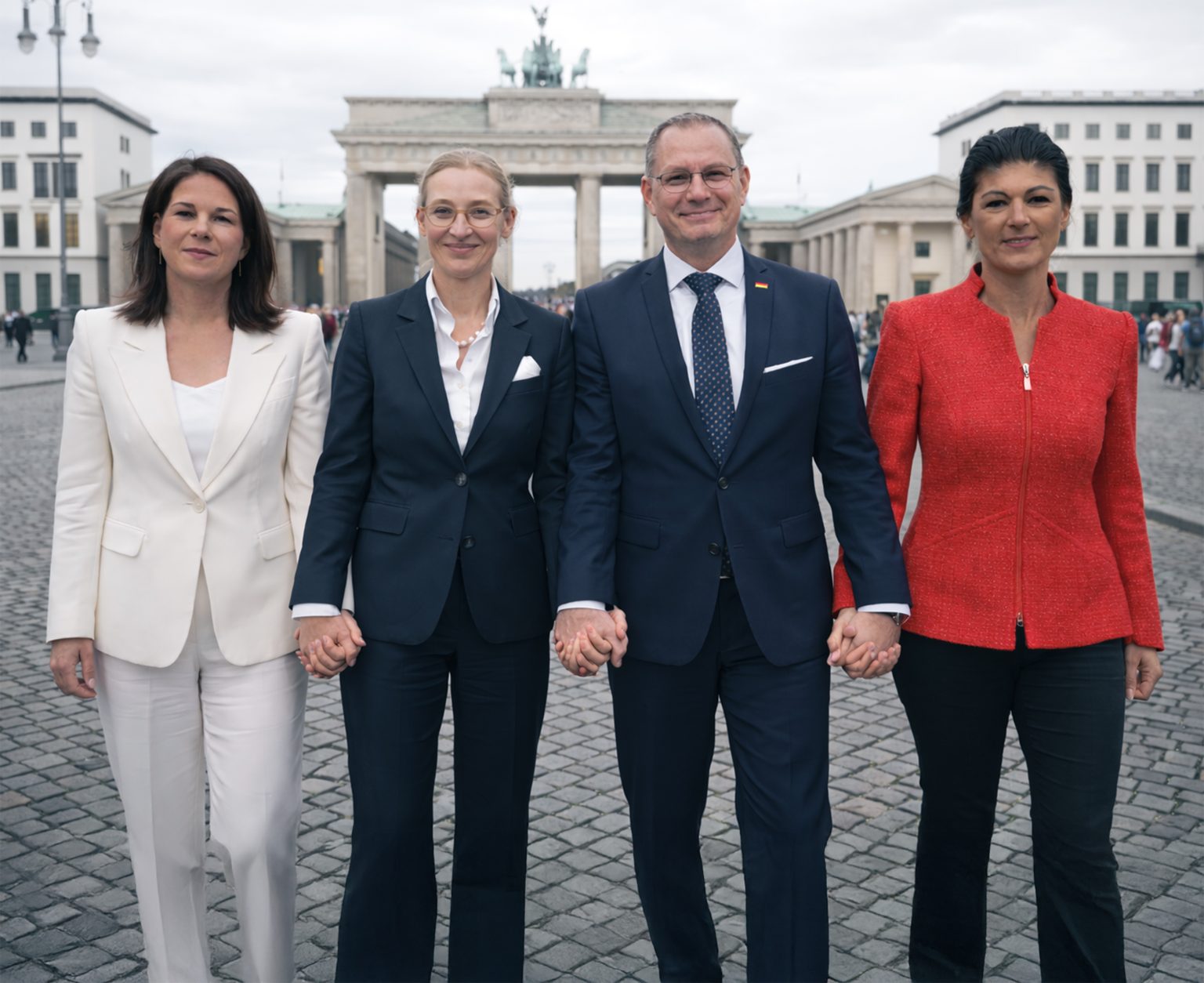
In Germany, the American and Israeli military operation in Iran has prompted a chorus of moralising international law scholars. It has revealed striking alliances between political camps that otherwise refuse to speak to one another or fight each other relentlessly. From the Greens and the radical left to committed socialists and the right wing of the AfD, there is remarkable unanimity in demanding that international law be observed and in issuing stern admonitions to Washington and Tel Aviv.
The question arises why jurists, pacifists and self-appointed guardians of international law voice concern only when butchers are killed somewhere in the world, yet remain silent when those same butchers are doing the killing.
At a moment when, for the first time since 1979, a serious historical window appears to be opening for the Iranian people to reclaim peace, freedom and human rights, many German politicians, media outlets and commentators are instead preoccupied with legal standards – not with the conduct of the mullahs, who only recently had thousands of opposition figures and demonstrators executed during unrest – but with that of the Americans and Israelis, who are attempting to rid the world of one of its most powerful terror regimes.
No ‘concrete threat’ to Israel
It took only hours for ARD’s Tagesschau, the flagship news programme of Germany’s public broadcaster, to feature Christoph Safferling, professor of international law at Friedrich-Alexander-Universität Erlangen-Nürnberg, in a detailed interview explaining why the air strikes on Iran were unlawful. The United States, he argued, had no right of self-defence and no entitlement to carry out a pre-emptive strike. The same applied to Israel, because he personally could see no situation in which the existence of the State of Israel was genuinely threatened by Iran. That threat, he said, was ‘very abstract and general’, and self-defence would be permissible only ‘if there were in fact a concrete danger’.
It has apparently not yet reached the lecture halls of Erlangen-Nuremberg that Iran, under the now deceased Ayatollah Ali Khamenei, repeatedly threatened to destroy Israel, including by means of nuclear weapons, presenting that aim as both official doctrine and political and religious necessity. Numerous threats to reduce cities such as Haifa and Tel Aviv to rubble do not suffice for German legal scholars to recognise a right of self-defence. Nor does the ‘countdown clock’ once installed in Tehran to mark Israel’s destruction. Whether through rocket fire by the Iran-backed Houthis or the assault carried out by the Iran-funded Hamas, Israel and its allies are expected not to respond disproportionately – lest Germany invoke international law.
As viewers were thus instructed on state television who the aggressors were – America and Israel – and who was the victim of legal violations – Iran, naturally – Annalena Baerbock of the Greens, currently President of the United Nations General Assembly in New York, had already spoken out. She condemned the military escalation in the Middle East. After all, she is known to come ‘from international law’.
In her official statement, Baerbock declared that the Charter of the United Nations was clear. All member states must settle their international disputes by peaceful means in such a manner that international peace and security, as well as justice, are not endangered.
The parties involved must conduct their international relations without the threat or use of force against the territorial integrity or political independence of any state. Serious concerns regarding Iran’s nuclear programme, its regional activities and its human rights violations must be addressed in accordance with the UN Charter and international law. She also called for de-escalation and a return to diplomacy and negotiations.
Jan van Aken, co-chair of the far-left party Die Linke, likewise took to X to urge de-escalation under the slogan ‘Stop bombing people’, as though this were a campaign of terror against innocent civilians rather than a militarily precise pre-emptive strike against the leadership of the mullah regime and its infrastructure. He, too, insisted that the attack was unlawful. In a longer party statement it was said that the aim of the strikes remained unclear, but that they had taken place ‘just hours after a breakthrough in the nuclear talks’, in which Iran had pledged to renounce all weapons-grade nuclear material. Now, it was claimed, ‘there are grounds to fear that Israel and the US intend to bomb their way to regime change’.
Iran recast as model of diplomacy
According to that logic, the United States and Israel engaged in months of diplomacy merely to kill their negotiating partner on the brink of success. One is left wondering at such reasoning. Within Die Linke, Iran thus becomes the model pupil of diplomacy, ready to lay down its arms before being bombed by the wicked Israelis and Americans.
The fact that many Iranians ‘see a military strike as a possible way to overthrow the regime out of desperation’ is seriously interpreted by Die Linke as an ‘expression of this massive oppression’. The Iranian people, who have been pleading for American intervention since December, are thus reduced to desperate actors portrayed as not entirely in their right minds for seeking military assistance, while the party continues to call for diplomacy.
It is correct, Die Linke says, that an Iranian nuclear bomb must be prevented at all costs, yet that can be achieved not through military action but only through negotiations and close monitoring on the ground. For 22 years, it argues, ‘clever diplomacy’ prevented the construction of an Iranian nuclear weapon. The killing of its own people over four decades attracts far less attention. The nuclear programme is to be monitored, but the population not liberated.
Russophilia meets hostility towards America
Sahra Wagenknecht, founder of the Bündnis Sahra Wagenknecht (BSW), also launched into a broadside on X, deploying the familiar vocabulary of socialist anti-imperialism and describing Europeans who disagree with her as an ‘appendage of US imperialism’. For her, the issue is invariably systemic.
For Wagenknecht, too, the attack by the United States and Israel constitutes ‘a grave breach of international law’ that will plunge the region into chaos. The United States is ‘manifestly’ not concerned with Iranian nuclear missiles, but with geopolitically motivated regime change. After all, according to mediators in Oman, there had just been a breakthrough in negotiations in which Iran assured Washington it would never possess nuclear material suitable for building a bomb. Her statement reads as though all left-wing politicians were drawing from the same script. The United States, she claims, is ‘certainly not’ motivated by democracy, but merely worsening the plight of civilians.
Wagenknecht accused Friedrich Merz, Emmanuel Macron and Keir Starmer of ‘double standards’ for sanctioning Russia over its unlawful war against Ukraine while failing to condemn the ‘unlawful war of aggression by the US and Israel against Iran’. Instead of such ‘complicity’, she demanded a clear denunciation of the American action and called on the German government and the European Union to prohibit the use of German and European military bases for attacks on Iran and to halt all arms deliveries to the United States and Israel.
It would have been astonishing had Wagenknecht missed an opportunity to express her entrenched anti-Americanism. Equally telling is her reference, in the same breath, to what she sees as the unequal treatment of Russia and Vladimir Putin.
AfD’s foreign policy unpredictability
In a development that is at once bizarre and yet hardly surprising, the Alternative for Germany (AfD) has aligned itself with this chorus of concern. In doing so, it appears to confirm the much-contested ‘horseshoe theory’, according to which the political extremes converge. This time, however, not only right and left but also the Greens and the UN find themselves on the same side.
On X, party co-leaders Alice Weidel and Tino Chrupalla declared that they had taken note ‘with great concern’ of the attacks by Israel and the United States on Iran – with Israel mentioned first. They called on all parties to exercise restraint. ‘The civilian population and civilian infrastructure’ must be protected. International law, including humanitarian law, must be fully observed. Further destabilisation of the Middle East, they said, was not in Germany’s interest and must be prevented.
Until recently, the party had sought to present itself as close to the United States and to play down the widespread perception of proximity to Moscow. It had hoped for support from Donald Trump and his MAGA movement, in the manner of Giorgia Meloni in Italy or Viktor Orbán in Hungary. That strategy is likely to have been undermined by its stance on Iran.
At the same time, by issuing a foreign policy rebuke to its transatlantic partner, the party risks alienating conservative voters who may sympathise with its domestic agenda on migration, identity politics or energy and fiscal matters, yet firmly locate themselves within the transatlantic alliance and alongside Israel. It appears contradictory to decry the dangers of Islamist immigration while criticising those who are confronting Islamist terror at considerable risk.
The Middle East does not need to be destabilised, as it has long been thrown into turmoil by Iran’s regime and its proxies, including Hezbollah, the Houthis and Hamas. One may, with sufficient cynicism, describe the silence of tens of thousands of murdered civilians and the suppression of Iranian women as stability.
Civilian populations and infrastructure do not merely need to remain protected; they must first be secured again. For more than 40 years they have been subject to the arbitrariness of rulers whose congratulations from abroad never ceased. Germany’s current President, Frank-Walter Steinmeier of the Social Democratic Party, received Iranian representatives with full honours during his political career.
International law and humanitarian law do not merely need to be ‘fully observed’, as the AfD demands; they have been broken every day for more than 40 years by those who must now finally be stopped. Should this effort succeed, it would in fact mark the first real opportunity in almost five decades to stabilise the region.
Peaceful liberation has never succeeded
Yes, war claims lives, civilian and military alike. Yet decades of Iranian policy have already cost tens of thousands of lives in wars, attacks and rocket strikes across several countries, with no end in sight. Iran has had every opportunity for a diplomatic solution and has apparently rejected it. Still, politicians across the spectrum ascribe good faith to Tehran and ill intent to Washington and Jerusalem. The paradox is that Annalena Baerbock and Vladimir Putin would presently agree with every substantive line of the Alternative for Germany’s brief statement.
The constant invocation of international law reveals a popular misconception – that conflicts with terror regimes and violent organisations can be resolved peacefully at round tables, while the UN presides like a referee at a tennis match. Terror organisations are indifferent to such norms.

Even activists who justify violence in the struggle against perceived fascism insist that mass murderers who threaten entire nations with annihilation and execute their own citizens must be stopped only through lawful and non-violent means.
It is therefore significant that Chancellor Friedrich Merz stated on Sunday that legal classifications ‘achieve relatively little’. That applies all the more, he said, when they remain largely without consequence. He added that ‘this is not the moment to lecture our partners and allies’, since, despite doubts, Germany shares many of their objectives without being capable of realising them itself. Germany, he said, has not been prepared to enforce fundamental interests by military means if necessary.
Had the international law established after the Second World War – now so frequently invoked to shield a terror regime from accountability – been applied in 1945 in the same rigid manner, the Allies might have remained locked in negotiations with the successors of National Socialism, who would doubtless have assured the world that they were on the verge of laying down their arms while continuing their crimes. At least international law would have been upheld and German territory left untouched.
Would that have sufficed?