Gallup: 77 per cent of German employees work in ‘energy-saving mode’
Only 10 per cent of German employees feel genuinely connected to their employer. In successful economies the figure is significantly higher. But how much do such comparisons really reveal about the deeper dynamics of different labour markets?
A disengaged office employee sleeps on his keyboard, revealing little interest in his work, a problem that appears to be becoming increasingly serious for Germany. Photo: ChatGPT
|
Berlin. Germany’s labour market is currently producing a remarkable figure: the dutiful employee without any real connection to the company. They arrive on time, complete their tasks and do not stand out through open rebellion. But they are not exactly on fire either.
This is the picture drawn with unusual clarity by the new Gallup Engagement Index Germany 2025. Only 10 per cent of employees are highly emotionally committed to their employer. Some 77 per cent have only a weak emotional attachment, while 13 per cent have none at all. Gallup estimates the economic productivity losses caused by ‘silent quitting’ in 2025 at between €119.2 billion and €142.3 billion.
What is most troubling is not just the figure but the finding behind it. Germans do not hate their work. A large share are quite satisfied with their tasks, working conditions and pay. According to Gallup, the problem lies elsewhere – not in an ‘attitude problem’ among employees but in the quality of leadership. Or, more soberly put, too many companies lack the kind of leadership that turns presence into performance and performance into identification.
This fits strikingly well with Germany’s present moment. A country that complains about labour shortages, piles up bureaucratic burdens and preaches transformation, while many companies cannot even manage the obvious: giving people the sense that their work is noticed, mentored and meaningfully embedded. Germany therefore suffers not only from weak growth, high energy costs and excessive regulation. It also suffers from mediocre day-to-day leadership.
Germany trails peers in international engagement rankings
Anyone hoping for comfort from abroad will find it only in part. Yes, Europe as a whole is the weakest region in the world when it comes to employee engagement. According to Gallup’s ‘State of the Global Workplace’, around 21 per cent of employees worldwide are considered engaged. In Europe, the figure is just 13 per cent.
Yet even this weak European average is higher than Germany’s. In the Gallup Engagement Index Germany, only 10 per cent of employees are highly emotionally committed to their employer. In Gallup’s global methodology, this corresponds to an engagement level of roughly 12 per cent, which is well below the global average.
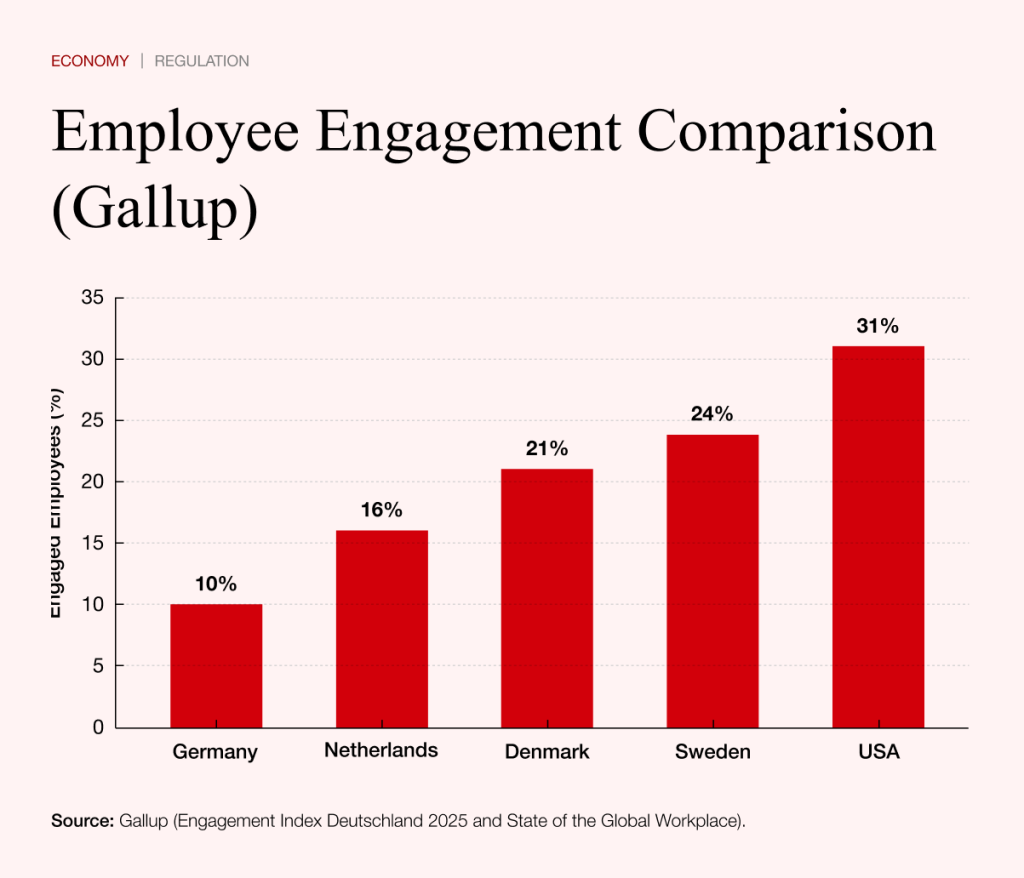
The gap becomes particularly evident when compared with the United States. According to Gallup, 31 per cent of employees there are considered engaged. In the US, roughly one in three workers is emotionally committed to their company, while in Germany it is only about one in 10. A clear gap also emerges within Europe when compared with the economically successful countries of the north. In Sweden the engagement rate stands at 24 per cent, in Denmark at 21 per cent and in the Netherlands at 16 per cent. These countries therefore reach levels that are in some cases twice as high as those in Germany.
The gap is therefore not merely statistical but structural. According to Gallup, the difference between Germany and Sweden is around 12 percentage points, and between Germany and the United States almost 20 percentage points. For Germany’s self-image, this is uncomfortable. The Federal Republic likes to see itself as a country of industrial discipline, engineering culture and an organised work ethic. Yet in terms of employee engagement it ranks not among the model performers but rather in the lower middle of developed economies.
These figures must be read with some caution. The German Gallup index and the international Gallup report use different survey methods. But the overall trend is clear: Germany is not among the countries where employee engagement can be considered a particular strength.
Employee Engagement Comparison. Source: Gallup
Germany’s issue is not work ethic but management
The convenient explanation that people simply ‘no longer want to work’ today finds little support in the data. Gallup instead reveals a far more uncomfortable pattern. Employees still believe they have opportunities in the labour market and, after the decline of previous years, even want to stay longer with their employer.
Yet most do not experience their working lives as inspiring. Some 56 per cent say they expect to remain with their current employer in one year’s time, and 40 per cent also in three years. At the same time, only 23 per cent say their management will successfully meet future challenges, and just 18 per cent feel inspired by them about the future.
This lies at the heart of the problem. In many companies Germany does not appear to face an acute loyalty crisis in the sense of open rejection. Instead, it faces a crisis of momentum. People stay, but they no longer truly believe in the broader project. They perform their tasks, but they do not identify with the organisation. They increasingly use AI in their daily work, yet only a small minority experience leaders who actively and meaningfully guide this development. The same pattern emerges here as well: technology advances while leadership lags behind.
Economically, this is highly significant. Emotional commitment is not a wellness indicator for HR departments but a factor of productivity. In its global meta-analysis Gallup points to lower absenteeism, lower staff turnover, fewer quality defects and higher productivity in teams with stronger engagement. The German report shows the same relationship in concrete terms: employees with strong emotional commitment were absent for an average of 5.7 days in 2025, compared with 9.7 days among those with no emotional attachment.
For an ageing country that is highly regulated and under economic pressure, this is particularly serious. Germany can ill afford inefficient organisation of work. It is expensive to employ people formally while losing them internally.
Why other successful economies perform better
The international comparison suggests that the difference is not primarily cultural or due to the current climate. Otherwise it would be difficult to explain why the United States or the Nordic economies achieve significantly higher engagement levels.
Of course, prosperity, institutions, labour market structures and corporate culture all play a role. But Gallup repeatedly identifies the same weak point worldwide: the quality of direct leadership. According to pollster, the global decline in engagement in recent years has been driven largely by falling engagement among managers themselves. When the middle management layer no longer provides support, commitment within teams begins to erode.
This may be particularly relevant for Germany. The Federal Republic is a country organised strongly around processes, hierarchies and clearly defined responsibilities. That works well as long as growth, skilled workers and established routines are in place. In periods of transformation, however, it can quickly become a disadvantage. Where leadership does not truly lead but merely administers, Germany’s strengths can turn into a kind of institutional heaviness. The result is precisely the workplace mood Gallup now measures so clearly: no open rebellion, but a collective energy-saving mode, a slow fizzling out.
Germany has not collapsed – but it has settled for less
Perhaps the most unsettling aspect of the new figures is that they do not describe a catastrophe in the classical sense. Germany is not experiencing a total collapse of work ethic. What it is experiencing is something more subtle: the normalisation of weakness. The share of highly committed employees has risen only slightly compared with previous surveys, from nine to 10 per cent. Those with weak engagement remain at a record level of 77 per cent. The downward trend has been halted, but only at a low level.
That may be worse than a sudden decline. A sharp fall alarms people. Stabilisation at a weak level encourages acceptance of mediocrity. People settle into it. That is precisely the danger for Germany: not a spectacular collapse, but the gradual normalisation of underperformance.
Internationally, Germany therefore does not stand out as one of the worst cases, but the issue is clearly present. It lags well behind countries such as the United States, Sweden and Denmark, and even falls below the global average. A country that wants to move ahead economically cannot afford workforces that largely do little more than go through the motions.
Placeholder For Topreaded Placeholder For Topreaded
Placeholder
Placeholder
Placeholder For Topreaded Placeholder For Topreaded
Placeholder
Placeholder
Placeholder For Topreaded Placeholder For Topreaded
Placeholder
Placeholder
Placeholder For Topreaded Placeholder For Topreaded
Placeholder
Placeholder
Placeholder For Topreaded Placeholder For Topreaded
Here is placeholder for Article excerpt Here is placeholder for Article excerpt Here is placeholder for Article excerpt Here is placeholder for Article excerpt
Here is placeholder for Article excerpt Here is placeholder for Article excerpt Here is placeholder for Article excerpt Here is placeholder for Article excerpt
Here is placeholder for Article excerpt Here is placeholder for Article excerpt Here is placeholder for Article excerpt Here is placeholder for Article excerpt
Welcome to the comments section of the Štandard daily. Please take note of our guidelines, comments are moderated by us. You can contact the moderators at [email protected].
Participate in the discussion
Comments are available to subscribers only. If you'd like to join the discussion, choose a subscription starting at €6.72 per month.
All comments 0
Register
Comments are available to registered users only. If you'd like to join the discussion, register here.