
The latest Index of Economic Freedom published by the Heritage Foundation paints a new picture of economic freedom around the globe. The current edition of the study evaluates 176 countries and reaches a sobering overall conclusion: from the authors’ perspective, the global economy remains largely only partially free. Europe continues to be well represented by international standards, yet developments are far from uniform. While some countries have advanced markedly, others – including Germany and Austria – are losing ground in global competition.
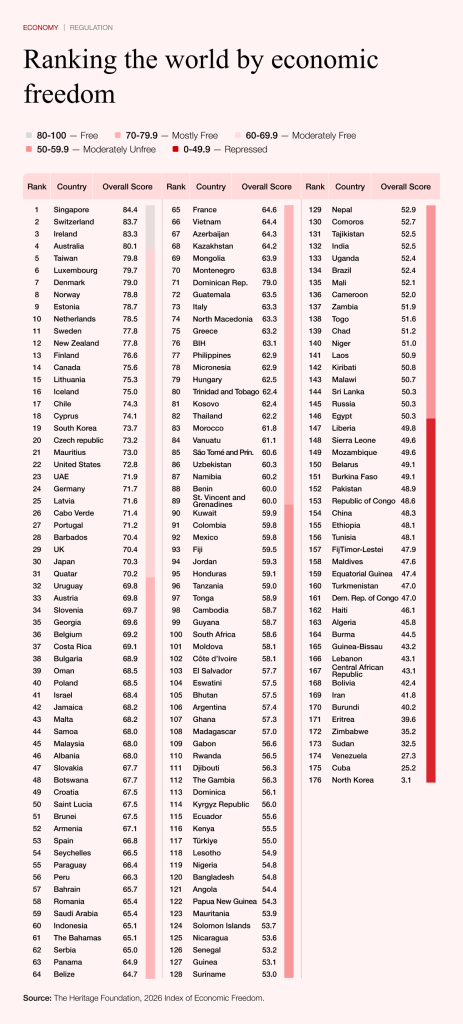
At the top of the ranking once again are economies characterised by particularly open markets and stable institutions. Singapore leads the list with 84.4 points. It is followed by Switzerland with 83.7 points and Ireland with 83.3 points. Australia and Taiwan occupy the next places. Notably, many of the leading economies are relatively small, strongly integrated into international markets and supported by stable legal and institutional frameworks.
Europe nevertheless features prominently among the top performers. Alongside Switzerland, Luxembourg, Denmark, Norway, Estonia and the Netherlands also appear in the top ten. Sweden and Finland likewise continue to perform very well. At the same time, however, the rankings reveal increasing differentiation within Europe. Some countries have further improved the conditions for market economies, while others are slipping back by international comparison. Germany is ranked 24th in the current index with a score of 71.7 points. Austria records 69.8 points, placing it 33rd. According to the index, both economies remain ‘moderately free’. Compared with earlier assessments, however, they have lost several places and now stand well behind a number of smaller, more flexible economies.

How Economic Freedom Is Measured
The Index of Economic Freedom is one of the best-known international rankings measuring the economic systems of individual countries. The Heritage Foundation has published the study since 1995. Its aim is to make economic freedom comparable worldwide and to analyse its relationship with growth, prosperity and social development.
Economic freedom is measured using 12 individual indicators grouped into four broad categories: rule of law, government size, regulatory efficiency and open markets. Each of the 12 indicators is assessed on a scale from 0 to 100. The average of all values produces a country’s overall score.
The first category, rule of law, includes property rights, judicial effectiveness and the integrity of public institutions. Countries perform particularly well here when contracts can be enforced reliably, property is protected and corruption remains low.
The second category concerns the size of government. It assesses tax burden, government spending and fiscal health. High tax levels, extensive public spending programmes or rapidly rising public debt weigh negatively on the overall score within this framework.
The third area examines regulatory efficiency. It includes business freedom, labour market flexibility and monetary stability. Countries with straightforward procedures for starting businesses, relatively open labour markets and stable currencies receive higher ratings in this category.
The fourth category concerns open markets. Here the index evaluates trade freedom, investment freedom and the openness of the financial system. Countries with low trade barriers, open capital markets and competitive financial sectors tend to achieve the strongest results.
From these 12 factors an overall score emerges. Countries scoring more than 80 points are classified as economically ‘free’. Scores between 70 and 79.9 are labelled ‘mostly free’. Between 60 and 69.9 points, the index classifies economies as ‘moderately free’. Below that come the categories ‘mostly unfree’ and, finally, ‘repressed’.
Prosperity and Economic Freedom
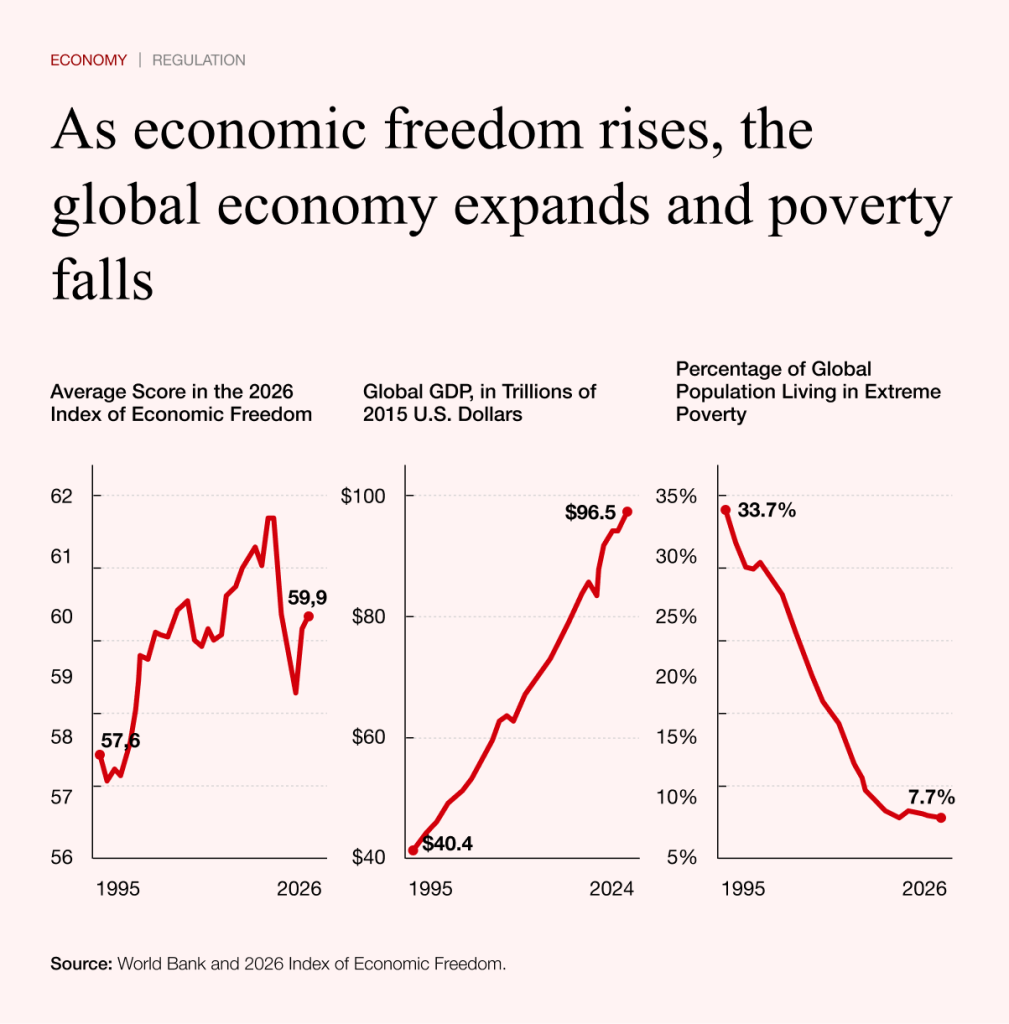
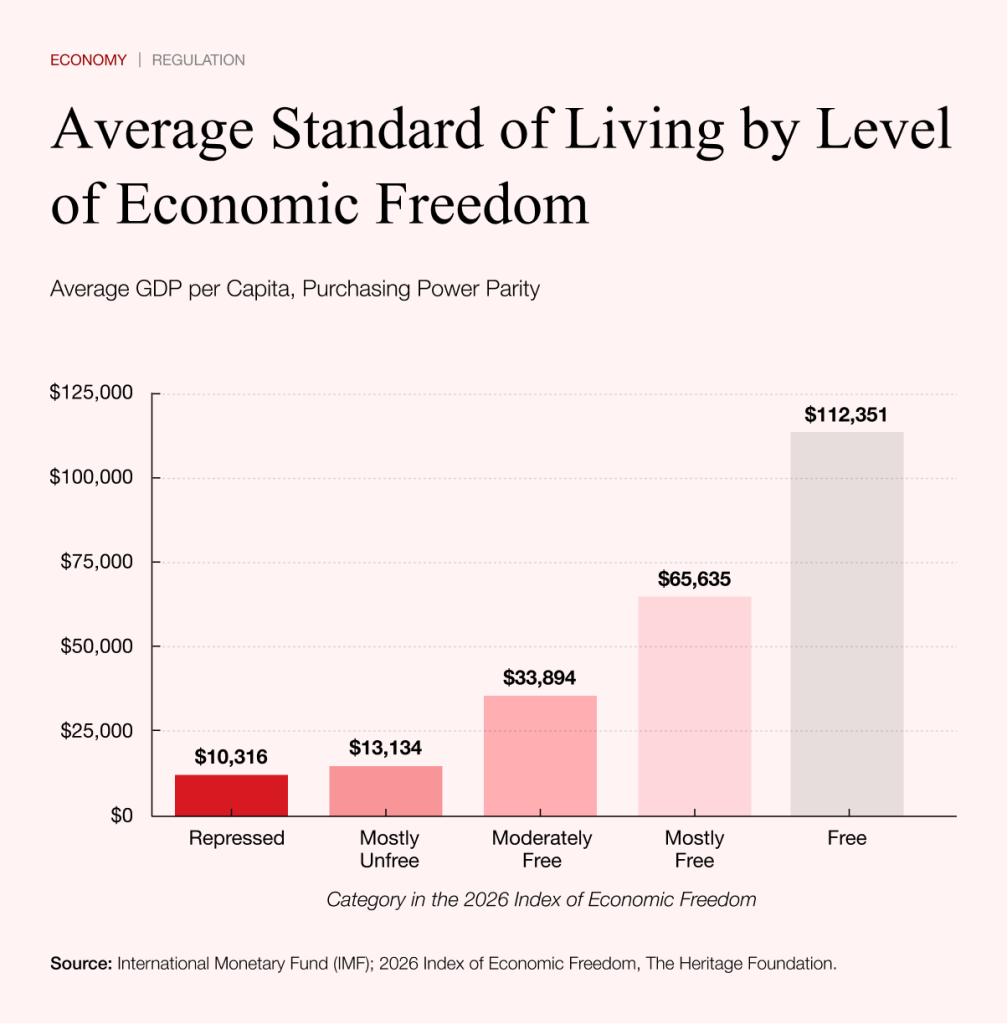
The study explicitly links its ranking to a broader economic policy argument. According to the report, countries with a high degree of economic freedom achieve significantly higher incomes and stronger economic dynamism.
Calculations by the Heritage Foundation suggest that the average per-capita income in countries classified as ‘free’ or ‘mostly free’ is more than twice as high as in states with limited economic freedom. At the same time, such countries tend on average to be more innovative, achieve better results in education and healthcare and maintain more stable democratic institutions.
The report also identifies clear correlations in the fight against poverty. In countries with high economic freedom, poverty rates are significantly lower than in economies characterised by heavy regulation or strong state control. The authors attribute this to better conditions for investment, higher productivity and greater innovative capacity.
Europe at Two Speeds
For Europe the result is a mixed picture. The continent still includes several of the economically freest countries in the world. At the same time, the rankings reveal growing divergence.
Switzerland has emerged as one of the clear leaders of the index. It combines a stable legal order with open markets, comparatively moderate state intervention and strong international competitiveness. Ireland has likewise established itself as one of Europe’s most dynamic economic locations and ranks third worldwide. Nordic countries such as Sweden, Denmark and Finland benefit in the ranking from stable institutions and relatively efficient administrative systems. Despite their high social spending, they achieve strong results in business freedom, innovation and institutional stability.
Germany and Austria, by contrast, now rank only in the broader upper middle tier. Both economies still possess stable institutions and a powerful industrial base. At the same time, the study criticises rising public spending, increasing regulation and growing fiscal burdens. In particular, many European economies perform less strongly in the areas of government size and regulatory efficiency than smaller and more market-oriented countries, according to the report.
The index also shows diverging trends in Central and Eastern Europe. Slovakia, with 67.7 points, ranks 47th and therefore also falls into the category of ‘moderately free’ economies. According to the study, the country continues to benefit from relatively open markets and an export-oriented industry closely integrated into European supply chains. At the same time, structural problems weigh on its position in the ranking. These include weaknesses in the efficiency of state institutions, comparatively complex regulation and only limited fiscal stability. Compared with some neighbours in the region, such as the Czech Republic or the Baltic states, Slovakia therefore remains in the middle of the ranking for economic freedom.
The Role of the United States
The study devotes particular attention to developments in the United States. In the current index, the US records a score of 72.8 points, placing it 22nd worldwide. The American economy therefore remains in the category of ‘mostly free’.
According to the report, the US assessment has improved noticeably in recent years. The stability of monetary policy, relatively open investment conditions and continuing entrepreneurial dynamism are viewed favourably. At the same time, structural challenges remain. Public debt in the United States stands at more than 120 per cent of gross domestic product. Persistent budget deficits also weigh on the country’s rating in the area of fiscal health.
Despite these weaknesses, the American economy is still regarded as one of the most dynamic in the world. The study points to high levels of investment, strong innovative capacity and a comparatively business-friendly regulatory environment.

Large Differences Worldwide
At the bottom of the ranking remain countries with heavily state-controlled economic systems. North Korea once again occupies the last place by a wide margin. Cuba, Venezuela, Sudan and Zimbabwe follow behind it.
China also continues to rank among the countries with relatively limited economic freedom. With 48.3 points, the People’s Republic stands only 154th. The study attributes this primarily to the dominant role of the state, extensive regulation and a state-controlled financial system.
Overall, the report depicts a global economy that is moving only slowly towards greater economic freedom. More than half of the countries examined still score below 60 points and are therefore considered economically constrained.
The study’s central message is clear: countries with open markets, stable institutions and limited state intervention achieve higher growth rates and higher living standards over the long term. Economies characterised by heavy regulation, by contrast, often fall short of their economic potential.