
The Persian Gulf is almost synonymous with oil. The Strait of Hormuz serves as a narrow chokepoint through which black gold reaches global markets. Yet the oil and gas industry encompasses far more than crude and petrol, extending to a wide range of related products. Alongside oil and natural gas, exports of several key commodities have also been disrupted by the closure of Hormuz.
The shutdown of the strait therefore signals not merely an oil shock, but a chain reaction across multiple sectors – the full extent of which remains uncertain and is scarcely discussed beyond specialist circles.
The range of affected products is vast. The focus here is on two critical commodities: urea and sulphur. Financial markets offer a useful guide to likely developments and real-world impacts. Share prices in particular tend to reflect risks in specialised sectors more quickly and precisely than political statements.
Urea: the nitrogen shock already priced in
Urea is the world’s most widely used nitrogen fertiliser. Around 30 per cent of global exports originate in countries on the Persian Gulf, where production relies on exceptionally cheap natural gas.
While oil benefits from strategic reserves, fertilisers do not. Once the strait was closed, global urea prices rose by tens of per cent. Europe may soon face shortages reminiscent of the early phase of the Ukraine war, when AdBlue, which relies heavily on urea, became scarce and prices surged.
Markets for temporarily unavailable raw materials follow a clear logic. Producers not dependent on Persian Gulf supplies are emerging as the primary beneficiaries. They can charge substantial crisis premiums.
Companies that built strategic reserves after the Covid pandemic or the European energy crisis, recognising the risks of ‘just-in-time’ inventory models, now enjoy a significant advantage.
At the same time, they are gaining market share from competitors forced to scale back production due to supply constraints.
One example of a company punished by markets is India’s National Fertilizers Limited (NFL). Its shares have fallen by more than a fifth since the start of the year. A shortage of Qatari gas prompted the government in New Delhi to introduce rationing, forcing the listed company to halt operations at plants in Punjab.
A special case is the group of major regional producers, including the Saudi company SAFCO, now part of SABIC (Saudi Basic Industries Corporation). Founded in 1965, it remains one of the largest fertiliser producers globally.
Its facilities produce more than 4.9 million tonnes of fertilisers annually, including 2.6 million tonnes of urea and 2.3 million tonnes of ammonia. Its shares have risen by more than 23 per cent this year, supported by access to domestic gas. Yet the company also illustrates a key geopolitical risk. Should Saudi Arabia become directly involved in the conflict, such infrastructure could become a target in any asymmetric escalation.
The resulting global shock would be profound.
Investors are acutely aware of the risk. The safest bets for those seeking exposure to rising urea prices are companies entirely removed from the region. North American producers have quickly become favourites on Wall Street.
Shares in CF Industries have risen by more than 58 per cent since the beginning of the year. Canada’s Nutrien has gained around 21 per cent, reflecting a broader shift of capital towards perceived safe havens.

Sulphur and phosphates: when playing it safe becomes a trap
While the shortage of nitrogen fertilisers is immediately visible, another critical input receives far less attention. Around 45 to 50 per cent of globally traded sulphur comes from Persian Gulf producers, where it is generated as a by-product of oil and gas refining. Sulphur is essential for producing sulphuric acid, which in turn is required to process phosphate rock into fertilisers.
Unlike Brent crude or urea, sulphur is not traded on open commodity exchanges. Transactions are typically arranged through bilateral contracts between producers and consumers, leaving the market relatively opaque.
This lack of transparency cuts both ways. Without reliable price signals or trading data, market dynamics can be difficult to assess, as recent developments have shown.
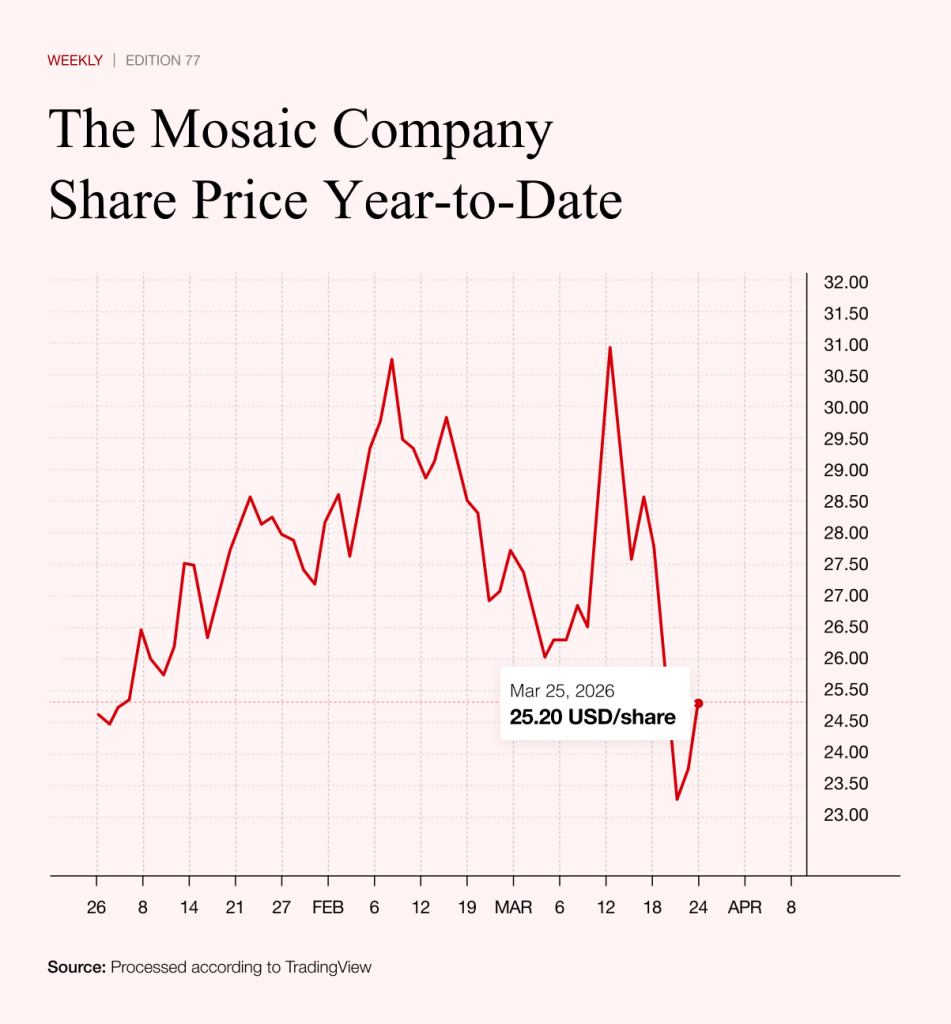
The same basic logic applies here. In theory, the most attractive investment would be a fertiliser producer with secure access to its own sulphur supply. By that measure, The Mosaic Company appeared well positioned. It mines phosphate in North America, has local access to sulphur and is not directly exposed to disruptions in Hormuz.
Yet markets delivered a surprise in late March. Instead of rising, Mosaic’s shares fell by around 13 per cent after Bank of America downgraded the stock. The reason lies in oversupply.
Producers had secured sufficient inventories in advance. At the same time, Brazil has expanded phosphate mining across the Americas, creating a regional surplus. In addition, weak demand from US farmers, many of whom are cutting costs sharply, has weighed on fertiliser sales. As a result, the company’s share price has remained broadly flat since the start of the year.
A Scandinavian lesson: flexibility as the key to success
Market outcomes are rarely straightforward. Some producers are performing strongly. Shares in Norway’s Yara International have risen by more than 30 per cent since the beginning of the year.
The company is among the world’s largest producers of nitrogen fertilisers and industrial ammonia. Access to regional resources allows it to operate independently of Gulf supply disruptions.
It also adapted quickly during the 2022 energy crisis, shutting down inefficient capacity, reducing output of low-margin urea and shifting production towards higher-value nitrates and specialised fertilisers.
That flexibility now positions it to expand again into urea and lower-cost segments.
Governments have at least rudimentary tools to respond to shocks in oil markets. For inputs such as urea and sulphur, however, policy options are far more limited. Managing such disruptions requires an understanding of complex chemical processes, logistics and global supply chains, which makes the current crisis more technical, less visible and significantly harder to address.