
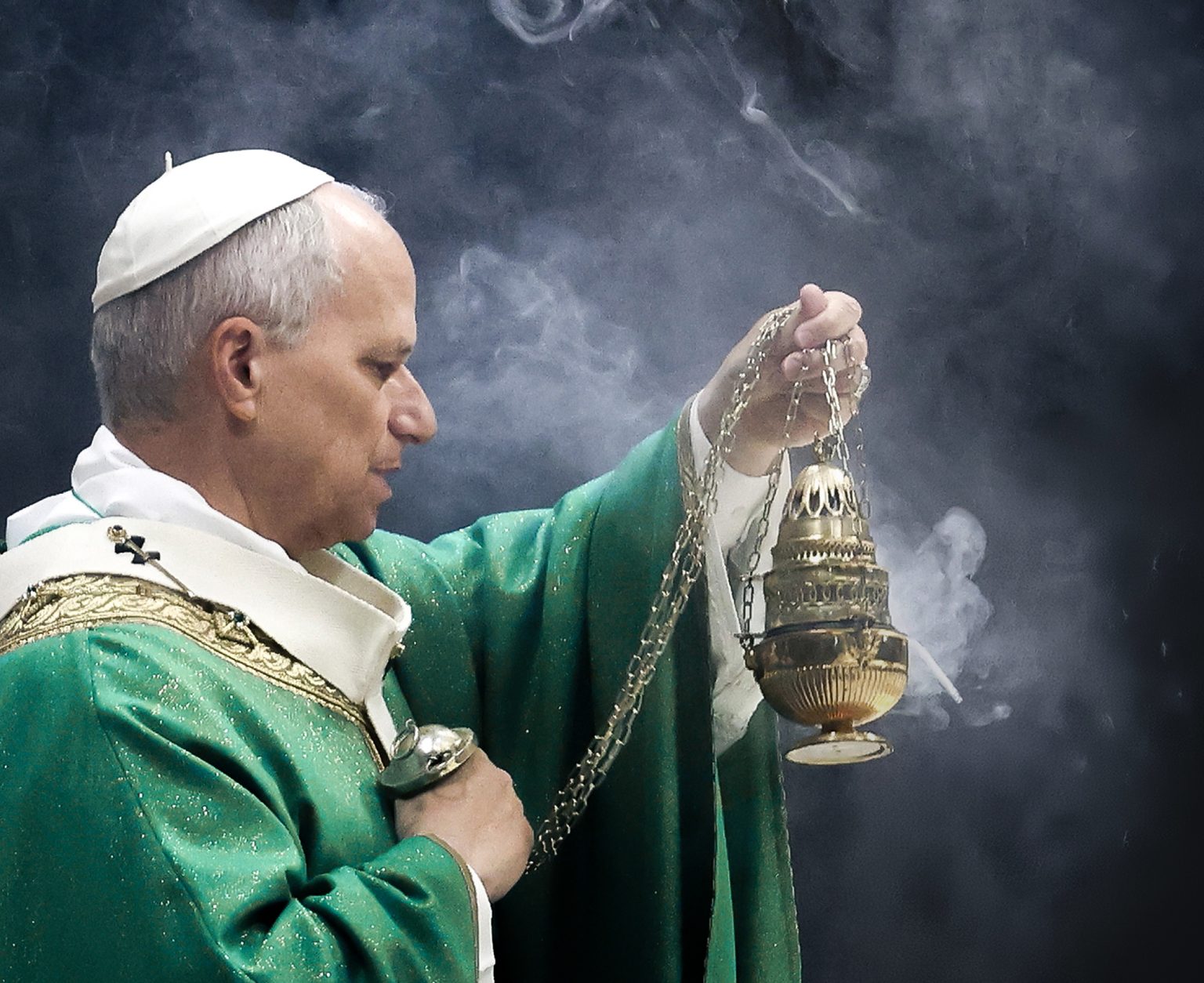
The recently published message of Pope Leo XIV to the French Bishops’ Conference deserves special attention far beyond the French context.
For there is a discernible tone in his words that is by no means self-evident in the current intra-church atmosphere: a tone of sober clarity but not harshness, a tone of pastoral breadth but not of abandonment of ecclesial form. A tone that neither treats the liturgical question as a peripheral issue nor transforms it into an ideological front line.
Therein lies its ecclesio-political weight.
Unity
When the Pope speaks of a ‘painful wound’ in connection with the celebration of the Mass, while calling for ‘practical solutions’ that would ‘generously include’ those who are bound to the Vetus Ordo – the celebration of the Mass in Latin according to the liturgy used before the Second Vatican Council – he is not only touching on a specialised liturgical topic, but a neuralgic point in contemporary ecclesiology. For the Holy Mass is not merely one of the Church’s acts, but a sacrament of her unity. Where permanent divisions, distrust and ecclesial ambiguity have arisen around its celebration, the Church is wounded at the very centre of its life.
This is why it is too simplistic to interpret the current situation as either a marginal disciplinary issue or as a mere ‘cultural struggle’ within Catholicism. In fact, it is a deeper matter: how can the Church maintain its visible unity without forcibly marginalising legitimate ties to the liturgical tradition? How can it show pastoral consideration without tolerating parallel structures that would be in long-term opposition to the sacramental form of the Church?
And how can the Pope, as the visible principle of unity, act in such a way that truth and patience, norm and paternal care, office and inclusion are not pitted against one another?
A responsible ecclesial-political response to these questions must be based on a principle: unity in the Church is not merely a matter of consent or administrative expediency. It is a sacramental, visible and hierarchically ordered reality. It cannot therefore be arbitrarily negotiated. Precisely because it is sacramental, it must not be reduced to administration, sanctions and formalism.
Unity must not only be declared, but also healed, made visible and spiritually borne.
Wound
The first strength of the Pope’s intervention is that he clearly does not see the situation as primarily a dispute over taste. This is not a matter of two liturgical ‘styles’ that do not happen to get along, but a wounding of the ecclesial community. If the celebration of the Mass becomes a place of permanent mutual alienation, it touches the heart of the Church. For the Eucharist, the episcopate and unity belong inseparably together.
Already Ignatius of Antioch ties the Eucharist to the unity of the Church with the bishop, and Cyprian of Carthage describes the episcopate as an indivisible reality in which each bishop has a share without the unity being broken.
From this perspective, it is also clear why the question of illicit episcopal ordinations without papal mandate cannot be downplayed as a purely administrative matter. The mandate is not merely a bureaucratic approval, but an expression of the sacramental order of the episcopate in communion with Peter’s successor. Ordination without a mandate therefore involves more than a disciplinary infraction: it entrenches a structure in which sacramental validity and ecclesial unity diverge.
It is precisely this ‘valid illegitimacy’ that is ecclesially very problematic, because it divides loyalties, weighs on consciences and creates a parallel form of apostolicity.
If Pope Leo XIV speaks of a wound, it is theologically accurate. The wound is not merely psychological or sociological. It is ecclesiological. It concerns the visible form of the Church. That is why Rome cannot remain indifferent. But at the same time, healing cannot take place only in a mode of demarcation.
A unity made purely juridical, which does not pastorally sustain and spiritually convince, remains external and fragile. Rather, the Church’s task consists in safeguarding unity without bringing people, groups and forms of piety into a state of permanent alienation.
Unity or souls?
The present situation is difficult because it is as if two ecclesial values are opposed to each other. On the one hand is the duty to safeguard the visible unity of the Church, the primacy and sacramental order of the episcopate. On the other is the pastoral vocation to care for souls, to provide sacramental ministry, to preserve the liturgical tradition and fidelity to the forms of Catholic piety that have developed over time. A serious ecclesial-political position must not dismiss either of these sides lightly.
It is here that the possible line of Leo XIV appears noteworthy. His call for ‘a deeper understanding of the mutual sensitivities’ suggests that the Church is not only to lay down the law, but also to understand the inner motivations of those involved. This is not to say that all positions are equally legitimate.
It does mean, however, that the Church cannot be content with naming conflicts, but must seek ways of reconciling inclusion. Church authority that merely corrects without listening may indeed enforce obedience, but it will not heal unity.
In this context, the basic line of Benedict XVI’s theology remains instructive. His action was based on an ecclesiology of communio that saw unity not primarily as a question of power but as a sacramental reality. Out of this grew his characteristic combination of clarity in substance, breadth in form and patience in procedure.
This line could be taken up again under the leadership of Leo XIV. The generous inclusion of the faithful bound to the Vetus Ordo would then not be a weakness, but a manifestation of a Church so sure of its identity that it does not reflexively see diversity as a threat.
How to calm the tension?
The idea that calming the situation is not primarily a tactic, but a duty arising from the Eucharist, is extremely important. He who confesses that the Eucharist builds up the Church cannot at the same time take steps that further damage its visible unity. Therefore, a moratorium on irreversible acts – for example further episcopal ordinations without a mandate – would not be a loss of face, but an expression of ecclesial sobriety and responsibility.
Such a move, however, would only make sense if it did not appear as unilateral submission. This is where Rome’s real role begins. The pacification of the whole situation can only succeed if the Holy See at the same time credibly shows that it sees the real pastoral situation and does not merely seek to gain time. Those who call for a delay must also open up a perspective. Otherwise, the moratorium will only become a postponed escalation.
Therefore, the concerns of traditional communities for the preservation of sacramental ministry must be taken seriously. Without priests there is no Eucharist, without the Eucharist the life of the Church is impoverished. It is not enough, therefore, simply to dismiss arguments about necessity as a pretext.
The Church must respond to them in practical terms – for example by ensuring episcopal ministry, the proper conferral of confirmation, visitations and ordinations according to clear criteria and transparent procedures. In this way it becomes clear that the Church does not leave the faithful bound to the older form to fend for themselves, but bears responsibility for them.
Gestures are not enough
But good gestures alone will not resolve the crisis. There are real theological differences, especially in the view of the Second Vatican Council, the liturgical reform and the degrees of commitment to Church teaching. That is why the Church needs more than calls to fraternity: it needs a methodologically clear dialogue. The document Lumen Gentium (25) offers an important point of departure when it clarifies the relationship between authentic teaching, graded consent and theological work.
Such a dialogue must be free from two illusions. On the one hand, the impression must not be given that the conclusions of the Council can be renegotiated or relativised after the fact. On the other hand, it would be equally wrong to regard every question of interpretation as an act of disobedience. The Church lives not only by definitions, but also by deepening, reception and theological clarification. What it cannot accept is not the question itself, but the divisive consequences of the question for which no conciliatory answer is sought.
At the same time, stable ecclesial forms are needed. A Church that keeps groups in grey areas for years inevitably creates insecurity, a camp mentality and identity hardening. The Apostolic Constitution Anglicanorum coetibus has shown that legitimate diversity can be integrated through ordered structures. The goal is not uniformity but legally expressed unity.

Conclusion
Pope Leo XIV could – if he adheres to the inner logic of his message – open a path that is at once broad, clear and truly ecclesial: broad towards those who sincerely cling to the Vetus Ordo, clear on the non-negotiability of visible communion, and ecclesial in the sense that the guiding principle will be neither power logic nor pious parallelism, but the sacramental form of the Church itself.
Such a line would be neither restorative nor progressive in the political sense. It would be Catholic. It would not narrow unity, but neither would it dissolve it. It would not cover the wound with mere administration, but would seek to heal it through a process of reconciliation, pastoral care, dialogue and legal order.
For the Church does not live on liturgical pages, but on the one Eucharist. And this Eucharist does not require uniformity, but communio. The future, therefore, will not lie in whether diversity is tolerated or forbidden, but in whether it can be arranged in such a way that it no longer provokes division. When Pope Leo XIV seeks ‘practical solutions’, he is touching the very heart of Catholic ecclesiology: unity, which must be visible because it is sacramentally true.
The article was first published on DoKostola.