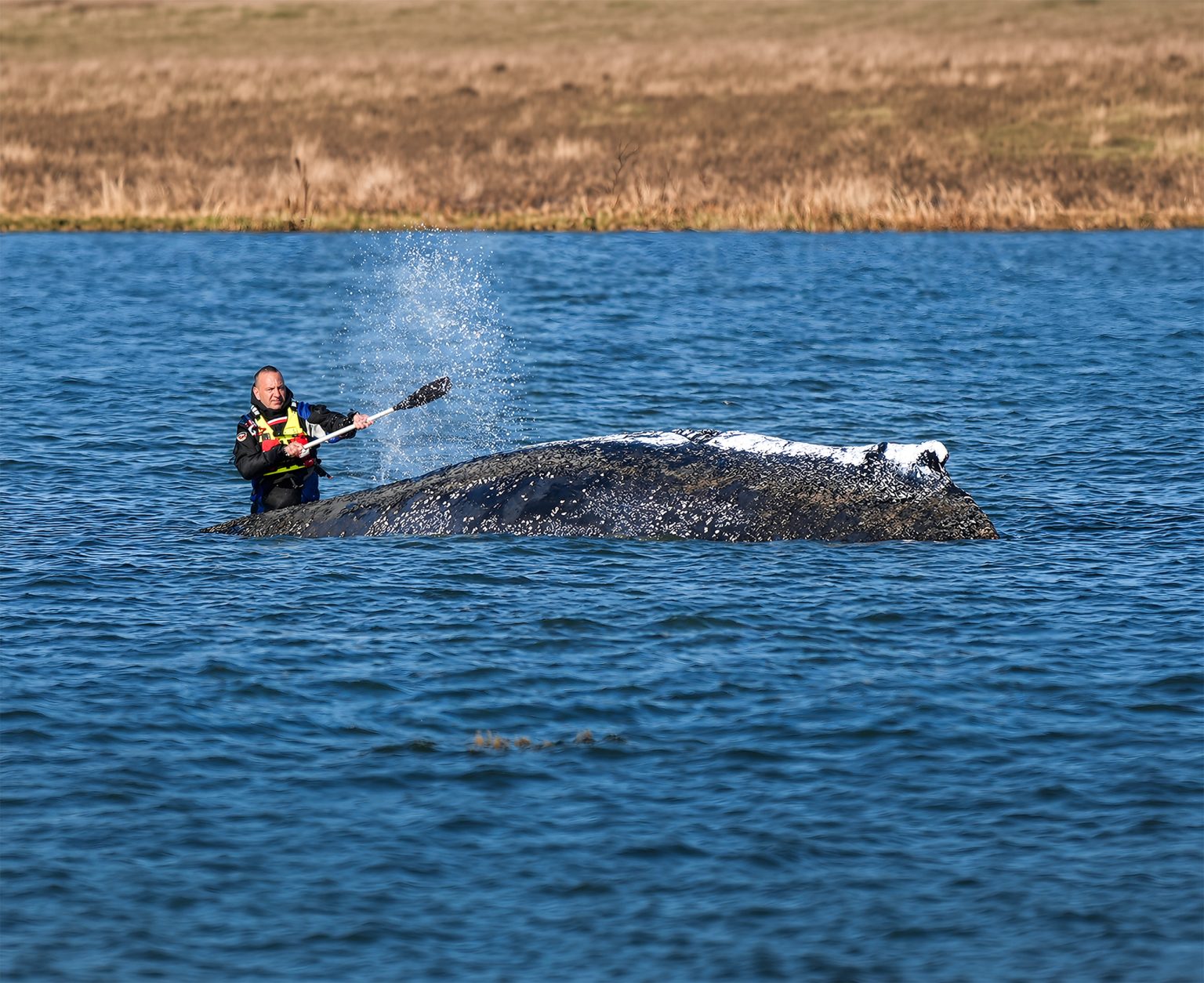
The drama began without much fanfare on 3 March. It was a sunny Tuesday when a whale was spotted in the harbor of the Baltic Sea city of Wismar. In itself, that is nothing extraordinary. Such incidents occur when whales follow shoals of herring from the North Sea into the Baltic.
Wandering through the harbor, the animal became entangled in a net, from which it was freed by the maritime police before swimming back into open water. Further west, somewhere in the Bay of Lübeck, the whale became caught again, this time in another net, the remains of which were removed by helpers from a conservation organization.
From Incident to Spectacle
Whether the marine mammal lost its bearings under the strain, was already weakened or simply disoriented remains unclear. On 23 March, the whale finally stranded at Timmendorfer Strand, just north of Lübeck, marking the first peak in media coverage.
From then on, the animal dominated headlines, particularly in the tabloid press, which named it “Timmy” after the site of its stranding. The media frenzy spilled into online hysteria, increasingly drawing in politicians, experts and would-be rescuers. What began as concern over a stray whale had become a full-blown media spectacle.
In an attempt to free the animal from its predicament, excavators dug a channel intended to allow it to reach open water again. In fact, it managed to leave the sandbank on its own. Had it only swum back into the North Sea.
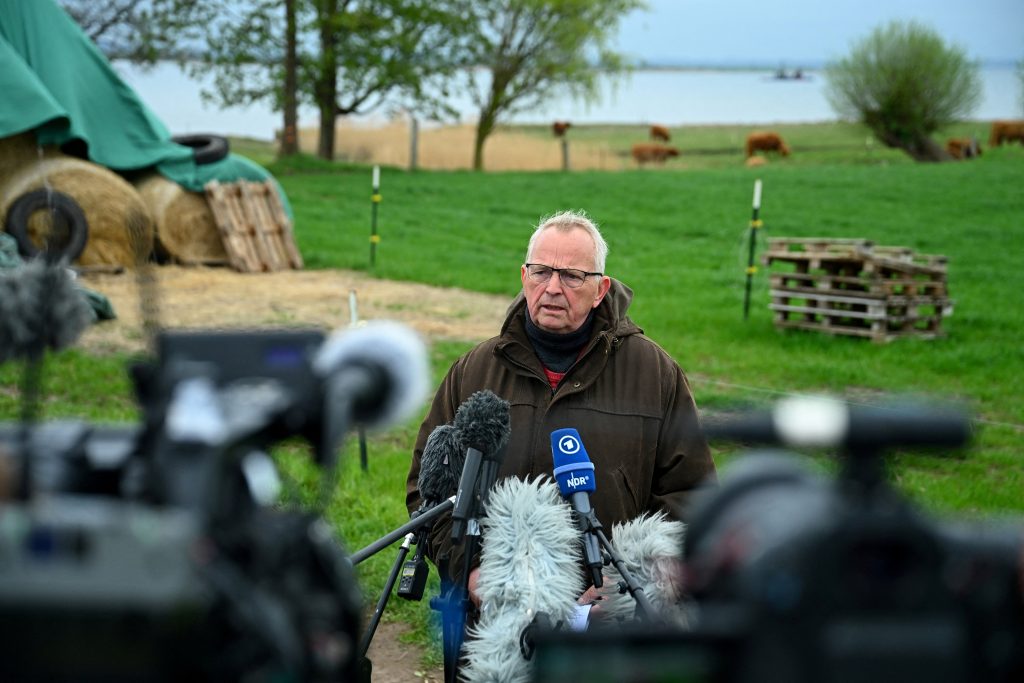
But it did not. And that is when the drama truly began. On 31 March, the whale again sought shallow waters, this time off the island of Poel, north of Wismar. At a press conference on 1 April that at times bordered on the embarrassing, Mecklenburg-Western Pomerania’s responsible minister, Till Backhaus (SPD), declared that “this is a very emotional day”. He looked into the cameras as though announcing the greatest natural disaster in decades.
What followed over the next few minutes was a sentimental political melodrama of the highest order. Instead of providing sober information, Backhaus wallowed in emotion and sentimentality. In the worst kind of therapeutic and coaching jargon, the minister declared: “We then motivated him (the whale).” For the animal, it had been a feat of strength: “I have absolute respect for this animal”, Backhaus said, wearing an expression as though he had just encountered Mother Teresa.
Anyone who believed the press conference had reached its intellectual low point was mistaken. To make clear how personally involved he felt and how close a connection he believed he had developed with the stranded animal, the minister added: “I begged him, all of us did, to set off, and he did – voluntarily, and we were no longer involved.” Yet the ministerial invocation proved short-lived. Just hours later, the whale was stranded again.
From Spectacle to Escalation
For a brief moment, reason appeared to return to the public debate. A decision was made to leave the animal alone and refrain from further rescue attempts. But by then it was too late. On social media, a mob of influencers and fundamentalist animal activists had formed, threatening Backhaus and attacking veterinarians and marine biologists involved in the case. Daily demonstrations were held in Wismar’s harbor.
In such moments of overheated media attention, a wealthy private rescuer is rarely far away. This case was no exception. An initiative led by multimillionaire Walter Gunz and the former harness racing driver and entrepreneur’s wife Karin Walter-Mommert proposed freeing the animal by creating a water channel. The operation was approved. International experts were flown in. Construction materials were shipped. Workers began removing silt beneath the whale. Then, aided by a storm system, the water level rose naturally to such an extent that the colossus was able to free itself, only to become stranded again a few kilometers later.
The whale has now occupied the German and international public for more than seven weeks. The New York Times wrote with gentle irony: “The Long, Slow Race to Save Timmy, Germany’s Favorite Whale”. The Guardian, with characteristic restraint, observed: “Stranded and dying, the German whale is a parable of our troubled relationship with these sea giants”.
Numbers Against Sentiment
Indeed, Germany’s relationship with whales is troubled, to put it mildly. More bluntly, not only our relationship with large marine mammals but our attitude toward animals in general and nature as a whole is profoundly neurotic. To understand this, a few figures suffice. According to official estimates, there are between 80,000 and 120,000 humpback whales worldwide, including up to 15,000 in the North Atlantic. Humpback whales are not endangered. Whether “Timmy” survives or not is, from an ecological perspective, entirely irrelevant. Given a natural mortality rate of 2%–3%, about 3,000 humpback whales die each year. Timmy will be one of them. That is the course of nature.
What has happened to the humpback whale in the Baltic is something that has occurred time and again for millions of years. Individual animals or even entire groups stray, even without fishing nets, artificial underwater noise or human interference. Sooner or later, they strand and die. There is nothing tragic or unusual about it. It is called nature.
The uproar surrounding the whale is therefore more than merely irrational. It becomes downright absurd when one considers that, in the European Union, around 23 million cattle, 225 million pigs and an estimated six billion chickens are slaughtered each year - figures that might strike even those not prone to excessive sentimentality toward animals as perverse. Yet a dying humpback whale moves people deeply, while they sit in front of the television eating their sandwiches without a second thought.

A Politically Useful Whale
This contradiction is possible only because the whale’s admirers are not truly concerned with the animal itself. Timmy is a symbol, the mascot of a civilization largely alienated from nature. In contemporary debates, nature appears only as something under threat, as a construct of a technologized society that seriously believes it can either destroy or save it. In reality, “nature” can neither be saved nor destroyed. At most, we can destroy ourselves. Yet even we are merely part of nature, and not even the most important part.
The whale clearly serves as a projection surface for a society that has lost any genuine relationship with nature. The hype surrounding the animal is simply another indication that we have forgotten any natural way of dealing with the natural world, much like “Knut”, the polar bear from Berlin Zoo, whose death in 2011 was mourned so intensely that he was preserved as a taxidermy exhibit in Berlin’s Museum of Natural History. The polar bear was dead, a national tragedy.
Or more recently, the baby macaque “Punch” in Ichikawa. Rejected by its mother, it is now embraced by social media and comforted with a stuffed orangutan as a surrogate. Even Deutsche Welle ran the headline: “Hang in there, Punch!”
Instead of accepting animals for what they are, they are symbolically elevated, sentimentalized and ultimately turned into kitsch fetishes in a society already inclined toward infantilism. Fetishes, however, carry desires and values – in other words, ideology. In the case of the whale, that ideology oscillates between naive romanticization of nature and misanthropy. Everything natural is elevated, regarded as good and pure. Humans, by contrast, appear as the evil and destructive force that brings only death and ruin into the supposed paradise of nature. That nature itself is deeply destructive, while the profoundly human nature of animal welfare is entirely ignored.
With so much irrationality, political activists are never far away. Commentators on the left see in the uproar surrounding the whale evidence of right-wing thinking that cares about a sick animal while 900 migrants have already drowned in the Mediterranean this year. On the right, others suspect that the hype is the result of lobbying by environmental groups and the influence of Greenpeace and similar organizations. At the very least, there is a striking closeness between environmental organizations and politics.
Yet it is not only the ideological charge of the debate and the considerable influence of non-governmental organizations that make the farce surrounding the whale a symbol. The animal’s own odyssey also recalls Germany itself: drifting, unable to find a way out of crisis, receiving help from outside and becoming stuck again. Perhaps many Germans sense, at some unconscious level, that the fate of the animal could one day be theirs as well. That may offer a deeper psychological explanation for the intensity of the reaction.