

For the first time in a long time, oil prices have staged a more substantial rally. Even Trump's announcement of an indefinite ceasefire, intended to allow Iran to consolidate its political position and give its negotiators stronger domestic backing, has not been enough to hold prices down. So why are oil prices rising if the ceasefire is supposed to pave the way for a peace agreement?
The Longer the Blockade, the Higher the Stakes
Much of the responsibility lies with the White House's own tactics. Trump's handling of the conflict follows the classic negotiating playbook: he wants Iran to be the one that blinks first and requests peace talks, giving him a clear media narrative that America has won.
The problem is that even during this pressure game, the Strait of Hormuz remains closed. The number of ships passing through has not exceeded 10 per day. The economic toll of restricting this commercial artery grows with each passing day — though that, too, is part of the broader negotiating calculus.
Trump cannot simply wait for Iran to capitulate. He must apply pressure from other directions, most visibly through military preparation for a possible ground operation — a prospect that would be extraordinarily complex and difficult. The US president knows he cannot afford to wait indefinitely.
A blockade lasting another month or two would be damaging across the board, but Trump alone faces the added pressure of the electoral clock. US markets still treat the Iran crisis as a temporary disruption that will eventually resolve itself, but that does not rule out partial reversals and further rises in oil prices along the way.

Reading Between the Lines
The Iran crisis has not been enough to derail Wall Street entirely. Earnings season has begun, and the first major set of numbers came from a tech giant with the power to move markets: Tesla.
On the face of it, the quarter looked strong. First-quarter sales rose 16% year on year to $22.4bn, and earnings per share came in at 41 cents, comfortably ahead of analyst estimates of 36 cents. Free cash flow jumped unexpectedly to $1.4bn — a figure that, on its own, would seem to put paid to the narrative that Tesla simply burns through cash. And yet the stock fell more than 3.6% after the results were published.
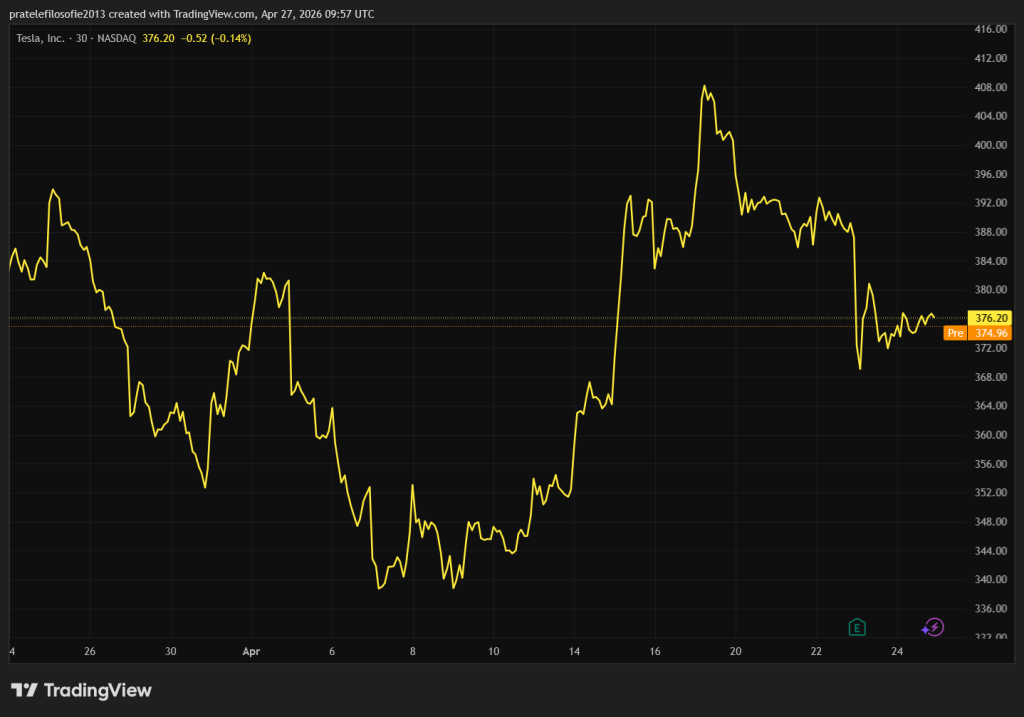
The market had several objections. That headline revenue growth looks impressive largely because it is measured against a weak first quarter last year. Earnings, meanwhile, were flattered by one-off accounting items — duty drawbacks and warranty accounting adjustments — worth around $480m. And that cash flow figure? It was achieved by extending supplier payment terms from 61 to 71 days. Tesla did not solve the problem; it rescheduled it.
Markets might have been willing to overlook Musk's accounting maneuvers. What has made them genuinely uncomfortable is his persistent disregard for deadlines. Tesla's growth narrative rests above all on Robotaxi. The service was supposed to be sweeping America as early as last summer. Instead, the number of test cities has grown from one to three, with Dallas and Houston joining Austin, but the service remains a loss-making trial. Musk compounded investor frustration with an unusually candid admission that Robotaxi will not contribute meaningfully to earnings growth until 2027.
Then there is the Optimus Gen 3. The third-generation robot has already slipped from late 2025 to the first quarter of 2026, and now looks uncertain even within this year. This from the man who once promised annual production of at least 10,000 robots by 2025. Analysts also took a dim view of the increase in capital expenditure, from the originally announced $20bn to $25bn, as Tesla seeks to hold its position in the artificial intelligence race.
Musk kept one final card in reserve, and it set Wall Street talking immediately: the possibility of a closer integration between Tesla and his space company SpaceX. Some fans see this as the blueprint for an ultimate tech empire. Not all Tesla investors share that view, however, particularly given the significant dilution of existing shares that any such move would involve.
The results, taken as a whole, did not fundamentally alter the investment case for the stock. That case continues to rest on a single premise: that Musk will achieve the impossible and that he remains the defining technological visionary of our time.
A European Bright Spot in Semiconductors
Not all the economic news this week has been gloomy. Europe, in particular, has reason to celebrate, especially in the semiconductor sector, where the continent has otherwise been slow to make its mark.
French company Soitec has made a spectacular return to the spotlight. Its shares have risen by around 200% since the start of this year alone. The driving force is a single word: photonics. The field concerns itself with light — its creation, propagation, control and application — and encompasses lasers, fibre optics, LED and imaging technologies, sensors and cameras, and quantum technologies.
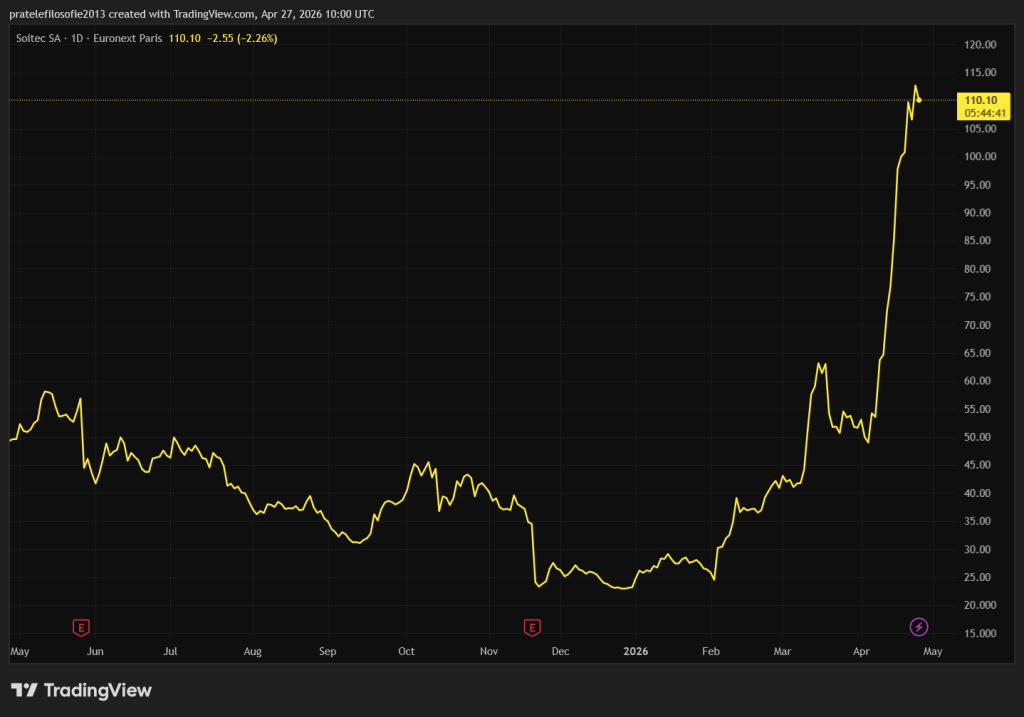
Soitec's traditional markets in smartphones and automotive had stagnated in recent years, and 2024 and 2025 were difficult as a result. But the tide has turned. After a period of intense investor focus on memory chip businesses, attention is now shifting to the next major theme in artificial intelligence: the physical infrastructure needed to move data at the speed AI demands.
Processor and memory performance is increasingly bottlenecked by data transfer speeds, and the answer lies in bringing optical fibre technology as close to the chips as possible. Soitec produces the key substrate that enables this. In doing so, it has given not just the Paris stock exchange but effectively the whole of Europe a strategically critical player in one of technology's most important emerging fields.

Iran, the Fed and Big Tech: What to Watch
Little relief is in sight for investors next week. The Fed meets to decide on interest rates, the Iran crisis continues to set the tone for energy markets, and results from Alphabet, Microsoft, Amazon and Meta will keep earnings season firmly in focus. It promises to be a full week.
Geopolitical tensions keep oil prices elevated and Tesla has once again fallen short on deadlines. Soitec, meanwhile, is putting Europe's semiconductor sector back on the map. Markets now turn their attention to the Fed.