

Last month, farmers and truckers took to the streets of Ireland to protest against the huge increase in fuel prices caused by the war in Iran. They wanted the government to reduce the colossal taxes it imposes on fuel.
The protesters took over O’Connell Street, Dublin’s main city center thoroughfare. They blocked highways. They even blockaded the country’s only oil refinery. Hundreds of petrol stations ran out of fuel. The government’s response was not even to talk to them because the protests were not official strikes. The justice minister threatened to call in the army.
But despite the huge disruption caused by the protests, a clear majority of voters, 56% according to one major poll, supported them. Eventually, the government was forced to placate both the protesters and the general public by cutting excise duties on fuel.
The Irish protests were reminiscent of what has happened in other parts of Europe, including France, Poland and the Netherlands, and like them had farmers at their heart.

A Liberal Elite That No Longer Listens
The response of the technocratic liberal elite is to look upon such protesters with horror. That is precisely how the Irish government reacted at first, until it was forced into a corner by the public mood.
As a result of the protests, populist parties in Ireland have risen further in the polls, in particular a rural-based party called Independent Ireland, which is something like the Farmer-Citizen Movement (BBB) in the Netherlands. Aontu, led by a politician who broke away from the nationalist, pro-IRA Sinn Fein, is also benefiting.
In Ireland, as elsewhere in Europe, a growing part of the electorate is increasingly dissatisfied with the liberal, managerial consensus embodied by people such as France’s Emmanuel Macron, previously by Germany’s Angela Merkel, and above all by technocratic, supranational, broadly liberal institutions such as the EU, the World Trade Organization (WTO), the World Bank, the UN and so on.
That consensus believes in high immigration, expensive green policies, social liberalism and the gradual erosion of national sovereignty. It claims to believe in the rule of law, but voters see that the institutions in charge of the rule of law are run by other liberals. This smug consensus is at its most smug and elitist at the annual Davos conference in Switzerland organized by the World Economic Forum.
The Liberal Critic of Liberalism
A man extremely familiar with the world of technocratic, managerial liberalism is Adrian Wooldridge because he worked for The Economist magazine for years. The Economist is a major cheerleader for technocratic liberalism. Wooldridge now works for Bloomberg and is the author of a new and extremely important book, Centrists of the World Unite! The Lost Genius of Liberalism.
Wooldridge is himself a liberal, but a somewhat disappointed and disillusioned one because he can clearly see how the liberal elite to which he belongs has cut itself off from the concerns of tens of millions of voters. He also sees how it regards some of those concerns, about high immigration for instance, as unacceptable, unreasonable and often bigoted.
Wooldridge condemns populists such as Donald Trump and Boris Johnson, and he means it. They genuinely appal him. But what also appals him is today’s liberals.
For instance, he can see how liberal institutions and liberal politicians have pandered to woke ideologies such as transgenderism and the woke tendency to divide the world into oppressors and oppressed.
Campus Liberalism Ties Itself in Knots
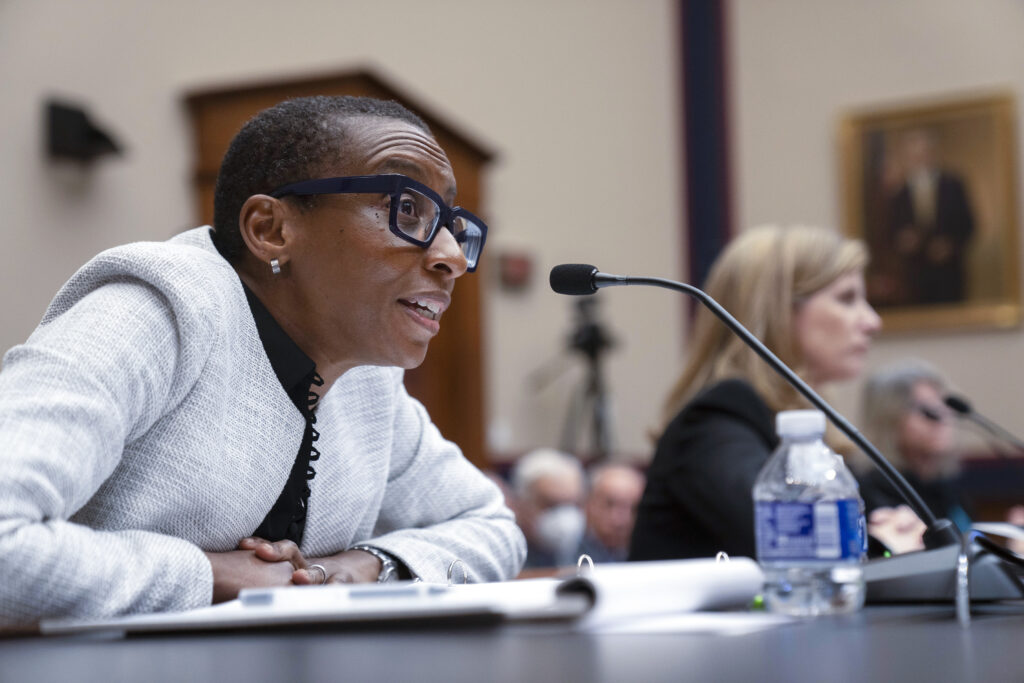
He gives a telling example. In December 2023, the presidents of three of America’s most elite universities, Claudine Gay of Harvard University, M. Elizabeth Magill of the University of Pennsylvania and Sally Kornbluth of the Massachusetts Institute of Technology (MIT), appeared before the House of Representatives Committee on Education and the Workforce. Congresswoman Elise Stefanik asked them: “Does calling for the genocide of Jewish people violate [your university’s] code of conduct or rules regarding bullying and harassment? Yes, or No?”
The three women could not give a straightforward answer. “It depends on context”, Kornbluth said. Gay and Magill gave similar responses.
They tied themselves up in knots because they did not want to get into trouble with hard-left students and faculty. You must remember that the exchange took place only a few months after the 7 October attack by Hamas on Israel.
Wooldridge writes that the “success of liberals in turning themselves into the establishment is hard to overstate”. He shows how “They ooze from one job to another – one moment they are leaning left as heads of Ivy League universities and the next they are sitting on the board of rapacious banks”, among which he includes Goldman Sachs.
The Comfort of Supranational Power
In Ireland, one of our most senior politicians recently stood down as finance minister to take up a big job at the World Bank. When ordinary voters see politicians leave a very important role in their own country for a more lucrative, more comfortable job at a supranational institution, they become more disillusioned. Why do liberals love supranational bodies so much? Is their own country not enough for them?
This kind of elitism is alienating voters from their rulers and rulers from their voters. But one group is still largely in charge, namely the liberals, either in government or through their control of supranational institutions. For the most part, the populists are still trying to be heard, as during the recent fuel protests in Ireland.
Wooldridge is rightly scared that populism can too easily shade into authoritarianism and demagoguery. That is why he wants liberalism to become a better version of itself, for instance by listening to voters’ concerns about high immigration and the excesses of wokeism.
He wants liberals to be less elitist and to come down from their ivory-tower world of supranational bodies and Davos conferences.

Bad at the Job They Claim to Do Best
I would add that managerial liberals have also become bad at the very thing they are supposed to be good at, namely governing. Would you say that countries such as Germany and France are very well managed? Far from it. For its part, Ireland is rich only because of the huge amounts of corporate tax it receives from the gigantic American multinationals based in the country. Ordinary Irish people, like people elsewhere, are under massive cost-of-living pressures and cannot understand why Ireland is called rich.
The liberal establishment looks aghast at the rise of populism. Its reaction remains disdainful and, frankly, snobbish, and people know when they are being looked down on. But what the liberal establishment needs to understand is that its own arrogance, ideological blind spots and managerial incompetence have driven the rise of populism.
The funny thing is that, for all their pretensions to intellectual superiority, liberals are often too stupid to see this.