

It is no secret that markets have been very optimistic about a solution to the Iran crisis since the conflict began. Wall Street’s basic calculation is that US President Donald Trump does not like to lose.
If he wants to keep alive the hope of a good result in the November elections, he needs to pull out of the conflict as quickly as possible, before the economic consequences become so severe that his already diminished voter base starts to crumble. This week brought reports that the US and Iran are close to a deal.
Fragile Optimism About Iran
Markets reacted as if peace had already been made at Trump’s Mar-a-Lago residence. Given the circumstances, that response looks overdone. A sober view, however, can still remain optimistic.
The main shift would be that the current ceasefire would open another window for talks focused on a final peace agreement. It is therefore another important stage in the negotiations.
If the bellicose rhetoric on both sides is set aside, the signal is positive because it shows that talks are moving at a healthy pace. They are not proceeding so quickly that agreements are stitched together in haste and the parties are given an excuse to break them. At the same time, the situation is not deadlocked, but slowly evolving. In any case, that is good news.

A Storm on Steroids
The problem is that the good news has arrived just as markets are being swept up by another wave of artificial intelligence euphoria. Earnings from the Magnificent Seven showed that huge investment will continue to flow into data centers. Investors have therefore renewed their interest in anything related to AI infrastructure.
Chipmaker Intel surged after its latest earnings. Its stock jumped by a staggering 23% in a single day last week. The rally did not stop there. Intel easily surpassed the $110 mark, adding another 36% in just a few days.
The climb was helped by speculation that Apple and Samsung were considering using Intel to produce chips on American soil. Over the past month, the stock has therefore gained a remarkable 113%. Intel, meanwhile, is not some hopeful start-up, but a colossal technology giant, which makes the move extraordinary. Donald Trump, and with him the entire White House, are celebrating. Ironically, Intel was also helped by results released this week from rival Advanced Micro Devices (AMD).
AMD’s numbers confirmed exactly what the market had already partly priced in with Intel: an absolute explosion in demand for AI hardware even beyond the dominant Nvidia. AMD’s revenue soared to $10.3bn, up 38%, while its key data center segment accelerated by a strong 57% year on year.
Chief Executive Lisa Su also impressed investors with a massive forecast. According to her, the market for AI data center processors will grow by 35% a year and reach $120bn by 2030. No wonder AMD stock immediately shot up 18%, with the company now confidently moving towards a market capitalization of $600bn and leaving even old giants such as Exxon Mobil behind.
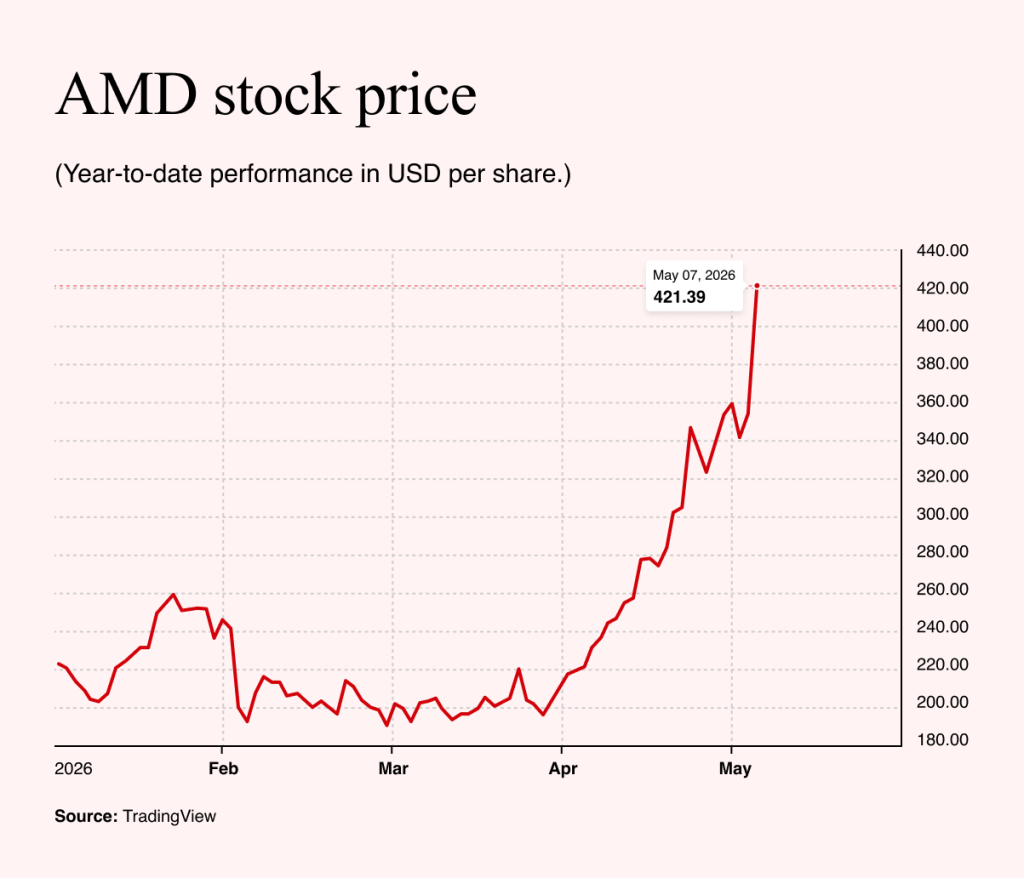
All of this points to one fundamental and predictable development. Nvidia simply could not maintain its gigantic technological lead and the associated $194bn in revenue for years to come. Customers from Meta to OpenAI are aggressively diversifying their supply chains, and competitors are inevitably catching up with the market leader.
Artificial intelligence is a dynamic field in which yesterday’s hegemony can turn into a fierce battle for market share tomorrow. It is worth recalling how, just a year ago, OpenAI seemed to rule unchallenged, while many assumed that Google, with its Gemini model, had already missed the train and would never recover the lost ground. Today, the cards are being reshuffled on a massive scale. In the coming months, the hardware chip market is likely to see the same tug-of-war that is now visible among language models.
The celebrations have spilled over from Wall Street to Japan. The Nikkei had one of its best trading sessions of the year from Wednesday to Thursday, gaining more than 5.66%. Much of the credit goes to the rise of Japan’s SoftBank, which jumped 18%. The company is one of the biggest investors in AI infrastructure and related technologies.
If the construction of data centers is completed and the facilities later become profitable, its shareholders can look forward to a large return on investment. The AI boom and the shift in Iran-US relations have therefore helped stock markets set new records. Trump, at least as far as the markets are concerned, can be satisfied.
But are the celebrations premature?
The Threat of Hidden Inflation
Although oil prices have fallen significantly, they are still far from pre-war levels. The Strait of Hormuz has been closed for some time, and many economists and geopolitical analysts have recently pointed out that far more than oil and gas is transported through it.
The Gulf States have turned heavily to energy-intensive aluminum production in an effort to diversify their industries and make use of cheap energy. Much of the world’s production of the metal is therefore now paralyzed.
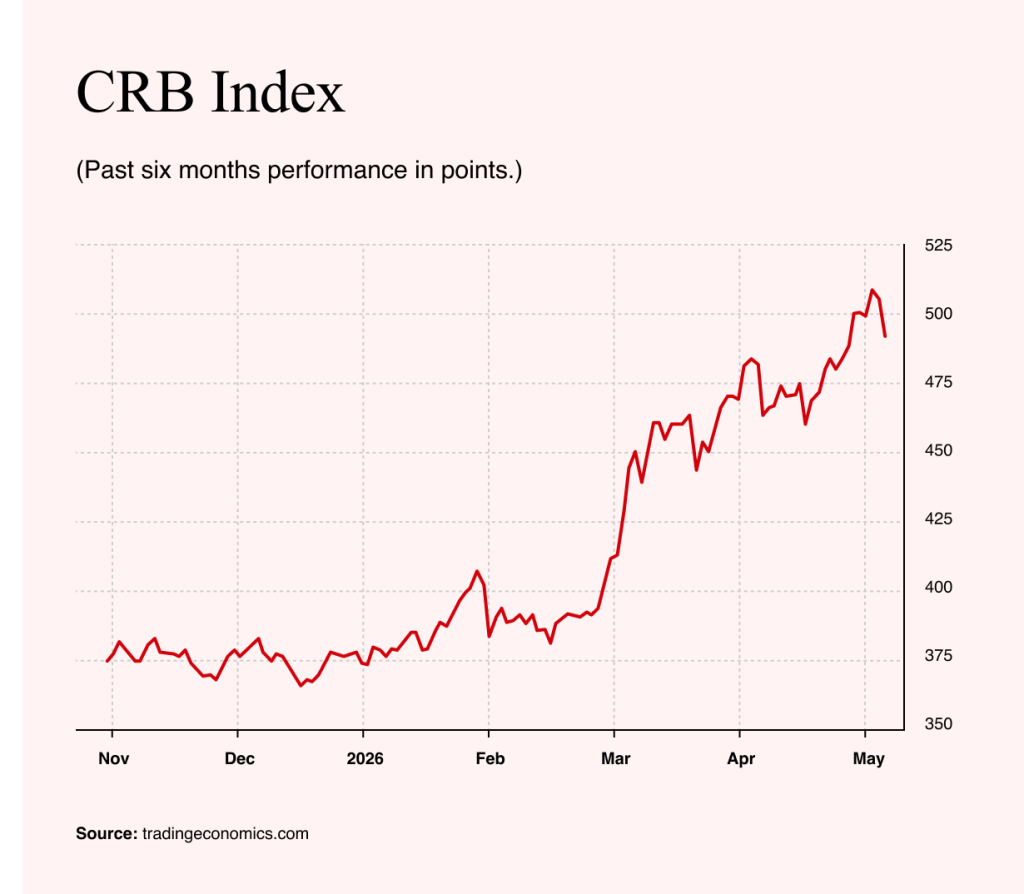
Price shocks are also being reflected in other commodities, as the development of the so-called Commodity Research Bureau (CRB) Index clearly shows. This key commodity benchmark does not contain just one commodity, but tracks and averages the prices of a basket of up to 19 different raw materials, from energy, which accounts for 39%, and agriculture, which accounts for 41%, to industrial and precious metals.
Despite a slight decline in recent days, its value has risen by roughly 30% since the start of the crisis. The world economy will therefore have to cope with the next wave of inflation, whether the Strait of Hormuz reopens or not.
The party in financial markets could end at any time once the full bill for the Iran war lands on the table.