
Britain's difficulties run deeper than politics or economics. In some respects, the country is tracing a path already taken by the United States, one marked by a more fundamental social exhaustion. Trump's first election was a symptom of a society that had lost faith in ordinary remedies, turning to a radical savior instead. Britain, which observed that moment with puzzlement, is beginning to recognize something of itself in it.
Growth in All the Wrong Places
One statistic captures the erosion of a society's internal strength more plainly than most: the annual number of abortions. In the UK, what stands out is not the figure itself but the speed at which it is rising.
In 2022, England and Wales recorded 251,377 abortions among resident women, the highest number since the Abortion Act was passed in 1967 and a 17% increase on the previous year. The age-standardized rate stood at 21.1 per 1,000 women aged 15 to 44, also an all-time high. The rise was not simply a function of a growing female population of reproductive age. The rate itself was climbing.
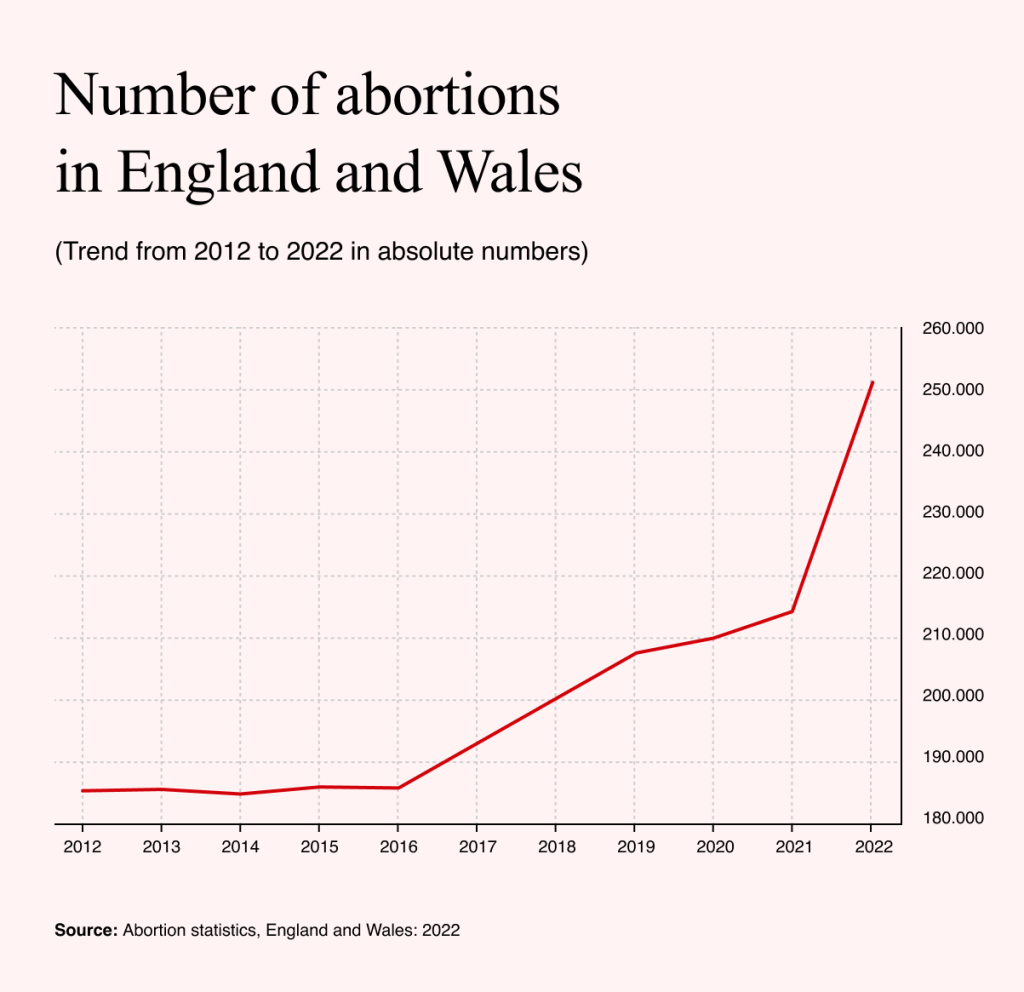
By 2024, the total number of abortions in the UK is estimated to have reached between 300,000 and 305,000. Figures drawn from Scotland, Northern Ireland and the annual reports of the main abortion care providers suggest 2022 was not an anomaly but the start of a new direction. The rate stands at around 22 per 1,000 women of reproductive age, with approximately 46.6 abortions per 100 live births.
Roughly one in three viable pregnancies in Britain now ends in abortion. This is not Russia in the 1990s, Ireland in the first years after legalization or a poor country where abortion fills the gap left by unaffordable contraception. Britain is a wealthy Western society with a national health system, a well-developed welfare state and a long tradition of liberal reproductive policy. That context is precisely what makes the trend so significant.

A Perfect Storm of Cost, Cuts and Convenience
The conditions have been building for a decade. The cost of living has risen. Housing and childcare have become more expensive. Spending on contraception and counseling has been cut. And abortion itself has become considerably simpler: medication that once required a clinic visit can now be taken at home. By 2022, 86% of abortions in England and Wales were medication-based, and in 61% of cases the woman took both drugs used in the procedure at home.
It is a shift of civilizational significance: from institution to home, from medical procedure to private event. What was once a medical encounter involving direct contact with the health system has become, in the majority of cases, a solitary experience: pills, instructions, waiting and, when it is done, a resumption of the normal day.
The economic backdrop is inseparable from the procedural one. Since 2017, the UK government's two-child limit has restricted welfare benefit eligibility for third and subsequent children. For many families, the signal was unambiguous: an additional child is a financial risk the state will not help to carry.
This is not a teenage pregnancy story. Abortion rates among girls under 18 had been falling for years, and though they edged up slightly in 2022, they do not account for the overall rise. The growth is concentrated among adult women, many of them already mothers.
Increasingly, this is not a young woman's first unplanned pregnancy. It is an additional pregnancy experienced by a woman who already knows what a child means in practice: what rent and nursery fees cost, what a loss of income does to a household, how fragile both partnership and employment can be. It is that knowledge, not ignorance, that leads to the conclusion that another child is not a source of hope but a risk she cannot take.
Where a woman lives in Britain turns out to matter considerably. In 2022, the abortion rate in England's most deprived areas was 28.9 per 1,000 women; in the wealthiest areas, 14.7. Women in the poorest decile were almost twice as likely to have an abortion as those in the richest. Abortion is framed in policy and public debate as a matter of individual choice. The decision may be individual. The pressures behind it are not.

When Hope Becomes Unaffordable
Abortion is not only a culture war issue. It is also an indicator of confidence in one's own future. It is also an indicator of whether a society believes in its own future. When women terminate pregnancies not out of ideology but because another child is economically, practically or psychologically unaffordable, the data is telling us something about the family, about work, about housing, about the welfare state and about the presence or absence of hope.
Britain is not simply following the Western demographic pattern. Falling birth rates, delayed motherhood, smaller families: these are common across Europe. What is less common is a simultaneous sharp rise in abortions. That combination points to pregnancies experienced not as a path to family life but as a problem to be resolved. A society having fewer children is one thing. A society in which a child has become an unwelcome prospect is another.
What is most troubling about Britain's abortion figures is not the number itself. It is the degree to which abortion has been absorbed into the ordinary fabric of life. The state funds it, independent providers deliver it, the post carries the medication and the statistics log the result. The process is efficient, discreet and increasingly unremarkable. Behind the figure of 300,000, therefore, the question is not only whether a woman has the right to make decisions about her own body.
The deeper question is not about reproductive rights. It is about why, in one of the richest countries in Europe, so many women have concluded that a child is not a future but a risk they cannot carry.