
Ukraine is already arguing about the country it will become after the war.
Russia’s full-scale invasion has killed soldiers and civilians, driven millions of people abroad and deepened a demographic crisis that began long before 2022. When the fighting ends, Ukraine will need workers to rebuild homes, roads, factories, farms and entire towns.
The harder question is political. If those workers cannot be found at home, should Ukraine bring them in from abroad?
For business groups and labor-market experts, the debate is increasingly practical. Ukraine faces a shortage of several million workers, and some employers have begun to explore recruitment from Asia, Africa and other regions.
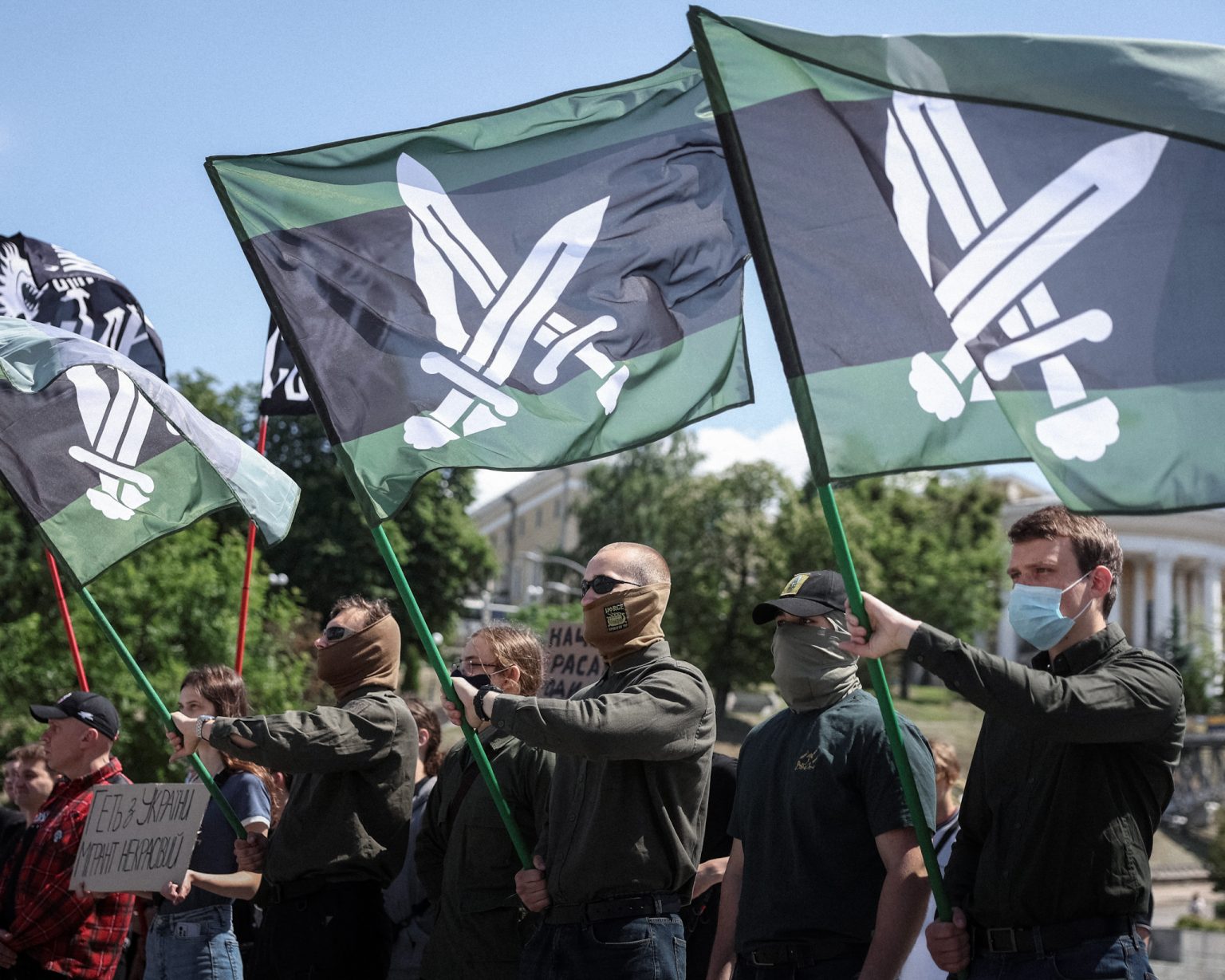
For right-wing activists, parts of the military and a number of politicians, however, the same debate raises a more explosive fear: that Ukraine could win the war and still lose part of its national character.
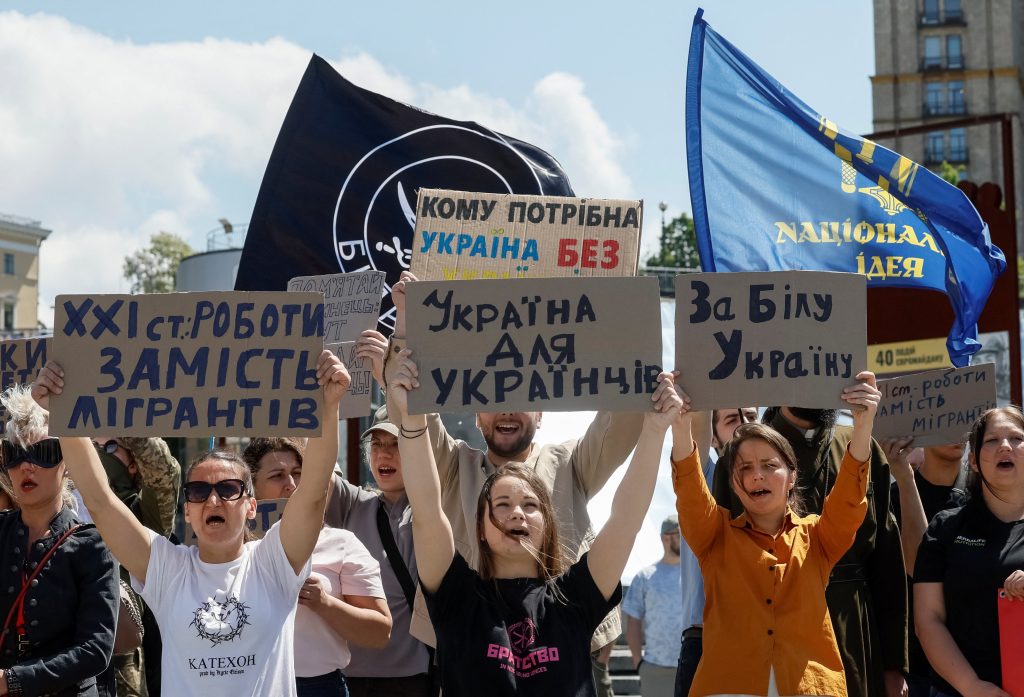
That tension produced small protests in Kyiv and several other cities on 23 May. The rallies were not large, but they showed how quickly a technical discussion about labor shortages can turn into a broader argument about identity, sovereignty and the future of a country at war.
A Shortage Measured in Millions
Ukraine’s labor problem is not theoretical. Mobilization has removed large numbers of men from the workforce. Millions of Ukrainians, many of them women and children, have spent years abroad. Birth rates have fallen sharply, and businesses in sectors such as construction, agriculture and manufacturing are already struggling to find staff.
Several estimates suggest that the country could face a shortage of several million workers after the war. Vasyl Voskoboynyk, president of the All-Ukrainian Association of International Employment Agencies, has cited forecasts of a gap of about 8.6 million to 8.7 million workers. Ukraine’s economy ministry has previously estimated that the country would need at least 4.6 million additional workers to sustain annual economic growth of about 7%.
Those figures do not mean that Ukraine plans to import millions of migrants. Voskoboynyk himself has argued that a massive influx of foreign workers is unlikely, partly because Germany, Poland, Czechia and other European countries will also be competing for labor.
Even so, the discussion has moved from theory to practice. Ukrainian media have reported that experts and employers are talking about the need for hundreds of thousands of foreign workers a year.
In 2025, however, the actual number remained tiny. Employers in Ukraine received 7,483 work permits for foreign workers and extended another 2,099, a total of about 9,600 permits.
Budanov Enters the Debate
The issue reached a higher political level in April, when Kyrylo Budanov, President Volodymyr Zelensky’s chief of staff and the former head of Ukraine’s military intelligence service, discussed the list of countries whose citizens face additional checks when entering or regularizing their stay in Ukraine.
After a meeting on relations with African countries, Budanov said Ukraine’s foreign ministry and Security Service had been instructed to examine possible changes to the list of so-called migration risk countries. The list includes 70 states, many of them in Asia and Africa, such as Afghanistan, Bangladesh, Nigeria, Ethiopia and Pakistan.
Budanov linked the strict approach partly to illegal migration risks, saying some foreigners enter Ukraine, receive documents and then leave their employers or use the country as a transit route toward the European Union.
Business representatives see the same system from the opposite angle. They argue that the rules are slow, costly and make it harder to fill labor shortages. For critics, however, any easing of those rules looks like the first step toward a larger migration policy that has not been openly debated.

From Panic to Politics
Budanov also warned that the online debate had become distorted. Speaking at a strategic communications forum in Kyiv on 21 May, he said claims about a migrant crisis had created an “alternative reality”. Ukrainians were not a people who hated foreigners or wanted no outsiders ever to enter the country, he argued. What was “very dangerous”, he warned, was the spread of that narrative.
That warning matters because Ukraine is also fighting an information war. Russian propaganda has long sought to exploit social tension inside the country. The migration issue offers obvious material: fear of job losses, anxiety over demographic change and anger at elites who appear to be planning Ukraine’s future while soldiers are still dying at the front.
But it would be too simple to dismiss the backlash as a Russian information operation. Some of the strongest opposition has come from people and groups that are fiercely anti-Russian and closely linked to Ukraine’s wartime nationalist scene.
On 1 May, the Times of Ukraine published a 15-minute interview with Lt Col Maksym Zhorin, deputy commander of the 3rd Army Corps, led by Brig Gen Andriy Biletsky, the founder and first commander of the Azov unit.
Zhorin rejected the idea that Ukraine should respond to its demographic crisis through large-scale migration from culturally distant countries.
“This exchange of the Ukrainian nation will happen through cultural groups that are very different from us. Namely mentally, culturally, ethnically… If we want Ukraine to cease to exist, then we can bring anyone here. But then what are we fighting for? What are we fighting for then? For a country for Filipinos or Indians? That’s a bit strange”, he said.
He described Voskoboynyk’s comments about ethnic mixing as a crime and warned of unrest if the state pursued mass immigration. Instead, he suggested that President Volodymyr Zelensky should recruit more foreigners into the army, thereby sparing Ukrainian soldiers.
Others in the nationalist military scene have made similar arguments. Maj Dmytro Kucharchuk, another deputy to Biletsky, has spoken against what he calls a “population exchange”. Olexiy Reyns, one of the main ideologues of contemporary Ukrainian nationalism, known by the fighting name Consul, has also taken up the issue, as have Right Sector and other nationalist groups.
The language in some nationalist channels is far sharper than the public policy debate. One Telegram channel described migration plans as a “hybrid genocide of the European nation”. Another military figure said Ukraine without Ukrainians would be merely a piece of land and warned against importing foreigners if Kyiv wanted to avoid racial conflict.
Such rhetoric reveals a real political fault line. For parts of Ukraine’s nationalist and military milieu, the war is not only a fight for borders. It is a fight for the survival of a particular national community.
A Dangerous Phrase
Ukrainian nationalists often describe the prospect of mass immigration as an “exchange” or “great replacement”. The language is associated internationally with the French writer Renaud Camus and with theories alleging the deliberate replacement or dilution of European populations through immigration. Critics widely describe those theories as conspiratorial.
In Ukraine, however, the term enters a different environment from Western Europe. The country is fighting a war of national survival, and many of those using the language of replacement are not detached observers, but veterans, soldiers or activists connected to movements that became prominent after 2014 and again after Russia’s full-scale invasion.
That explains why the migration debate in Ukraine cannot be read simply as another imported culture-war argument. Demographic anxiety, wartime sacrifice and national identity are now tightly linked.
The controversy intensified after reports that Voskoboynyk had spoken of future Ukrainians as “mixed” families involving Ukrainians and migrants from countries such as India or Bangladesh. He also stressed that the central issue was whether newcomers obeyed the law, paid taxes and gradually became part of Ukraine’s civic nation.
The Regional Backlash
The argument has spread beyond Kyiv. In Ivano-Frankivsk, Mayor Ruslan Martsinkiv confirmed that about 30 Indian workers were employed in the region, mainly in construction. While warning that Russia was exploiting the issue, he said his position on migration had not changed: Ukraine should focus on creating conditions for its own people to work and earn a living at home rather than bringing in foreigners.
Businesses are moving more cautiously. The agricultural group MHP began studying foreign labor recruitment in 2024 and brought in workers at the end of 2025. Its pilot project showed how difficult that can be in wartime. Seven foreign workers arrived in Ukraine, but after the first night-time Russian attack, some left the workplace without warning and stopped responding. They were later found, but the work permits for the entire group were annulled.
MHP said the case showed that foreign workers need specific preparation for wartime conditions. Air alerts, power cuts and life under attack have become routine for Ukrainians. For workers arriving from abroad, they can be a severe shock.
For now, foreign labor remains a limited answer to Ukraine’s workforce problem, not a systemic solution.
No Clear Government Line
The government has not announced a comprehensive migration policy. Nor has Zelensky set out a political argument for large-scale labor migration. That absence has left space for speculation, fear and competing narratives.
Some critics believe Kyiv is preparing to follow Russia and parts of Western Europe by replacing lost domestic labor with migrants from poorer countries. Others suspect the government is merely signaling openness to migration in order to satisfy Western partners and business interests. Supporters of a more pragmatic policy say Ukraine cannot rebuild on slogans alone.
On 24 May, the day after the protests, Serhiy Sternenko, an adviser to the defense minister, said the Ukrainian army would recruit substantially more foreigners. That is likely to be an easier argument to make during wartime. Recruiting foreigners to fight is one thing. Bringing in foreign workers to rebuild the country is another.
The debate will not disappear. Ukraine’s labor shortage is real. Reconstruction will require manpower. Automation and higher productivity may reduce the gap, but they are unlikely to erase it.
The political question is whether Ukraine can discuss labor migration without allowing the issue to be captured by panic, propaganda or ideological slogans. The answer will matter beyond immigration policy.
It will help determine how Ukraine defines itself after the war: as a civic nation rebuilt by all who commit to it, an ethnic nation determined to preserve itself after enormous sacrifice or a country forced to negotiate uneasily between the two.