Two Deaths Expose Uneven Coverage of Migrant Crime in Ireland
Contrasting political and media responses to two deaths in Dublin have raised questions about selective coverage when crimes involve migrants.
|
Two videos circulated on social media in Ireland over the past week, capturing the final moments of two young men who died in separate incidents in Dublin this May. While one has received wide coverage and political response both locally and internationally, the other has seen comparatively little attention, highlighting issues of selective reporting when it comes to crimes involving migrants.
Yves Sakila died on 15 May after being restrained by security at Arnotts, a popular store near Dublin’s city center. The Congolese-born 35-year-old was suspected of theft and was reportedly known to the security staff. He was also homeless and suffered from drug addiction, with a history of theft and more than 50 convictions.
Sakila attempted to flee the scene, injuring an 80-year-old man in the process, before being held on the ground for as long as 20 minutes by the shop’s security team. Up to seven men were involved in restraining him.
After gardaí, members of Ireland’s police force, took Sakila into custody, they realized his condition was deteriorating and brought him to the hospital, where he was pronounced dead a short time later. An investigation has been launched and the incident has also been referred to the police ombudsman for investigation.
As yet, gardaí have not released the results of the post-mortem, citing operational reasons. According to reports in some Irish media, the results were inconclusive as to his cause of death, finding no visible injuries on his body or “any signs of foul play”.
This has not stopped Sakila’s nephew from telling Channel 4 News that his uncle’s death was like that of George Floyd, who died after being forcibly restrained by a police officer in the United States, sparking nationwide protests. Ex-police officer Derek Chauvin was convicted of murdering the African-American man in Minneapolis in May 2020 and given a jail sentence of 22 years.
In a post on X, Channel 4 News stated that Mr Sakila died “at the hands of police in Dublin”. The post was deleted and re-uploaded with a correction after gardaí contacted the station.
Nor did it stop Irish Senator Eileen Flynn from telling a group gathered near the Irish parliament, the Dáil, on 22 May that Sakila was “murdered”.
Flynn claimed that “seven men” had “murdered a black man” before saying that “we have to ask ourselves” if this would have happened if he were white.
On 23 May, Ireland's Special Rapporteur on Racism and Racial Equality, Dr Ebun Joseph, a prominent anti-racist activist, claimed the death took place in a climate of “increasingly hostile rhetoric surrounding migrants, refugees, racialized minorities, and black communities”, which he says has been “normalized within public discourse”.
She called for an independent investigation, sentiments echoed by the Ministry for Foreign Affairs of the Democratic Republic of the Congo, Sakila’s home country.
The case has attracted international attention, with Channel 4 News, Amnesty International and Reuters all reporting or commenting on it.
This is not the first death in Ireland to be described as a so-called George Floyd moment. Speaking at a demonstration outside the Irish parliament, Irish councillor Yemi Adenuga compared Sakila’s death to that of George Nkencho.
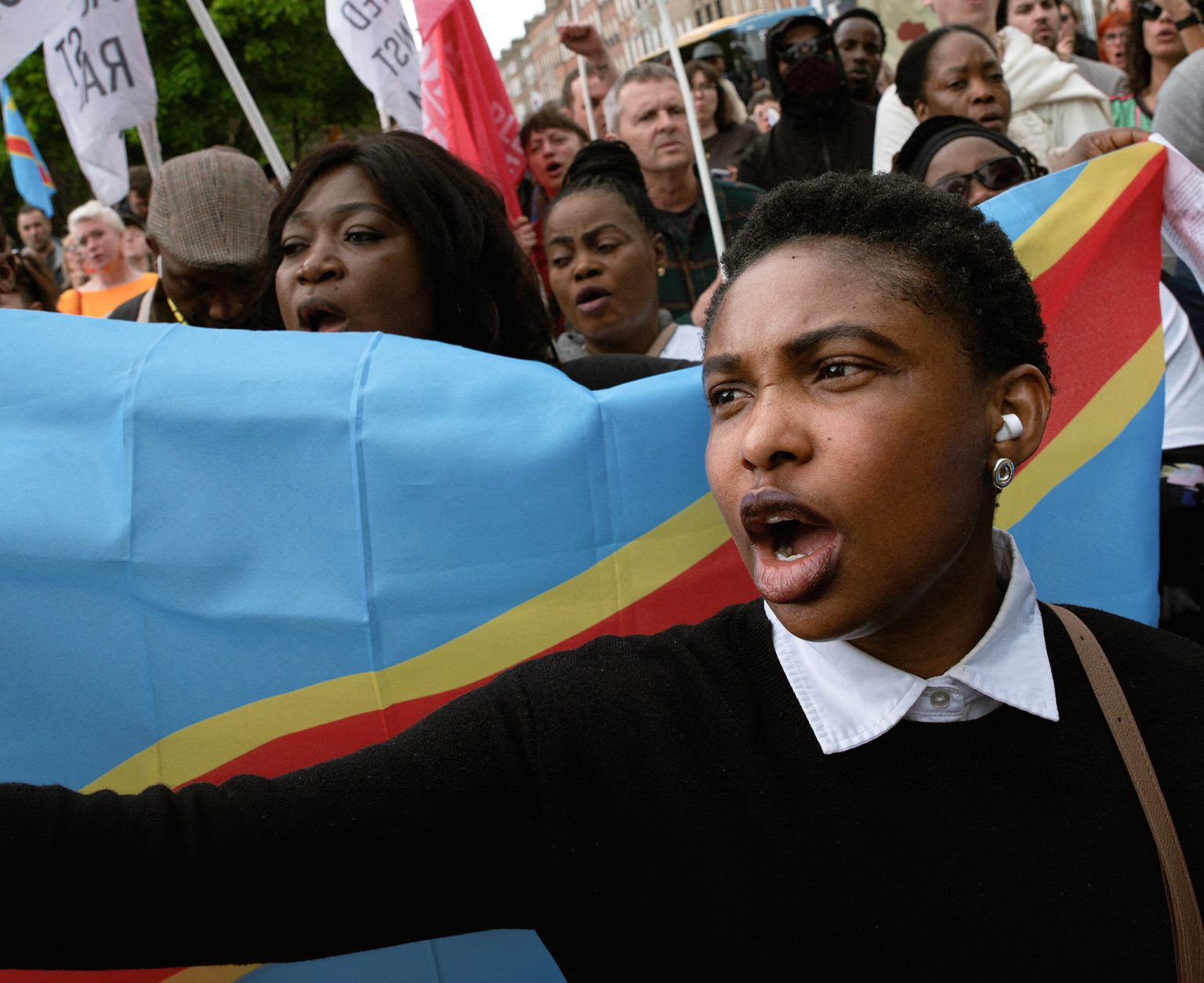
Nkencho was shot and killed by Gardaí in 2020 after he repeatedly lunged at officers with a machete. There were protests, but not on the scale of those occurring in other countries such as the US and the UK. As with Nkencho, so too with Sakila: despite coverage suggesting nationwide protests and expressions of anger from activists, the movement from the ground is small, with only a few protests reported. The largest took place in Dublin and reportedly attracted several hundred people.
The coverage contrasts with that of Irishman Alex Coughlan, who was killed during an alleged aggravated burglary. Two 16-year-olds, reportedly of immigrant background, have been charged.
Irishman’s Death Draws Far Less Attention
A video circulated showing the 37-year-old kneeling on the ground, crying and pleading with the perpetrators, before he was fatally assaulted.
A court heard last week that Coughlan died in hospital after an assault and robbery in Blanchardstown, west Dublin, on Sunday 17 May.
The alleged perpetrators cannot be identified because of their age. In court, Sergeant Emma Ryan argued that both were flight risks, with one holding dual nationality. The defense disputed this, saying one boy would surrender his passports, while the other had lived in Ireland since birth. Both were remanded in custody and are due to appear in court this week.
Whereas the first incident made international news, the second has been quietly sidelined, with minimal coverage in mainstream news outlets. A vigil was organized by a local councilor and reportedly drew 500 people. However, no local member of parliament or TD showed up, despite the fact that some laid flowers outside Arnott’s in memory of Sakila.
Irish media and politicians have made little secret of their fears that highlighting such cases will stoke racial tensions.
After a young Irish teacher, Ashling Murphy, was brutally murdered by an unemployed migrant, her boyfriend, Ryan Casey, lamented in court that the Irish state had allowed her murderer to live in Ireland for years while on state support.
Irish media deliberately ignored these comments when reporting on his statement. Kitty Holland, social affairs correspondent for one of the main daily papers, The Irish Times, made comments to the BBC broadly alleging that Casey’s words were likely to excite anti-migrant sentiment.
Casey subsequently sued the UK public broadcaster for defamation, settling the issue out of court.
Mainstream parties, the largely left-wing opposition and non-governmental organizations continue to push back against criticism of Ireland’s migration policies. At the same time, the media’s selective coverage of migrant crime has fueled frustration among citizens.
Polling has consistently shown that immigration is a hot-button issue in Ireland. In the Dublin region, anti-immigration candidates received more than 20% of the vote, while a recent poll found immigration ranked ahead of the cost of living as a key issue for Irish voters.
Cases similar to that of Alex Coughlan are beginning to make international headlines elsewhere, with the death of Henry Nowak in Britain under scrutiny.
The prosecution alleges that Vickrum Digwa stabbed Nowak with a ceremonial knife, which Sikhs have a religious dispensation to carry. Digwa argues that he was acting in self-defense after being subjected to racist abuse and physical violence. Police arriving on the scene handcuffed Nowak, who drowned in his own blood.
That has raised accusations of two-tiered policing, with accusations that the police focused not on the stab wounds of a young man but on the claim that he had made racist remarks.
Nowak's story has been boosted by Elon Musk on X, formerly Twitter, who expressed outrage. So far, migrant crimes in Ireland have failed to capture international attention, while the Irish media seems to want to turn a blind eye.
Welcome to the comments section of the Štandard daily. Please take note of our guidelines, comments are moderated by us. You can contact the moderators at support@statement.com.
Participate in the discussion
Comments are available to subscribers only. If you'd like to join the discussion, choose a subscription starting at €6.72 per month.
All comments 0
Register
Comments are available to registered users only. If you'd like to join the discussion, register here.