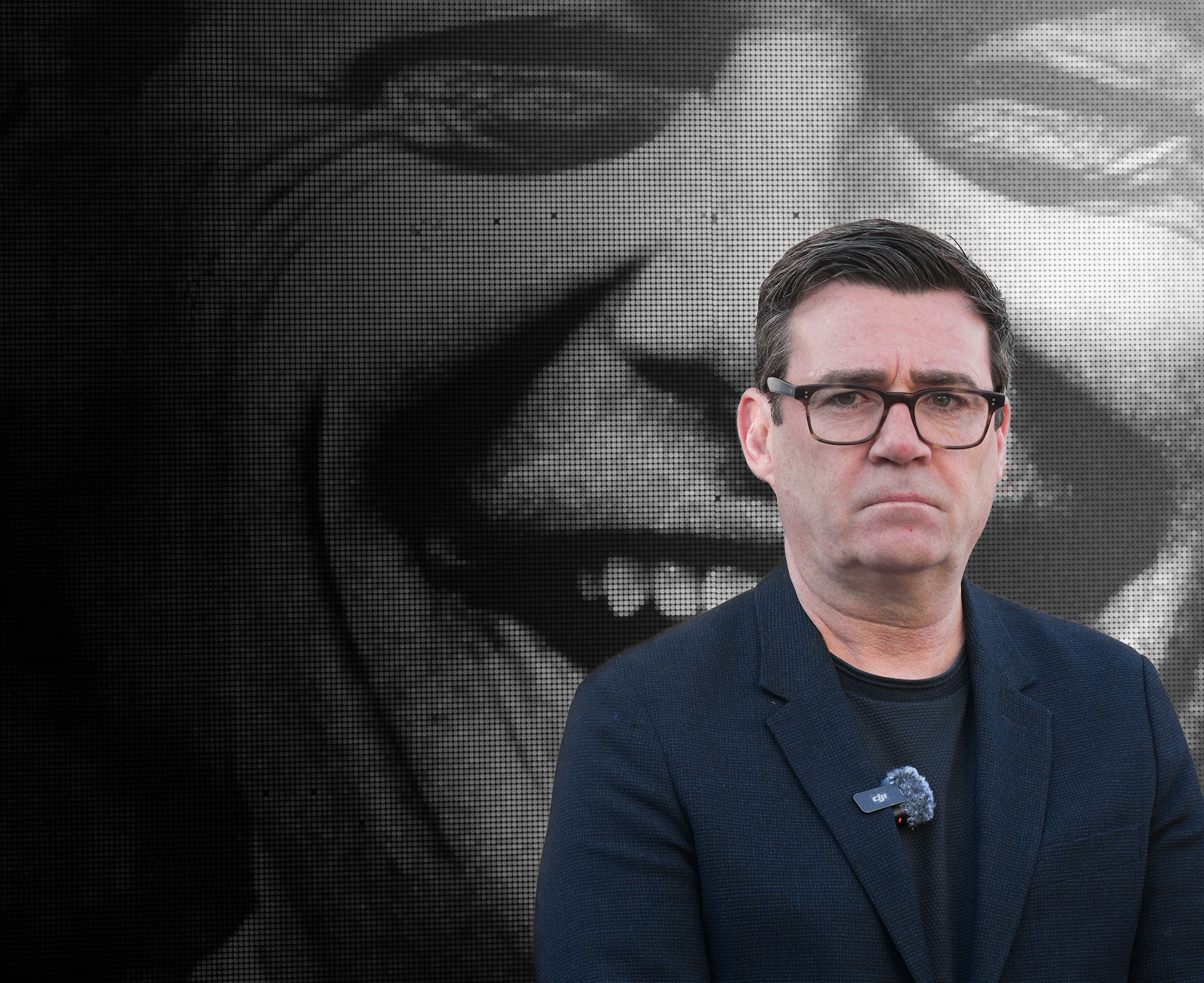
Andy Burnham’s Rise and Europe’s Quintus Cicero Problem
Across Europe, voters look to their politicians and wonder where the great men of history have gone. The answer might lie in voters’ own hostility to politics.
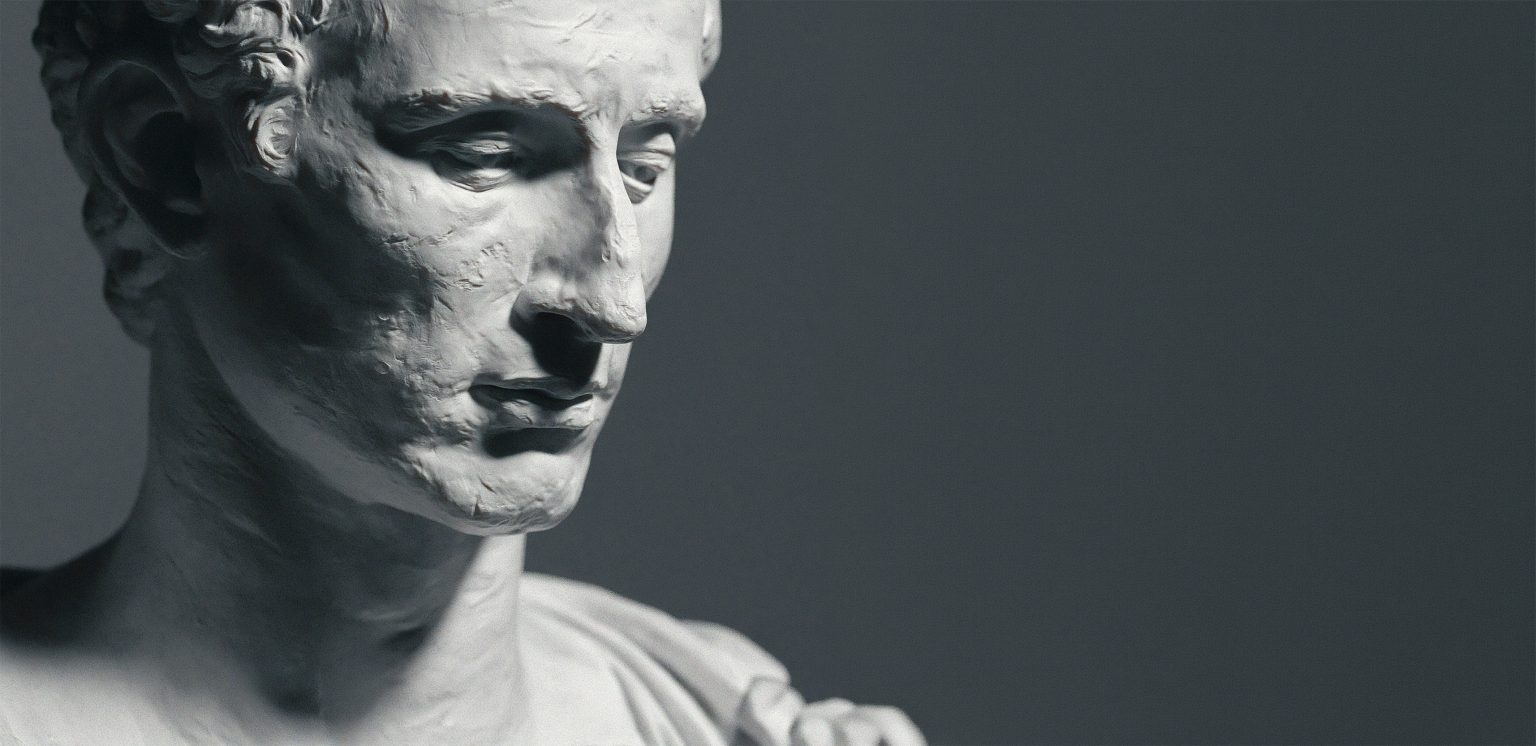
Quintus Cicero’s respectable career was eclipsed by an age of political giants. Photo: Statement/AI
|
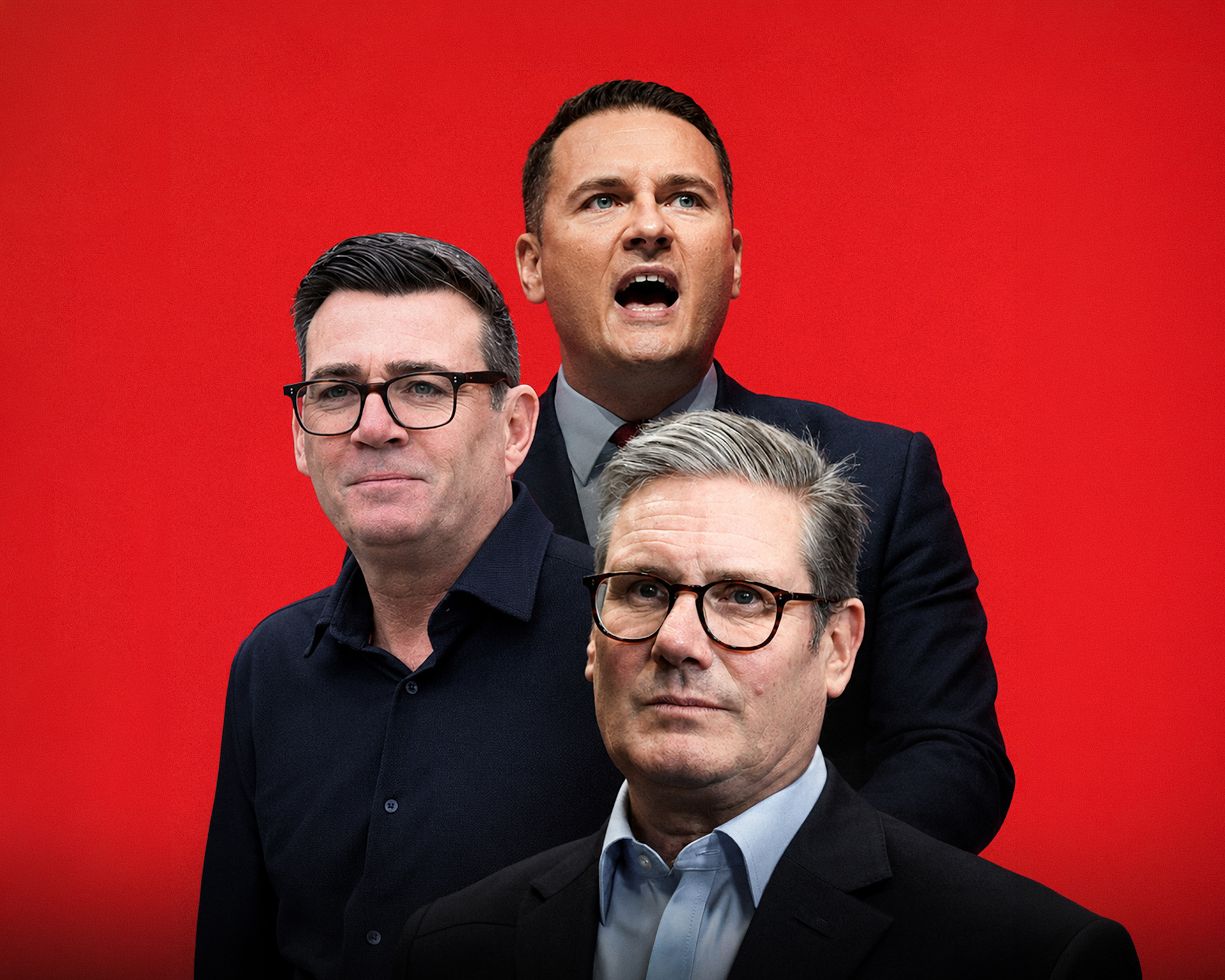
Andy Burnham wants nothing less than to become prime minister of the United Kingdom and is currently positioning himself to kick Keir Starmer out of Downing Street. In any other era, a quick scan of the Burnham resume might indicate a respectable middle-ranking journeyman politician who had achieved a moderately credible national career before retreating to become a regional governor. Quintus Burnham, observers of antiquity might have called him.
Why Quintus? Well, because almost every European who has achieved a moderate education knows the name of Marcus Tullius Cicero. Consul. Orator. Lawyer. Glorious defender of the Roman Republic.
A man whose oratory was so feared that Mark Antony – a brute’s brute – had his head and hands shorn off in death and displayed in public to signal that Cicero would write no more. Ancient sources scandalously record that Antony’s wife, Fulvia, impaled the great man’s tongue with pins so that his voice might be silenced forever.
It did not work.
The Younger Cicero
For all Marcus Cicero’s fame, relatively few Europeans, by contrast, know the name of his brother. And yet Quintus Tullius Cicero had a perfectly respectable career.
The younger Cicero rose to the praetorship in 62 BC, the second most senior of the Roman offices of state. He was then sent off to Africa, where he served as governor of the Roman province for three years. He went on to fight for Caesar in Gaul, before turning against the dictator in the civil war. Siding with his brother, he was killed on the orders of Octavian and Antony in the proscriptions of 43 BC.
It is perhaps the tragedy of this perfectly respectable and decent Roman that he was born into an era of so many great men and leaders, meaning that his perfectly decent career as a Roman statesman was overshadowed. Had he been born in a time of lesser men, he might well have risen further.
He might, in other words, have been the Roman Andy Burnham.
Burnham is a strange sort of British Messiah. The mayor of Greater Manchester did not stand at the last UK general election. He served only two years and 10 months as a cabinet minister, and that was over a decade and a half ago. His most notable political achievement has been to relaunch a bus service in Manchester. These are not normally the things that a prime ministerial CV is made of, but then he might say that neither Boris Johnson nor Liz Truss arrived at Downing Street armed with sparkling qualifications either.
There are, after all, 400 sitting Labour MPs. And yet none of them, it seems, are more capable in the eyes of the Labour faithful than Andy Burnham. This, with no disrespect to Burnham, seems to say more about that 400-strong cohort of parliamentarians than it does about Burnham himself. British Labour is heavy on the rank and file, but short, it seems, of centurions and officers.
In that, the British Labour Party is not alone. Look around Europe and you see leaders who have many fine qualities, but few whom one might imagine having thrived in a political world populated by orators like Marcus Cicero, tacticians like Gnaeus Pompey or strategists like either of the first two Caesars.
Why might this be?
The Dearth of Political Rewards
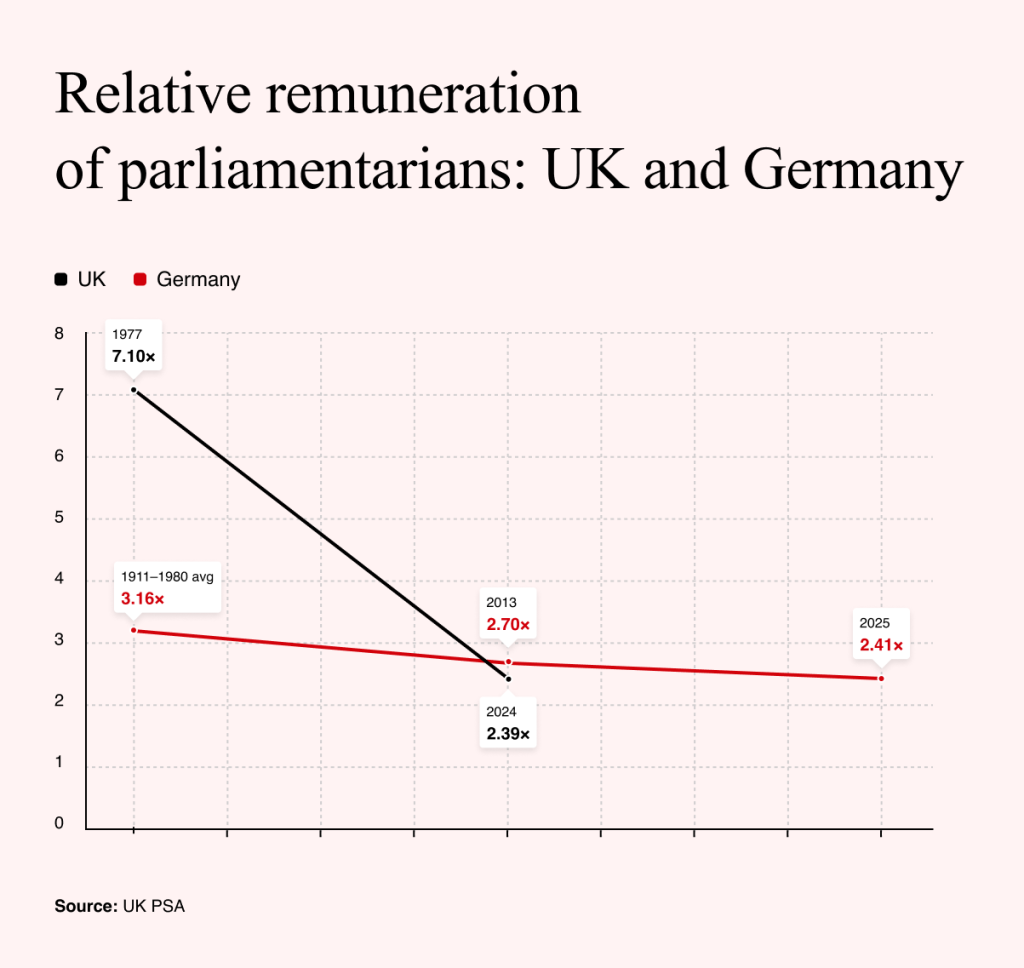
For one thing, politics is not quite what it once was, if you are looking for a way to stamp your name into history. Political careers today are relatively less remunerated, with the relative earnings of politicians falling across a great many Western democracies. It is not that our politicians are badly paid. It is that for people of exceptional ability, politics is no longer one of the most efficient ways to turn your talents into wealth. London and Berlin have many thousands of lawyers, financiers, actuaries and doctors who earn more than the average parliamentarian.
Source: UK PSA
Further, the politician is no longer quite so remote. The great figures of history might themselves seem rather diminished had the modern public access to a log of their social media postings. Historians might view the greater Romans with somewhat lesser awe if there was a record of Cato posting a sweaty video after his morning jog up the Palatine Hill to discuss that day’s Senate motion – and a record of hundreds of his constituents telling him “you suck” in the replies.
The “aura”, in other words, is gone. These days, it is reserved for celebrities or the international titans of business. Outside of the great offices of state in a handful of major world powers, politics is not a career to attract you if you desire dignity and respect. Just ask Ed Davey, the British Liberal Democrat leader who has become famous for embarrassing and cringey stunts that make him the butt of the joke in return for some transient publicity.
Youth and Inexperience
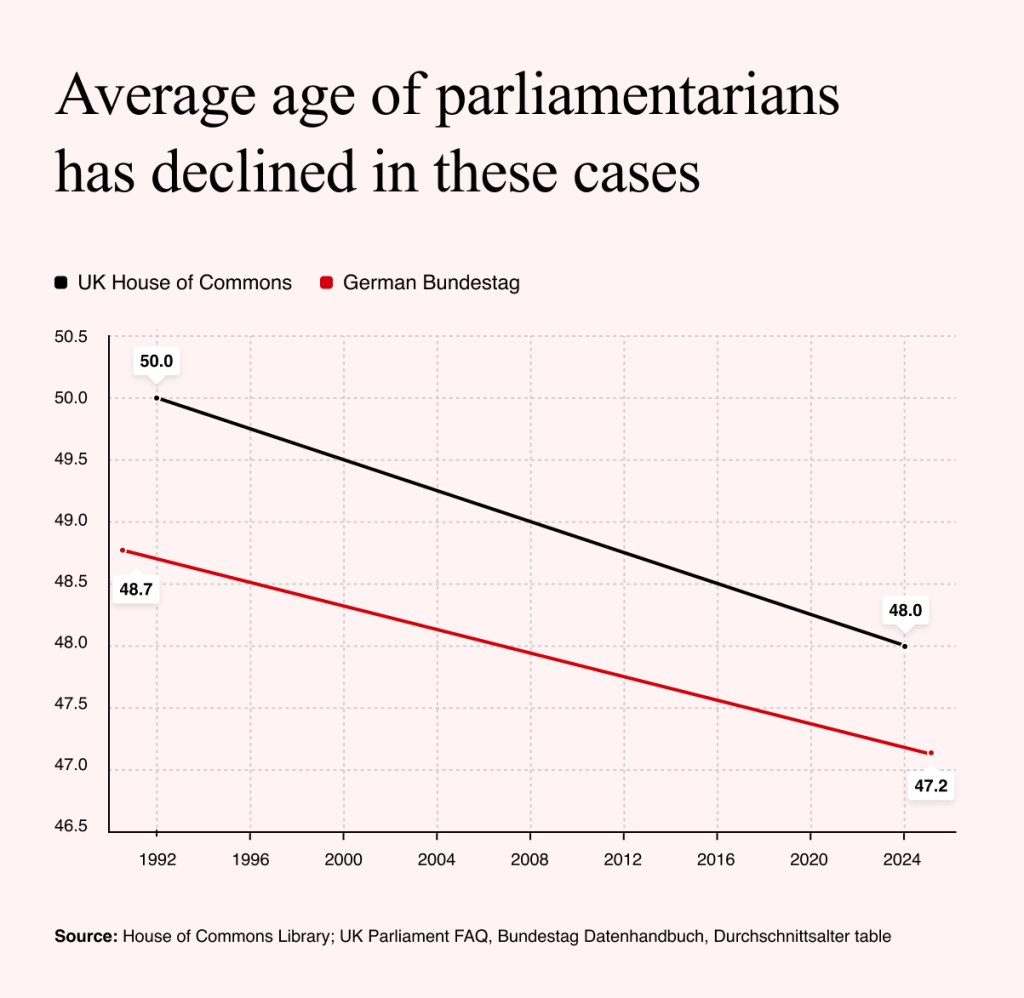
Our politicians are younger too. They are entering politics younger and, increasingly, they are leaving it younger. Emmanuel Macron will be a pensioner at 49 years of age when he leaves office next year. Finland’s Sanna Marin is a former prime minister at 40. Ireland’s Leo Varadkar is another to become a newspaper columnist and elder statesman in his early 40s. Sebastian Kurz of Austria was put out to pasture amid scandal at the almost geriatric age for a politician of 35. While the average age of parliamentarians has not fallen dramatically, it is falling – and falling consistently.
Source: House of Commons Library/UK Parliament FAQ/Bundestag Datenhandbuch
Youth, of course, is no impediment to greatness – ask Alexander the Great or Augustus Caesar – but the enormous surge of youthful leaders does say something about the kinds of people being attracted to politics and the life experiences they have on average.
Burnham’s own career is an example of that: His first job out of university was as a political researcher for the then frontbencher Tessa Jowell in 1994, when Burnham was 24 years old. He was then a special adviser to a Labour cabinet minister before being elected himself at 31. He has never held a job outside politics or anything politics-adjacent.
Across Europe, the pattern repeats: generations of leaders and prospective successors who enter politics young, rise quickly and then, only after their political career, go on to become columnists, businesspeople or lawyers, often turning their political careers into “real money” once they leave office.
Monkeys and Peanuts
Of course, one of the impediments to solving the problem is that the public – while broadly detesting many of their politicians – detest the obvious solutions even more. There are few less popular ideas than paying politicians more. The German solution, benchmarking political pay to that of senior judges, has been replicated in a number of countries but usually to the pay of senior civil servants. No country in Europe has yet managed to benchmark pay to the level of, say, a corporate multinational CEO.
And yet our politicians are expected to perform even more complicated public tasks than senior corporate personnel: The British state employs 6.2 million people directly, whereas Apple employs 164,000 people worldwide. Apple CEO Tim Cook last year earned $74m after shares and bonuses, whereas Andy Burnham will earn just £172,000 if elected prime minister.
“If you pay in peanuts, you must expect to get monkeys”, said Leslie Coulthard in 1966. Andy Burnham is not quite applying for a ration of peanuts: But nothing in his CV would qualify him to run Apple or Microsoft or even BP. Yet he is first in line to become CEO of a much bigger operation, on a fraction of the salary.
The exceptional people, it seems, are no longer in politics. The best voters might hope for these days is that they get modern versions of Quintus Cicero – and that is on our best day.