

The French model of integration rests on a universalist idea: that political legitimacy derives not from blood or soil but from equality, citizenship and human rights. Out of the Revolution grew a republic with a universal mission – a country that believed one did not have to be born French to be French.
The clearest expression of that belief came from the historian and philosopher Ernest Renan in his lecture What is a Nation?, delivered at the Sorbonne on 11 March 1882. A nation, Renan argued, is not built on race, language, religion or geography. It rests on a shared memory and the daily will to live together.
From that idea, the French model of integration took shape. The Republic believed it had the power to make anyone French. Origin, blood and surname were irrelevant. What mattered was acceptance of the language, the schools, the laws and the core values of liberty, equality and fraternity. France was not an ethnic category but a political choice.
For a long time, the model held. It worked best when migration came from culturally proximate backgrounds – Italy, Poland, Spain, Portugal and, later, Eastern Europe. These newcomers were not always welcomed without friction, but the Republic absorbed them in the end. Their children spoke French, attended French schools, took on the French national story and, by the second or third generation, had become part of the nation.
The Crumbling of a National Myth
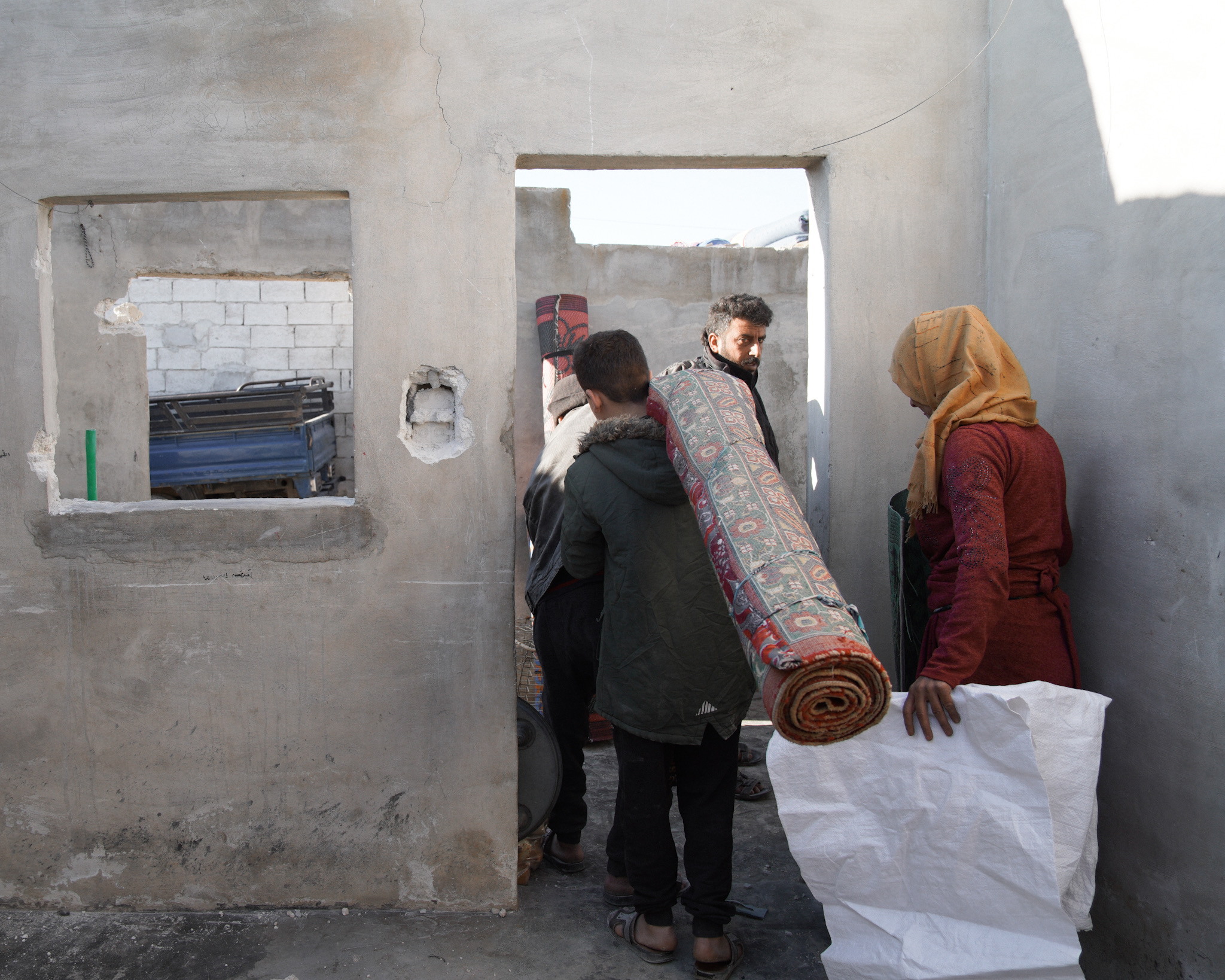
Mass non-European migration exposed the hidden assumptions on which the French model had always rested. After Algerian independence in 1962 and the subsequent waves from the Maghreb and sub-Saharan Africa, it became clear that assimilation had never been a universal solution – only a process that worked under particular conditions, which were now changing.
Migration had ceased to be a limited flow of individuals entering a dominant, self-confident culture. It had become a permanent demographic force that, in parts of France, was large enough to alter the cultural environment itself – the very substrate into which assimilation was supposed to occur.
The Republic kept speaking the language of universalism, but the reality it described was dissolving. Schools in some parts of the country had lost the ability to do what they had always done. French was no longer the language of the home in every classroom. The welfare state had drifted from integration toward the management of permanent dependency. And where a common civic identity should have been forming, separate worlds were taking its place.
The question this raises is no longer simply whether France can absorb migrants. It is whether France can still produce French people. If the republican substrate is eroding faster than a new shared nation is being built, a harder question follows: whether France, as a coherent political community, can exist without the French.

A New France Is Already Here
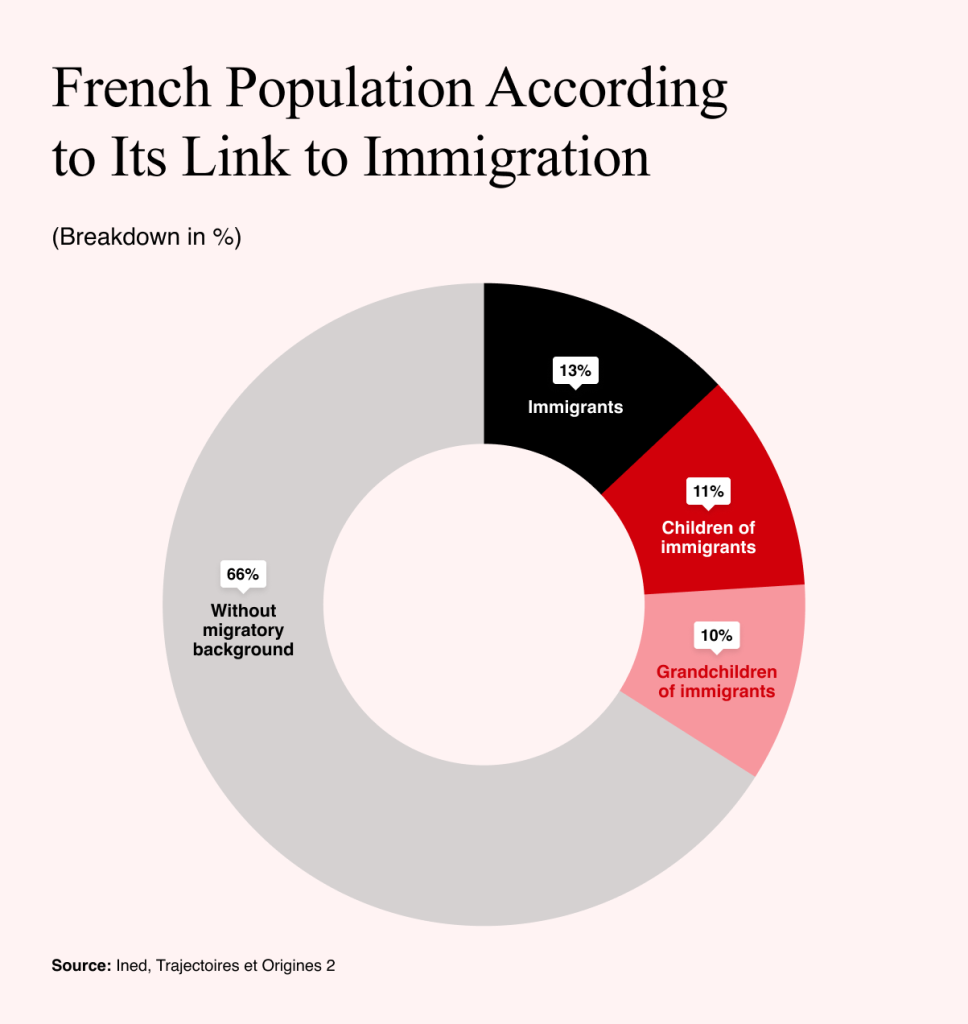
The scale of the transformation is documented in Trajectoires et Origines 2, a study by the Institut National d'Études Démographiques (INED) and the Institut National de la Statistique et des Études Économiques (INSEE) based on a survey of 27,000 people. Among the population of metropolitan France aged 18 to 59, 13% are immigrants, 11% are direct descendants of immigrants and a further 10% have at least one immigrant grandparent.
That adds up to roughly one third of working-age French people with a direct link to migration across three generations. When family and partner ties are included, the study's authors put the figure at 41% of the population in this age group.
France is no longer a country with an immigrant minority. It is a country in which migration has become one of the principal forces shaping how society reproduces itself. The implications reach far beyond borders, visas and residence permits. They extend into families, schools, marriages, neighborhoods, social trajectories and the identity of the generation now growing up. The transformation is real, and it is vast.
Which raises the question the study does not answer: how did France arrive here?
The Rhetoric of Control, the Reality of Drift
Jean-Marie Le Pen had been running for president since 1974, with the halt to mass migration as a central plank of his program. For decades he was dismissed as a fringe figure. His advance to the second round of the 2002 presidential election changed that: it was the first clear signal that a significant part of France had come to see migration not as an asset but as an existential risk. The issue moved to the center of the political agenda and stayed there.
Nicolas Sarkozy was among the first on the mainstream right to absorb the lesson. His 2007 campaign placed security, immigration and national identity at its core, drawing traditional right-wing voters and a portion of Le Pen's base into a single coalition. The strategy worked: in the second round, he captured a substantial share of those who had voted for Le Pen in the first, and in doing so confirmed that migration had moved irreversibly from the margins of French politics to its center.
The creation of a Ministry of Immigration, Integration and National Identity spoke for itself: migration was no longer a technical matter of visas and labor market management but a question of national cohesion. Sarkozy had at least acknowledged as much. But naming the problem was not the same as solving it. The rhetoric of control had arrived; the trend it was meant to address had not reversed.
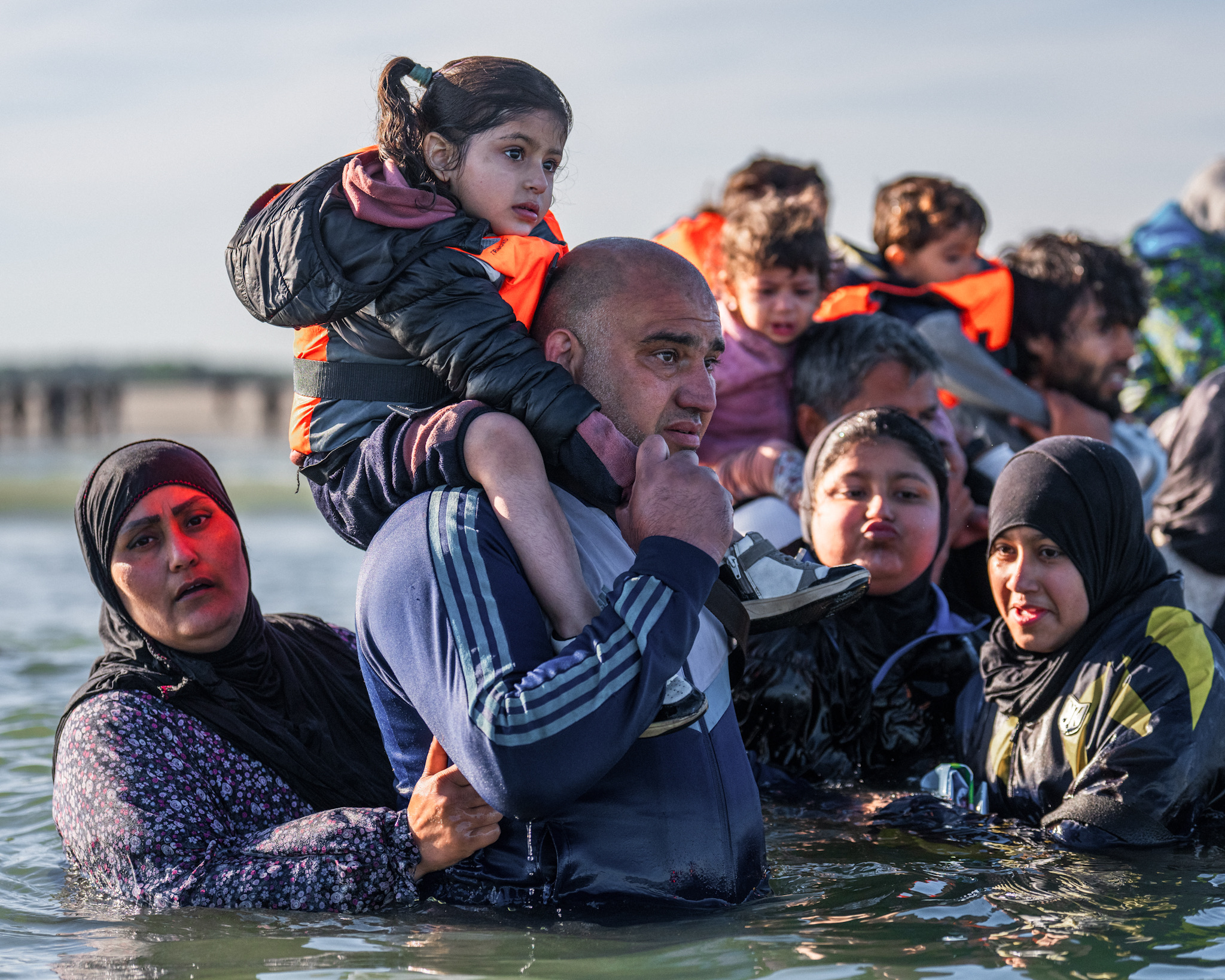
The Hollande years brought a different kind of evasion. Migration was reframed as a matter of humanitarian obligation, procedural compliance and European burden-sharing – a language that foreclosed democratic argument almost by design. At the height of the Syrian crisis, the question of how many people France should admit was not put to the French. It was answered by treaty obligations, asylum law and the logic of emergency. Politics, again, gave way to procedure.
Macron took the retreat furthest. Migration was absent from the center of his political project, displaced by Europe, reform, the climate, competitiveness, Ukraine and the battle against populism. What had become the defining question of French society was reduced to a technical brief for the interior minister.
The administrative machine, meanwhile, kept running. First residence permits issued in France rose from 326,954 in 2023 to 345,587 the following year and to more than 384,000 in 2025, according to preliminary interior ministry figures. The period of greatest political silence had produced the highest numbers on record.
The conclusion is hard to escape. French political leadership has not lost control of migration because its presidents wanted open borders. It has lost control because migration has drifted, gradually and without announcement, out of the realm of democratic decision-making and into the realm of European rules, supranational treaties, judicial interpretation and administrative inertia.
The French were never asked. No government told them plainly that the demographic, cultural and social fabric of their country would be transformed within a generation. What arrived instead was a succession of procedures: asylum claims, family reunification, regularization, humanitarian exemptions, judicial protection.
This is what makes migration, at its core, a democratic question. Voters can change governments. They cannot, it turns out, change the trend. And as long as that remains true, the deepest question facing France is not who is coming. It is who is actually in charge.