
One of the most overused pieces of stock market wisdom goes: "Past performance is no guarantee of future results." The warning is aimed primarily at stock market newcomers who believe that certainties can be gleaned from reports about previous years.
There are no sure bets on the stock market. Investors who wagered on European defense are finding that out. The sector's golden age appears to be behind us.
The Peace Dividend
Defense stocks had been overlooked for decades before their recent run. European economic development after the Cold War was built on a simple premise: unlike the US, the continent could afford to spend little on defense. Rather than maintaining large standing armies, Europe shifted toward smaller, specialized forces designed for limited engagements.
The savings were put to other uses. The logic was straightforward: no major conflict had erupted between EU member states since the Second World War, and the bloc's great achievement was precisely that historic rivals had learned to settle disputes without arms. Tensions persisted, but they no longer spilled into open conflict.
In that environment, large standing armies made little economic or strategic sense. The shift was visible across the continent as defense budgets shrank and compulsory military service was quietly wound down.
France suspended conscription in 1997, with the last conscripts leaving the military in 2001. Spain followed in 2001, Italy in 2005, Germany in 2011. Belgium had moved earlier still, in the mid-1990s. One by one, Western Europe's mass armies gave way to smaller, professional forces.

Ukraine as a Turning Point
Both the decline in defense spending and the retreat from conscription came to an abrupt end with Russia's invasion of Ukraine in 2022. What Moscow had envisaged as a matter of weeks became a war that continues to this day, and one of the largest confrontations between regular armies in Europe since the Second World War. Combat evolved as the conflict deepened: the tank-and-artillery battles of the early phase gave way first to close infantry fighting and then, increasingly, to drone warfare.
European defense stocks rose in response, though gradually. Markets were uncertain how long the conflict would last, and much of the early Western aid to Ukraine drew on existing stockpiles rather than new production. That suited Kyiv, which was still fighting largely with Soviet-era equipment.
Berlin's Open Purse, Washington's Ultimatum
European defense shares had been climbing steadily, but the real surge came when Germany changed course. Incoming Chancellor Friedrich Merz announced an end to the country's long austerity regime and unveiled plans for large-scale debt issuance, with the proceeds earmarked primarily for arms industry contracts. It was the clearest signal yet that European governments were serious about rearmament.
Germany was not acting alone. The election of Donald Trump to the White House delivered a second jolt to the sector. The new US president made clear that NATO allies could no longer count on Washington to shoulder the bulk of the defense burden and pressed member states to invest heavily in their own militaries.
The target set by the Trump administration, 5% of GDP, is of a different order of magnitude from anything European governments have previously committed to. Sums on that scale cannot be spent simply by buying more of what already exists. The entire defense industrial base will need to expand and adapt.
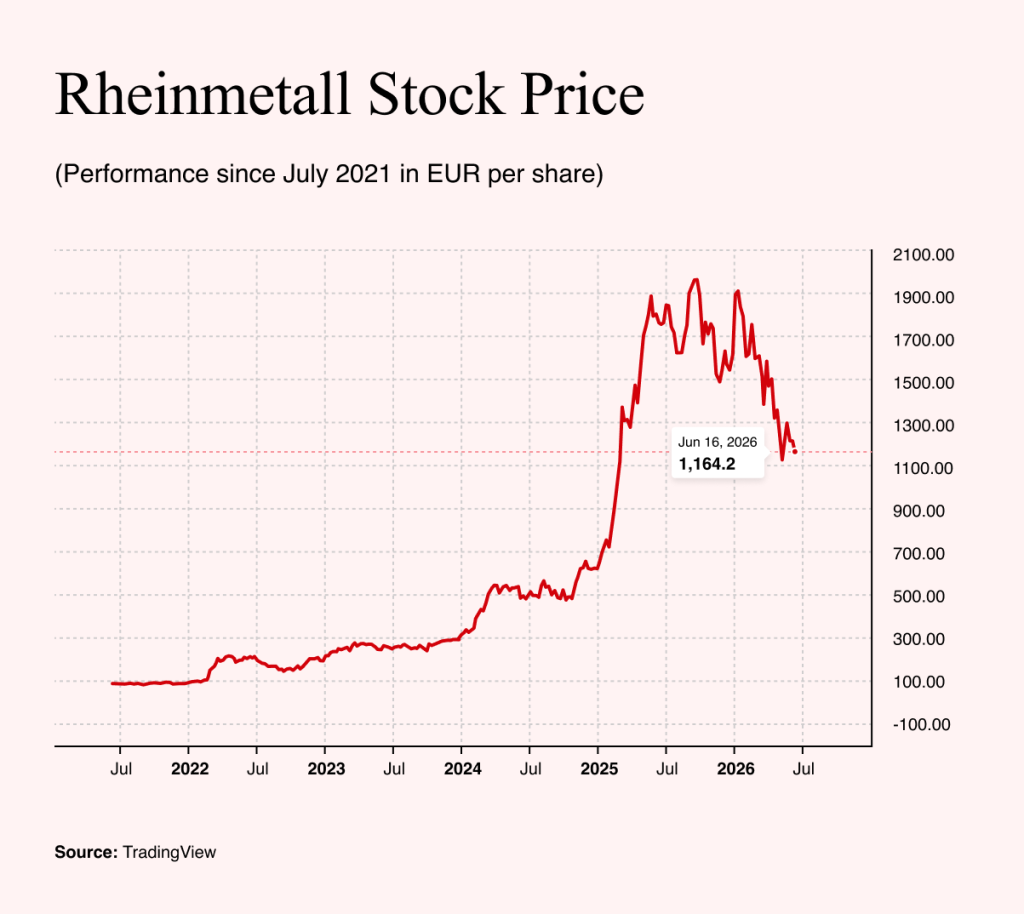
It was against this backdrop that Rheinmetall became the emblem of the European defense boom. In 2021, the German arms manufacturer had a market capitalization of around €3.45bn ($4bn). By October 2025, that figure had surpassed €86.3bn ($100bn), a more than twentyfold increase in four years.
The scale of the rise is best understood by comparison. In 2021, the Czech energy company CEZ was worth roughly €17.5bn ($20.3bn), five times more than Rheinmetall. Today those positions are dramatically reversed. And yet the share price trend for Rheinmetall, as for other European defense companies, suggests the boom has already peaked.
2026: The Market Sobers Up
Since the start of 2026, investor appetite for European defense stocks has been fading. The reason is straightforward: the sector has become very expensive, and the fundamentals no longer justify the enthusiasm that drove prices to their peaks.
Rheinmetall trades at a price-to-earnings (P/E) ratio of 50 despite a declining share price, a multiple more associated with high-growth technology companies than with industrial manufacturers. Sweden's Saab is not far behind at around 40. Even the more modestly priced names, Italy's Leonardo and France's Dassault Aviation, both at 23, look stretched given the capital demands facing the industry.
Nor has the broader geopolitical picture provided the expected lift. The conflict between Iran and the US, which might have been expected to bolster defense stocks, has instead highlighted a structural paradox: geopolitical tension boosts demand for weapons, but it also pushes up government borrowing costs, making it harder to finance that demand in the first place.
Orders Signed, Profits Pending
A second problem is the gap between orders and earnings. European defense companies are sitting on vast government contracts but are struggling to convert them into revenue and profit at the pace investors had anticipated. Rheinmetall illustrates the problem most clearly.
The German company ended the first quarter of 2026 with a record order backlog of €73bn ($84.6bn). Yet its financial results for the period fell well short of expectations. Revenue grew by 8% year-on-year to €1.94bn ($2.25bn), against analyst forecasts of around €2.3bn ($2.67bn).
The backlog is as much a burden as a prize. Working through €73bn ($84.6bn) of orders takes time, and the pipeline is still growing. If new contracts continue to arrive faster than existing ones can be fulfilled, profits will stagnate or fall as the company is forced to invest heavily in expanding its production capacity.
Drones Have Left the Giants Behind
The deepest challenge facing traditional defense companies is not their valuations but their relevance. Rheinmetall, the sector's most celebrated name, has become the emblem of a broader concern: markets are beginning to see manufacturers of heavy equipment as ill-suited to the warfare that Ukraine has made familiar, where cheap drones have repeatedly destroyed vehicles worth many times their cost.
The economic logic is shifting accordingly. A drone costs a fraction of a modern armored vehicle, and its battlefield effectiveness has made that disparity impossible to ignore. Money is moving out of the traditional defense giants and into companies focused on high-tech warfare, drone systems and military IT. Parrot, the French drone manufacturer, grew by 36% this year. MilDef, a Swedish military IT specialist, grew by two-thirds.
Europe will spend more on defense. That much is certain. Whether today's shareholders will benefit as handsomely as the market once assumed is a different question. Military spending occupies a peculiar place in any investment calculus: if it proves unnecessary, the equipment rusts in warehouses; if it proves necessary, something far more serious has already gone wrong.
The falling share prices of defense contractors may therefore be less alarming than they appear. They may simply reflect a return to an older and more sober understanding: that defense is something states must provide, but a poor foundation on which to build a prosperity story.