

For Elon Musk, the title of the world’s richest person is nothing new. He first reached the top of the closely watched list in January 2021, when he surpassed Jeff Bezos. This was not the result of a sudden influx of cash or an extraordinary dividend, but primarily the result of the sharp rise in Tesla’s stock price.
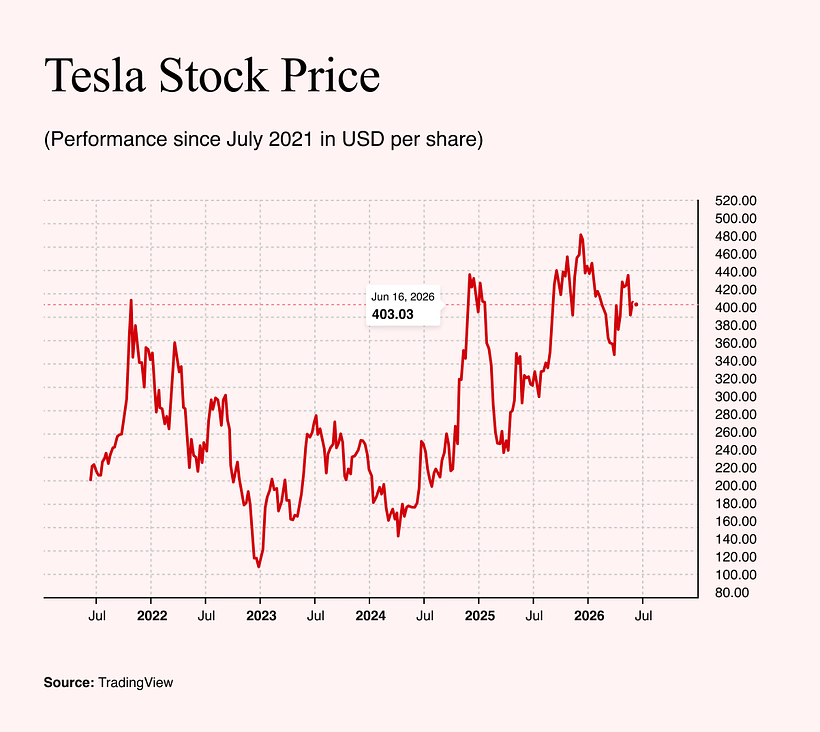
This distinction is crucial. Musk's net worth can rise or fall by tens of billions of dollars within days without any noticeable change in his personal life. Because Tesla's share price has been highly volatile in recent years, trading between $122 and $481, the billionaire could have moved up or down several places in the rankings.
The fortunes of his closest rivals, Jeff Bezos and French billionaire Bernard Arnault, are also largely tied to the value of the companies they founded or control. Over the past five years, the rankings have therefore depended less on personal spending and more on market sentiment. They have been shaped by factors such as Chinese demand for luxury goods, the performance of Amazon's cloud computing business and Musk's ability to persuade investors that future technologies, including robotaxis and humanoid robots, will generate substantial profits. Tesla's financial results have also benefited from the sale of emissions credits, helping to support the company's valuation and, in turn, Musk's wealth.
The World's First Trillionaire
The public listing of SpaceX made it possible to estimate Elon Musk's wealth more accurately, although his net worth remains closely tied to market valuations. Following the company's stock market debut, Musk became the first person in history to achieve a net worth of more than $1tn. While the milestone was remarkable, it did not come as a surprise to many market observers.
The contrast with 2021 is striking. At that time, several technology entrepreneurs were competing closely for the title of the world's richest person. Today, Musk sits comfortably at the top of the rankings, with a lead that appears difficult to challenge in the near future.
Google co-founder Larry Page is estimated to be worth $257bn, while fellow Google co-founder Sergey Brin has a fortune of $237bn. Amazon founder Jeff Bezos is worth $224bn and Meta chief executive Mark Zuckerberg has an estimated net worth of $222bn.
Together, their combined wealth amounts to $940bn, still less than the fortune attributed to Musk alone. Further down the rankings are Oracle co-founder Larry Ellison with $190bn, LVMH chief executive Bernard Arnault with $171bn and NVIDIA co-founder and chief executive Jensen Huang with $154bn.
What was once a contest decided by differences of a few tens of billions of dollars has evolved into a ranking dominated by a single individual. Musk's lead over his rivals is now so large that it exceeds the total fortunes of many of the billionaires who once competed alongside him.

SpaceX, Tesla and the Value of Stock Options
Calculating Elon Musk's exact wealth in real time is difficult because of daily fluctuations in financial markets. The largest component of his fortune is currently his stake in SpaceX. However, it is important to distinguish between shares he owns outright and those he controls through stock options.
Stock options are not ordinary shares. They give the holder the right to purchase shares at a predetermined price, known as the strike price, at a future date. Their value is therefore not equal to the market value of the underlying shares. Instead, the strike price must be deducted from the current share price to determine the option's intrinsic value.
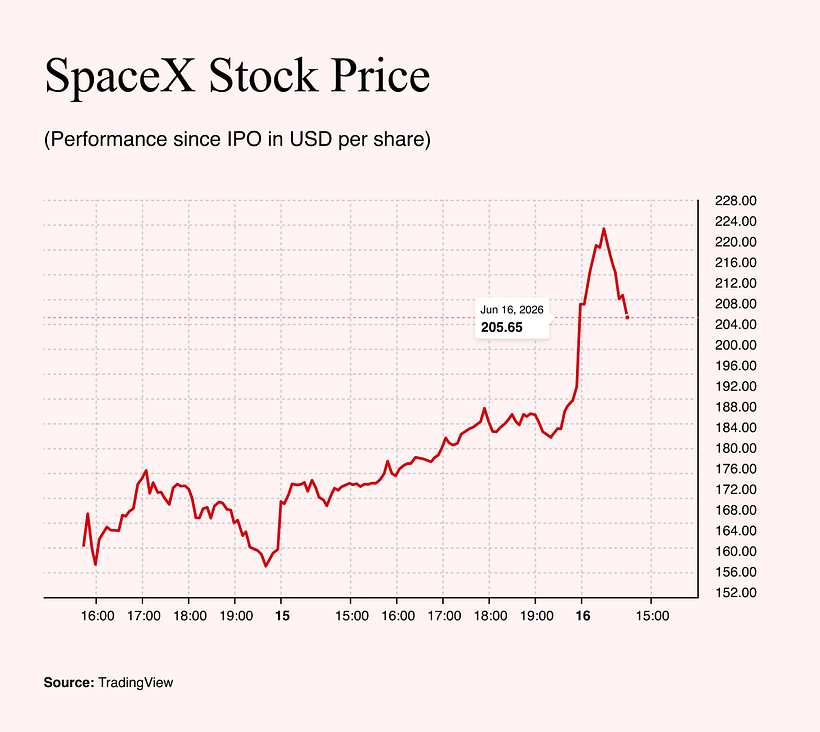
For example, if SpaceX shares are trading at $207 and Musk holds options allowing him to purchase shares at $8.39, each option has an intrinsic value of approximately $198.61 before taxes, transaction costs and any regulatory restrictions are taken into account.
This distinction is particularly important when assessing Musk's net worth. While option holdings can add hundreds of billions of dollars to a fortune on paper, their value depends on both the market price of the shares and the terms under which the options can be exercised.
Musk's stake in Tesla can be valued using a similar approach. In this case, the calculations are more straightforward because the company is publicly traded and detailed regulatory filings are available.
According to the latest disclosures, Musk owns 413,152,109 Tesla shares. At a share price of $407, that stake is worth approximately $168.2bn.
He also holds options on an additional 303,960,630 shares with an exercise price of $23.34 per share. Based on Tesla's current share price, the intrinsic value of those options is approximately $116.6bn. Combined, Musk's exposure to Tesla equity amounts to roughly $284.8bn.
The situation is less clear at Neuralink, the brain-computer interface company developing implantable neural technology. The size of Musk's ownership stake has not been publicly disclosed. The company is currently estimated to be worth about $9bn. Compared with SpaceX and Tesla, Neuralink remains a relatively small component of Musk's overall portfolio.
Based on his holdings in SpaceX and Tesla alone, Musk's net worth is estimated at approximately $1.35tn. To this must be added the value of his stakes in Neuralink and several other private ventures. Because these companies are not publicly traded, their precise valuations are difficult to determine. Even a conservative estimate places Musk's wealth comfortably above $1.35tn.
The figure is difficult to comprehend in practical terms. On paper, Musk's fortune approaches the market value of Berkshire Hathaway, the investment conglomerate led by Warren Buffett, and exceeds the market capitalization of most publicly listed companies worldwide.
Such comparisons should be treated with caution. If Musk attempted to acquire a company of that size, he would first need to sell portions of his existing holdings, pay a premium to shareholders and likely reduce the value of his own assets in the process. As a measure of scale the comparison illustrates just how extraordinary his wealth has become.
Wealth Greater Than the Economies of Many Countries
Comparisons with national economies are equally striking. Musk's estimated net worth exceeds the nominal gross domestic product (GDP) of the Netherlands, which amounted to roughly $1.21tn in 2024. It is also significantly larger than the economies of countries such as Poland, Belgium, Austria, the Czech Republic and Slovakia.
Compared with Europe's largest economies, Musk's remains smaller than a nation. Spain's GDP was approximately $1.73tn in 2024, while Italy's economy was worth about $2.37tn. Germany and France were larger still.
An even more striking comparison can be made with government budgets. On paper, Musk's fortune would be equivalent to roughly 20 annual budgets of Slovakia, nine annual budgets of the Czech Republic or nearly three annual budgets of Poland.
Such comparisons have clear limitations. Musk cannot instantly convert his holdings in SpaceX and Tesla into cash without significantly reducing the value of those assets and potentially losing control of the companies. A state, meanwhile, is not a single balance sheet but a complex system that collects taxes, issues debt and finances public services.
The comparison nevertheless illustrates the extraordinary scale of Musk's wealth. His fortune is no longer merely a measure of personal entrepreneurial success. At its current level, it invites comparisons with the economic output and financial resources of entire nations.