Return Hubs May Not Be the Immigration Fix Europe Is Hoping For
While many governments and politicians are championing the EU Migration Pact for opening the door to return hubs, their effectiveness is open to question.
Migrants aboard a boat in the Mediterranean Sea await rescue after departing from Tunisia. Photo: Jesus Hellin/Europa Press via Getty Images
|
Tackling illegal immigration is high on the list of priorities of a majority of voters across the European Union (EU) and increasingly so for politicians too. But while the Migration Pact is a cause for celebration on the right – marking a significant shift in the union’s approach to deportation – proposals for return hubs may not be the fix the right is hoping for.
Given that, since 2014, migrant crossings of the Mediterranean have resulted in millions of people arriving on European shores to seek asylum, while more than 30,000 migrants have lost their lives in the attempt, it is unsurprising that European leaders are looking for a quick solution.
After the Migration Pact successfully passed through the European Parliament, thanks predominantly to support from politicians on the right, leaders of 19 member states signed a letter calling for the union to pursue “innovative solutions” to the continent’s “migration challenges”.
This is where return hubs come in. Under the Migration Pact, these are envisaged as facilities hosted in third countries, such as those proposed in Rwanda, which are designed to house asylum seekers whose claims have been rejected and have received return decisions. However, it may also open the door to plans, such as those proposed by Italian Prime Minister Giorgia Meloni, to entirely offshore the process of assessing claims of asylum seekers intercepted at sea by the nation’s border force.
The inspiration for this approach is Australia, which has successfully deterred migrants entering the country illegally by boat not once but twice in the past 20 years. Australia’s Pacific Solution responded to two waves of illegal immigration, both linked to people smugglers in Indonesia, the first in the early 2000s, the second in the 2010s.
In the first instance, the Australian government – then led by a conservative coalition – responded quickly to growing disquiet among the public with three measures: narrowing Australia’s migration zone, setting up offshore processing in nearby island states and naval “turnbacks”. This last measure involved the Australian navy and border forces intercepting boats carrying migrants and either bringing them to offshore processing facilities or returning them to their point of origin.
Although expensive and controversial, the policies were a resounding success and the number of boat crossings plummeted. However, it was not clear which of the three policies could be credited with the success.
Return Hubs or Naval Turnbacks
But then came the second wave. The newly elected Labor government ended the policies in 2008, and boat arrivals surged by a factor of 17 in 2009. By 2012, they surpassed the peak in the early 2000s and at their height saw 25,000 people arrive in a 12-month period spanning 2012 and 2013.
The Labor government made a U-turn in the face of the Australian public’s frustration and reinstituted one policy, offshore processing. This time it did not work. The facilities were quickly overwhelmed and the Labor government was voted out in favor of an opposition that promised a tougher approach.
The new government, led by the right-wing Liberal Party politician Tony Abbott, launched Operation Sovereign Borders, which kept the offshore processing, but placed a heavier focus on boat turnbacks.
The Australian navy resumed its policing of borders, beginning by bringing intercepted boats to offshore processing facilities, before turning them back directly to Indonesian waters. It was an overwhelming success.
When it became apparent that the offshore centres had a capacity problem, the government increased its focus on turnbacks, with the facilities used only in situations where the navy considered returning a boat to Indonesian waters too risky.
The last boat sent offshore under Operation Sovereign Borders was in 2014, but boat arrivals were negligible for years after, suggesting that turnbacks on their own proved sufficient.
Having opposed the turnback policy while in opposition, the present Labor Prime Minister Anthony Albanese has since conceded that the military-led border enforcement operation had stopped the boats. His government now regularly turns back boats that attempt to reach Australia, while offshore processing remains a back-up option.
As Albanese’s concession and his current policies suggest, it was not offshore processing that proved decisive in tackling Australia’s migration issues, but turnbacks.
But despite evidence suggesting that offshore processing is less effective than turnbacks, costly and potentially prone to injustices such as indefinite detention, it remains by far the most popular proposal among European leaders.
The appeal may come down to a few factors, including EU law and optics. In the first instance, rather than directly targeting those arriving by boat, the present Migration Pact envisages return hubs primarily as a means of speeding up deportation orders. At present, official figures suggest that less than a third (28%) of deportation orders have been carried out across the EU.
Return Hubs’ European Appeal
The hubs would therefore largely be used to house those whose claims have already been rejected, although, as mentioned earlier, Italy favors offshoring the asylum process entirely.
This would leave those rejected out of sight and out of mind, while potentially freeing spaces within an often overwhelmed asylum system. It raises the possibility of the average citizen seeing an immediate, tangible difference.
Italy's right-wing leader Giorgia Meloni has been one of the most prominent proponents of return hubs.
Then there are the legal concerns, with the European Court of Human Rights previously judging that some cases of turnbacks count as “collective expulsion”, prohibited under European human rights law.
Lastly, there is the question of safety. All sailors have an international obligation to ensure the safety of lives at sea. When Britain examined the possibility of pursuing naval turnbacks for boats illegally crossing the English Channel, its navy rejected the plan.
The possibility of a turnback going wrong and ending in fatalities is the kind of negative press that could make a government twitchy – although Australia maintains that loss of life at sea has been reduced to zero since implementing the turnback policy. This is contested by human rights agencies.
But the risks posed by turnbacks cannot change the fact that they, rather than offshore processing, appear to have been the decisive factor in Australia’s long-term reduction of arrivals by boat.
Scale of Illegal Immigration
Nor can it change the fact that, in Europe, the sheer scale of immigration via boat crossings outstrips the Australian situation quite substantially and poses a threat to the viability of return hubs.
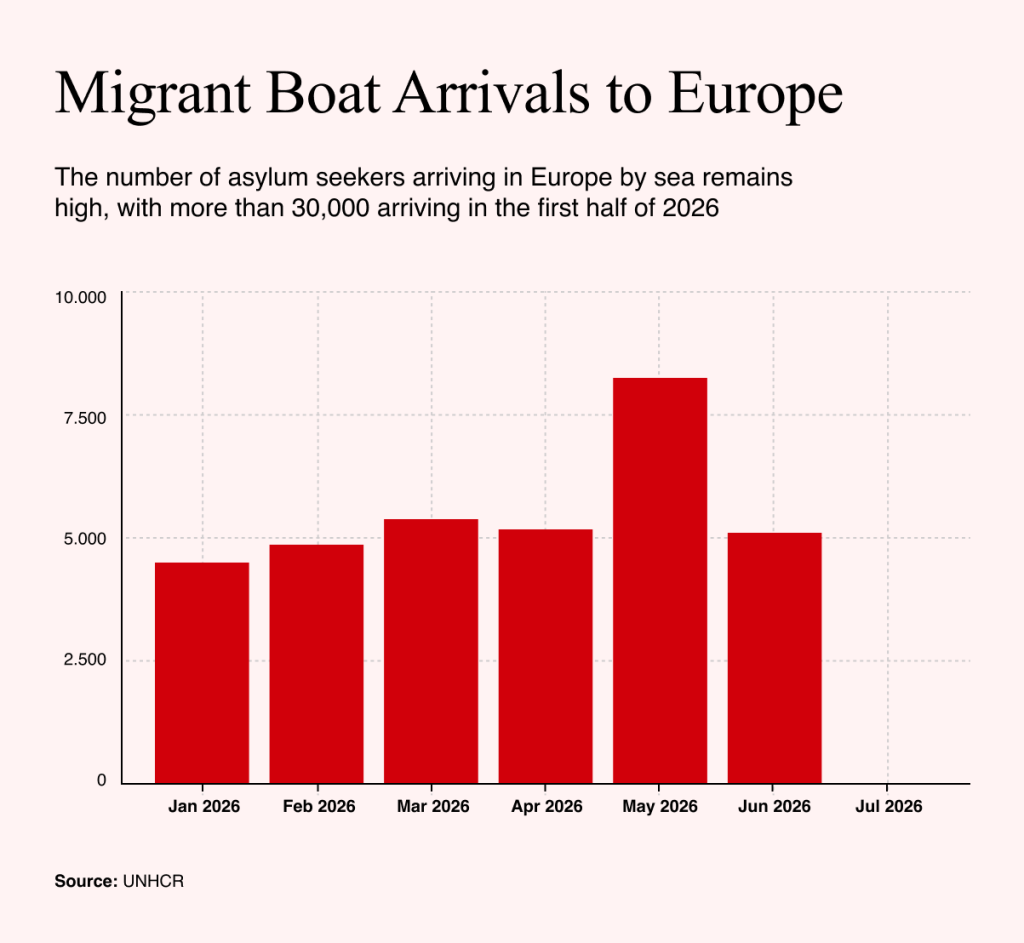
Between 2008 and 2013, more than 50,000 people traveled to Australia – over 30,000 are estimated to have arrived in Europe by sea in the first half of 2026 alone.
Source: UNHCR
This raises questions about the number of offshore detention centers that would be required to tackle such high levels of illegal immigration. Even though the level of arrivals by boat to Australia was significantly lower than Europe’s, the several thousand spaces it maintained in its offshore facilities – at a cost of $1bn a year – were still quickly overwhelmed.
To rehouse even those asylum seekers whose claims have been rejected by European nations would require phenomenal, sustained investment, while still possibly failing to deter future waves of boat crossings facilitated by migrant smugglers.
Ethical and Political Risks
The Australians' hard-nosed approach has proved successful not only in deterring illegal immigration, but also in shoring up support for legal migration and asylum seeker policies. Polls suggest that Australia became one of the most welcoming countries to asylum seekers in the developed world on the back of its Pacific Solution.
That is a tempting prospect. Something has to be done, politicians and citizens largely agree; but the evidence regarding the effectiveness of different policies must be examined carefully.
Governments pursuing return hubs, especially right-wing leaders who have long championed a tougher approach to illegal immigration, need to be aware not only of ethical dangers and legal pitfalls.
They must also consider the possibility that return hubs may not actually be the best approach and that selling them as a solution to Europe’s illegal immigration crisis could backfire, providing fodder for the significant number of politicians and advocacy groups that oppose stricter deportation approaches.
Welcome to the comments section of the Štandard daily. Please take note of our guidelines, comments are moderated by us. You can contact the moderators at support@statement.com.
Participate in the discussion
Comments are available to subscribers only. If you'd like to join the discussion, choose a subscription starting at €6.72 per month.
All comments 0
Register
Comments are available to registered users only. If you'd like to join the discussion, register here.