Canada’s headline GDP kept growing while living standards barely moved. Economists say the country’s experience offers Europe a warning about population growth without productivity.
Canadian Prime Minister Mark Carney argues the country’s economic weakness results from a drop in immigration, but critics say he is missing the deeper issue. Photo: Artur Widak/Anadolu via Getty Images
|
As Canada reckons with a possible recession, economists are warning that years of ramped-up immigration have papered over and even contributed to the reality of an economy that is in a state of stagnation.
The economists’ analysis should be heeded by leaders in Europe and the developed world, where the mainstream view has long been that high levels of immigration will lead to a strong economy. Instead, the Canadian experience shows that poorly managed migration leads to poor economic performance.
Debate about the state of the North American country's economy was sparked after it fell into a technical recession in the first quarter of 2026, when the economy contracted just 0.1% on an annualized basis. However, while debate largely focused on the question of whether the country was in a recession or not, some economists argue this misses the point entirely.
Instead, economists like professor Mikal Skuterud of the University of Waterloo have criticized the immigration policies of former Prime Minister Justin Trudeau, saying they masked pervasive systemic troubles in the country's economy.
While gross domestic product (GDP) was growing at an apparently acceptable rate, according to Skuterud, the fixation on this metric is misleading due to the nation’s rapid population growth through immigration.
Over the course of Trudeau's 10-year tenure, from 2015 to 2025, the country saw GDP rise consistently. If the population growth had been relatively stable, economists suggest this may have indicated a healthy economy.
But from the time that Trudeau’s Liberal Party increased immigration rates in 2015 to the end of 2025, Canada saw its population rise from 36 million to 41.6 million people, an increase of 16.3% within a decade.
After the pandemic, the Trudeau government dramatically accelerated intake, pushing annual population growth above 3%, a rate unprecedented in modern Canadian history.
This policy was in part driven by advocacy groups like the Century Initiative, which critics argued influenced public debate around immigration levels through its campaign for a Canadian population of 100 million by 2100.
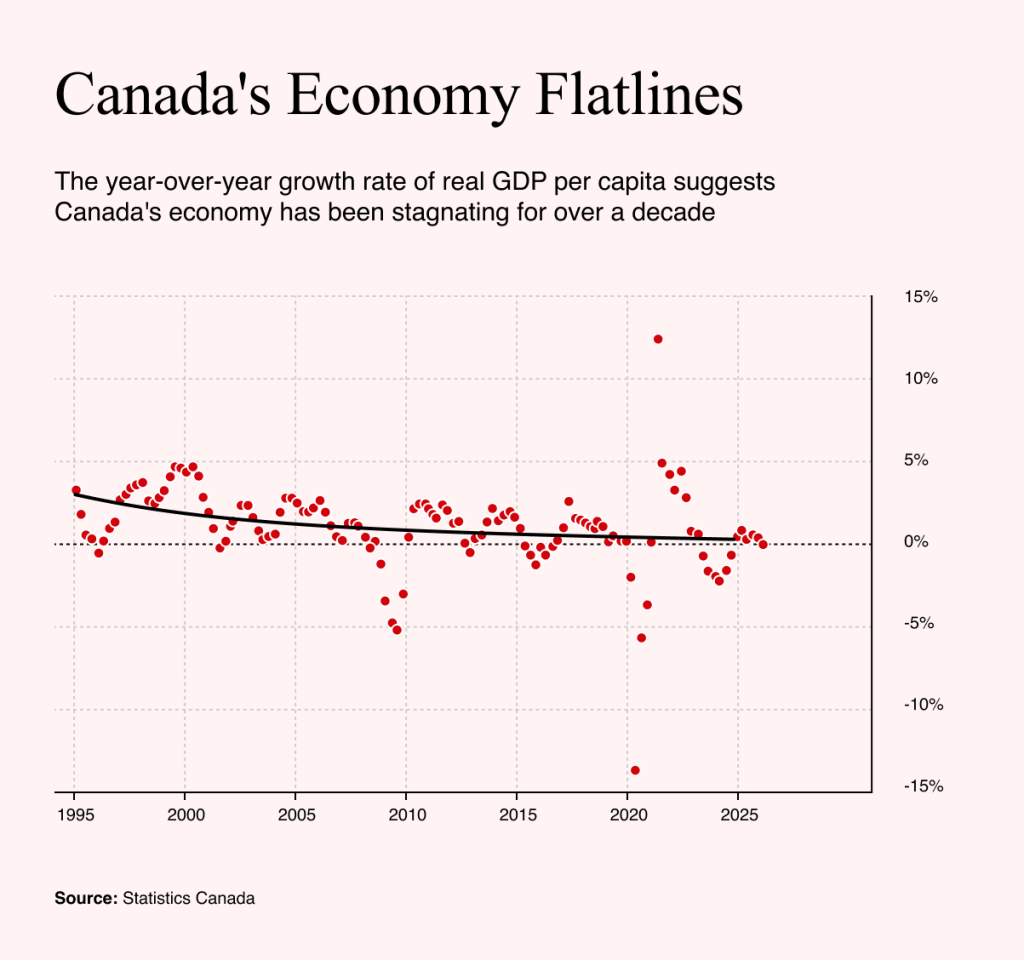
The net result was that, while GDP went up, other economic metrics indicated a worrying problem – real GDP per capita, the slice of the economic pie the typical Canadian received, was decreasing or barely growing.
It is this last metric that offers a more accurate assessment, according to Skuterud. Real GDP per capita is the total value of all a country's goods and services produced in a year, divided by the population and adjusted for inflation. Economists like Skuterud argue that this measurement is genuinely representative, because most Canadians' living standards will cluster around the average, telling you something true about the typical person's material wellbeing.
Economic Stagnation
What this metric shows is that, rather than being in a cycle of recession and growth, Canada's economy is in a state of stagnation and has been for years, Skuterud told Canadian outlet The Hub.
He argues that aside from the overall issue of immigration increases, the type of migrant also causes issues. Acceleration was largely concentrated on international students who were not high-earning, high-productivity immigrants who raise GDP per capita by pushing above the existing average. Instead, Skuterud says, they were enrolled in lower-cost colleges, working low-wage jobs and spending modestly.
Tracking real GDP per capita growth shows that Canada's economy is stagnating. Source: Statistics Canada
Skuterud's analysis was echoed by Jack Mintz, a University of Calgary economics professor, who said migration policies made it easier for businesses to hire temporary workers "rather than seek more innovative ways to grow the economy".
In fact, it is not just economists who are raising a red flag about the effect of Canada's immigration policy on the economy. Even pro-immigration advocates like the Century Initiative have been forced to admit that immigration-driven population growth is not automatically positive – it depends on context, such as which immigrants are selected and how settlement services are designed.
Lobbying Replaces Innovation
What Canada’s immigration policies have led to, Skuterud warns, is a situation where the only way to get ahead is to take from someone else’s portion of the economic pie, at a time when slices are not getting any bigger.
Instead of pursuing growth, lobbying replaces innovation so that the pieces of the pie are redistributed rather than policymakers addressing the root problem.
Economist Mikal Skuterud on how Canada's immigration policies harmed its economy.
Skuterud hit back at Carney's framing that immigration cuts are partly to blame for the economy's present weakness, pointing to the long-term trend of "weak growth" in real GDP per capita.
Mintz agreed, saying the "turtle pace" of Canada's growth and the lack of investment point to systemic issues, rather than a temporary dip.
At present, the International Monetary Fund projects Canada's economy to grow by 1.5%, compared with India's 6.5% and the United States' 2.3%, while a number of reports have noted that most Canadian provinces are now poorer than the majority of American states.
This poor performance continues a long-term trend. Real GDP per capita grew by just 3.2% in Canada between 2014 and 2024, as compared with an OECD average of 15%. Economist Charles Lammam puts this down to structural failures: declining business investment, the emigration of many of Canada's top 1% of earners to the US and immigration policies that prioritized volume over selection quality.
An Uncomfortable Truth
For Skuterud, the message for younger Canadians is an uncomfortable one. Rather than facing a storm to weather, they are sitting on top of a plateau where, on average, they are probably not going to be better off than their parents.
This message should be uncomfortable not only for Canadians, but for Europe too, where mass migration has long been touted as a solution to the continent's economic woes. Spain's strong economy is a prime example, as high levels of immigration are often cited as a driving force in its growth.
But as the country seeks to regularize the status of more than one million undocumented migrants, Canada’s experience serves as a warning – poor immigration policies can lead to productivity crises and economic stagnation.
Here is placeholder for Article excerpt Here is placeholder for Article excerpt Here is placeholder for Article excerpt Here is placeholder for Article excerpt
Here is placeholder for Article excerpt Here is placeholder for Article excerpt Here is placeholder for Article excerpt Here is placeholder for Article excerpt
Here is placeholder for Article excerpt Here is placeholder for Article excerpt Here is placeholder for Article excerpt Here is placeholder for Article excerpt
Welcome to the comments section of the Štandard daily. Please take note of our guidelines, comments are moderated by us. You can contact the moderators at [email protected].
Participate in the discussion
Comments are available to subscribers only. If you'd like to join the discussion, choose a subscription starting at €6.72 per month.
All comments 0
Register
Comments are available to registered users only. If you'd like to join the discussion, register here.