Four Centuries Later, Britain Quietly Abandons Protestantism
Last week, Charles III released a slew of documents concerning the monarchy. The revelation hidden within? Quietly, and without public debate, the UK is no longer a Protestant nation.
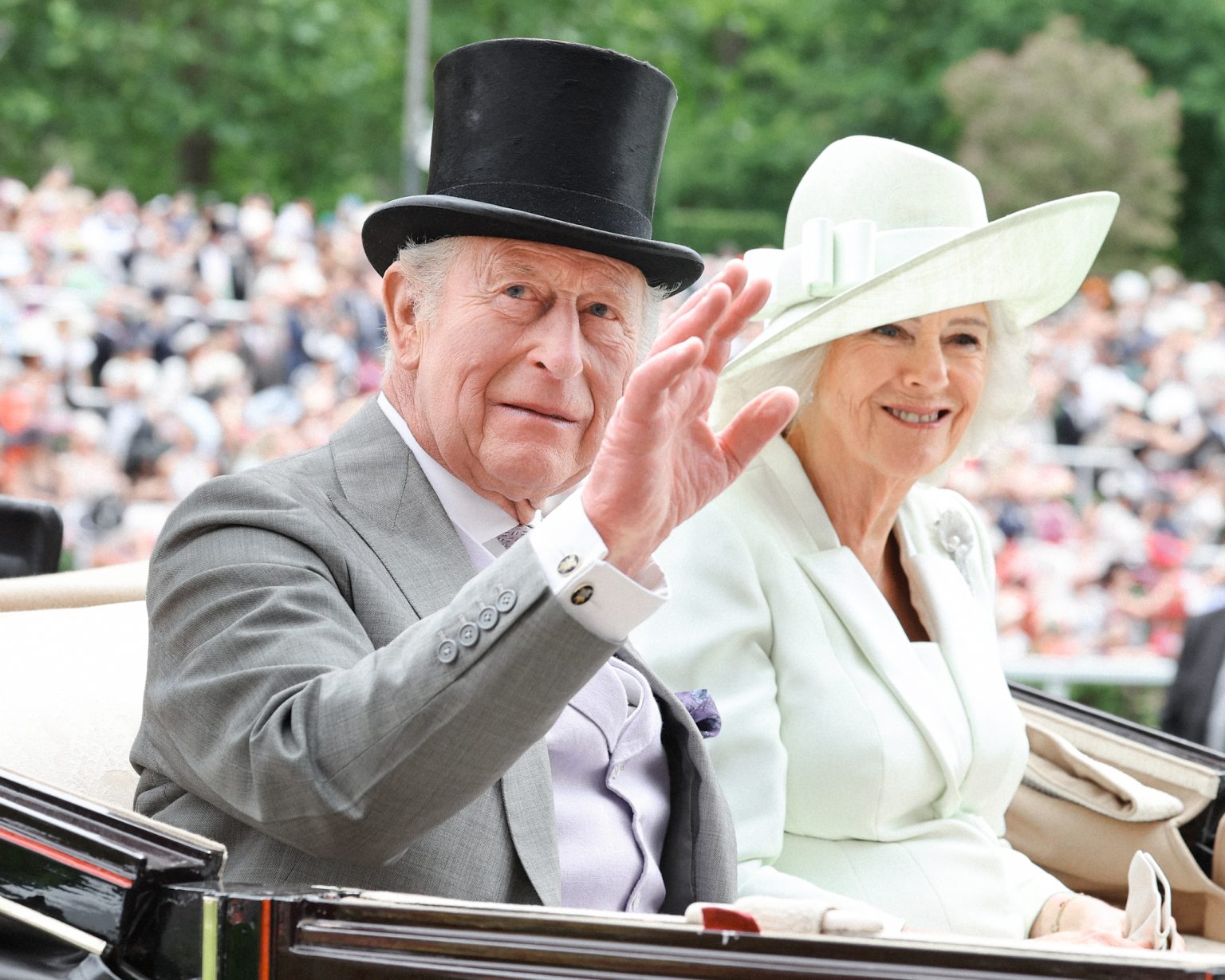
Ascot, England, 18 June 2026: King Charles III and Queen Camilla smile and wave as they attend day three of Royal Ascot 2026 at Ascot Racecourse. Photo: Chris Jackson/Getty Images
|
Given that the title is so closely associated with English Protestantism, many readers may be unaware that “Defender of the Faith” was first conferred by Pope Leo X in 1521. The Roman pontiff awarded it to Henry VIII, who in the early years of his reign had been a conventionally Catholic monarch and who had been so outraged by the heresies of Martin Luther that he had taken the time to write Assertio Septem Sacramentorum – the defense of the seven sacraments.
Later, when the king came to be so fond of one of those seven sacraments that he indulged in it on six separate occasions, he found it necessary to divorce the Church in England from the Church of Rome. Yet he decided to keep the title of Defender of the Faith in perpetuity. Each of his 22 successors has borne it since – even Mary I and James II, both of whom reigned as Catholics. Charles II converted to Catholicism on his deathbed, but reigned as a Protestant.
For over 400 years, the reigning monarchs of England and then the United Kingdom have used the title to symbolize their supreme governorship of the Church of England and the Crown’s role in the defense of English Protestantism. Until last week, at any rate.
A New Royal Role
A few days ago, Charles III released a slew of documents concerning the British monarchy, including, for the first time, the amount of personal tax he voluntarily pays. But buried in those documents was a key revision to the role of the monarchy: the king, according to the documents, no longer sees his role as being “Defender of the Faith” but instead, in a redrafted job description from the Palace, as to “protect the space for faith within the multi-faith nation”.
Quietly, and without any public debate, the United Kingdom is no longer a Protestant nation.
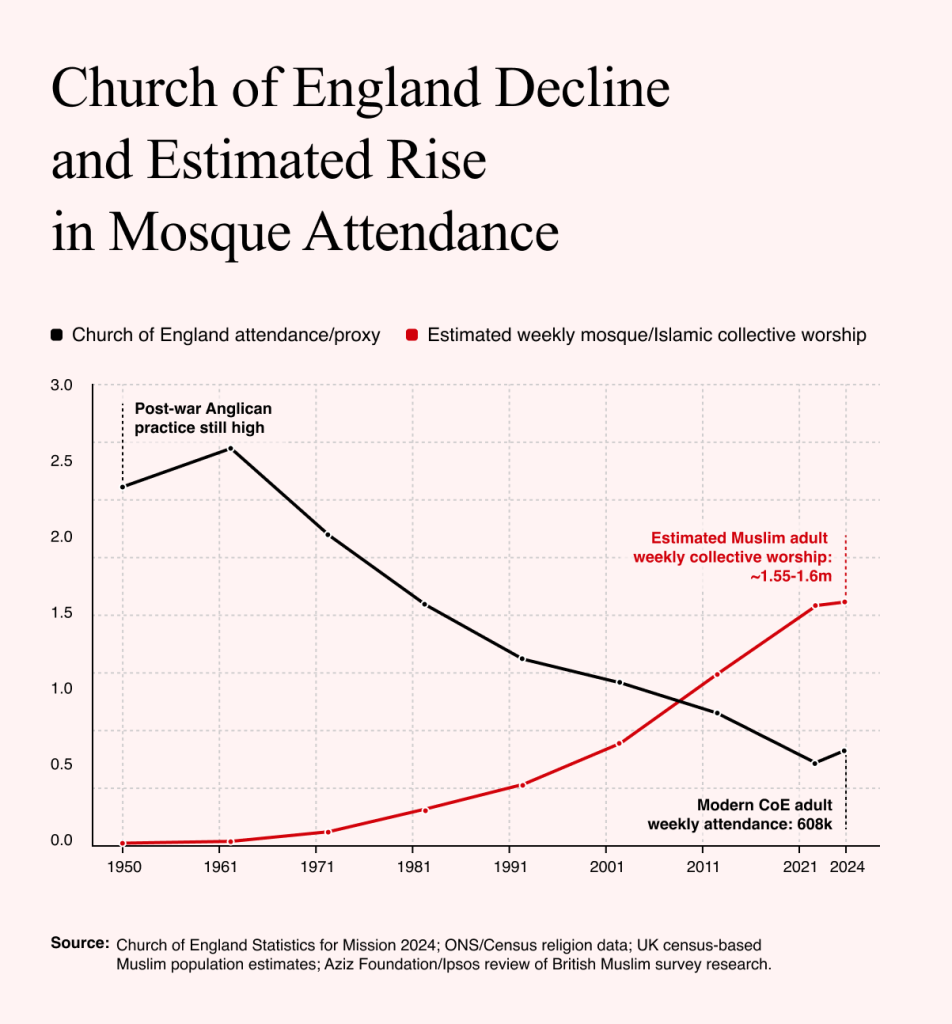
Unofficially, of course, this has been the case for decades. The most recent figures suggest that only about 608,000 people – roughly one in every 90 British adults – attend a Church of England service at least once a week. It might be argued, then – albeit with tongue in cheek – that the bearers of the title “Defender of the Faith” have not done a very good job.
Indeed, using a conservative estimate that approximately 55% of British Muslims attend a mosque at least once a week, the practice of Islam is now three times more prevalent in the United Kingdom than the practice of what remains the official state religion.
Source: Church of England, ONS religion data, UK census-based estimates, Aziz Foundation/Ipsos
A Protestant King in a Godless Nation?
For the monarchy, this presents an obvious legitimacy problem. By law, the occupant of the throne must be a Protestant, yet English Protestantism – at least as practiced by believers – is now a distinct minority pursuit within the realm. For centuries, for example, English Catholics have complained that a member of the House of Windsor who converts to Rome becomes automatically disbarred from the succession. Indeed, the king is the only person in the British constitutional structure – clergy aside – whose religious practice is mandated by law.
What Charles is doing, then, for perhaps strategic as well as personal reasons, is – in the best spirit of Henry VIII – attempting a quiet divorce between the British monarchy and Anglicanism.
On paper, this should not be unpopular. The small-scale practice of Anglicanism within his kingdom should mean that, in theory, the king offends very few of his subjects by subtly shifting the Crown away from that particular faith and becoming, as the modern world demands, more inclusive. Yet his decision last week has provoked a degree of consternation among Britons, even those who do not practice Anglicanism, because it is being taken as another sign of a fraying British national identity.
After all, oceans of blood were spilled throughout history to keep England Protestant – from Elizabeth I’s repulsion of the Spanish Armada through the Jacobite wars against those who fought for a Catholic Stuart monarchy. Much of Britain’s great architecture and buildings are closely associated with Anglicanism, and its great national hymns and anthem all have a distinctly Anglican theme. To many, for the king to step away from the defense of Protestantism and adopt a more generic “pro-religion, whatever that religion might be” disposition is an abandonment not only of the Crown’s historic role, but also of Britain’s distinct national character.
Criticism rolled in all weekend: David Campbell Bannerman, the former Conservative Party MEP, described the king’s decision as “deeply worrying”, while reports suggested “disquiet” within royal circles at the king’s perceived redefinition of his role. On social media, the reaction was scathing.
Be Slow to Doubt the Survival of the House of Windsor
Yet, from the point of view of the monarchy, what the king is doing makes a degree of sense. The British monarchy is one of very few in Europe to have survived without interruption over the past four centuries, and the House of Windsor has a track record of flexibility. Charles himself is the first divorcee in history to take the throne. (Henry VIII was never technically divorced – his marriages were annulled, cut short by death or severed by the executioner’s axe.)
The Royal House divorced itself from its German ancestry during the First World War in order to maintain its legitimacy. The king now voluntarily pays tax on his personal income, even though the law does not, and could not, require it.
The survival of the institution officially requires no popular legitimacy, but unofficially depends entirely on the consent of the king’s subjects. His subjects having abandoned English Protestantism en masse, the narrow political analysis suggests that the king would be a fool to associate the monarchy so closely with such a minority religion.
The larger questions, of course, concern why it is that Anglicanism has fallen into such disfavor: it is the most openly progressive of the major Christian denominations, has made immense concessions to modernity by appointing female clergy and opening up the space for LGBT people in its ranks, and generally appears to spend as much time preaching about climate change as it does salvation. Yet despite all that, church attendance continues to decline, and the relevance of the Church continues to dwindle. So much so that now even the king – himself the classic example of a modern Anglican in terms of his sensibilities – no longer feels able to identify himself exclusively with his own faith.
Over the last century, Britain has lost an empire, much of its global power and now, increasingly, its faith. That the monarchy still stands while much around it crumbles is probably more a testament to the flexibility of that institution than it is to anything else: after all, Britons who have abandoned their faith in religion seem to retain a sentimental attachment to the House of Windsor. Even as the pomp and ceremony of royal occasions increasingly serves as the last remaining echo of a historic culture that has long since lost almost all of its unique DNA.
Welcome to the comments section of the Štandard daily. Please take note of our guidelines, comments are moderated by us. You can contact the moderators at support@statement.com.
Participate in the discussion
Comments are available to subscribers only. If you'd like to join the discussion, choose a subscription starting at €6.72 per month.
All comments 0
Register
Comments are available to registered users only. If you'd like to join the discussion, register here.