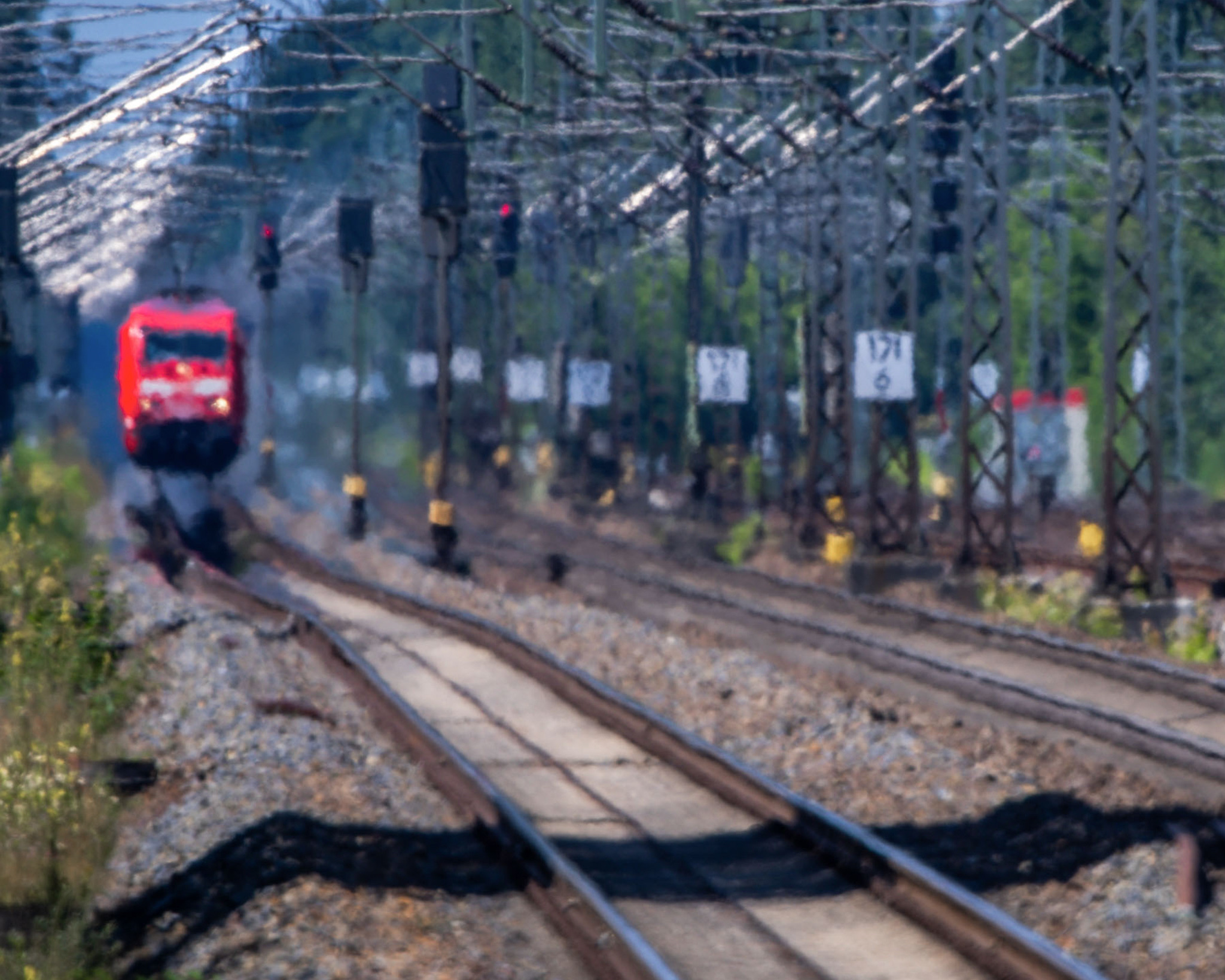
As the augurs once did in ancient Rome, so today legions of official and unofficial meteorologists are busy explaining to Germans why the weather of the moment is unique and therefore a menacing sign of the globe’s imminent death by heat.
Accordingly, last weekend’s headlines were once again breathless. The map of Germany in the media first turned red, then dark red and finally redder still, so that no one could miss the message: Germany was virtually in flames. New heat records were reported by the minute.
Yet the weather was not quite as exceptional as all that. The heat was caused by an area of high pressure over Central Europe which, together with two low-pressure systems to the west and east, pumped hot air from Africa into Central Europe and, because of its stability, formed a heat dome.
Meteorologists call this an omega weather pattern because the isobars on a weather map form the shape of the Greek letter omega.
Such weather patterns have always existed. What is true, however, is that extremely hot summer days are becoming more frequent and the peak temperatures reached are rising. But one does not need a meteorologist to understand that. A conversation with a farmer or a winemaker is sometimes far more revealing.
One might also learn that heat cannot be prevented, but that societies can adapt to it. They can do so, for example, by maintaining infrastructure capable of withstanding ten high-summer days without immediately buckling.
In large parts of Asia, Africa, Australia and America, it is generally hotter than in Germany, yet daily life does not collapse. Only in Germany does an atmosphere of doom take hold as soon as the thermometer passes the 30C mark.
Air Conditioning as Cultural Suspicion
That may also have something to do with the advice public broadcasters offer to a sweating population. The news editors at Zweites Deutsches Fernsehen advised people to ventilate only when it is cooler outside than inside, which, at more than 30C, is a fairly superfluous tip.
The idea of keeping windows closed during the day hardly cools down an overheated flat either. And the advice to switch off electrical devices and roll up carpets because the latter store heat can, at best, pass for satire.
There is, of course, a very simple way to protect against heat and cool a room: air conditioning. Anyone who has ever traveled in Asia or the United States knows how impressively effective these devices can be, turning even the largest hall into an Arctic frost zone in the middle of summer.
In the United States in particular, one sometimes gets the impression that the aim is to put fellow citizens through a permanent cardiovascular stress test by sending them back and forth between hot, humid outdoor air and ice-cold interiors.
Germany is very different. Here, air conditioning is met with suspicion. Air conditioners are frowned upon. And even when they are available somewhere, for example in a suitably equipped hotel room, people do not use them. Where this German aversion comes from is somewhat mysterious.
A Very German Discomfort
There is, however, much to suggest that a deep-seated anti-Americanism is being expressed here. Since the Second World War, the average German has known that Americans are essentially a soft and spoiled people who live on cheeseburgers, drink cola with lots of ice, walk around in trainers and keep their rooms far too cold.
This narrative has proved so enduring because it fused the cultural contempt for America of the wartime generation with the political anti-Americanism that emerged after 1968.
From the 1980s onwards, the environmental movement was added to the mix. For those seeking simple and alternative ways of life, air conditioning was an absolute no-go.
Then, when traditional environmental protection was replaced by climate protection in the 1990s, air conditioners came to be seen not merely as an expression of affluent decadence but as pointless energy guzzlers.
In principle, that is true. Ice-cold flats when it is 35C in the shade are just as questionable from an ecological point of view as detached houses heated so intensely in the depths of winter that their residents walk around in T-shirts.
But equipping all public buildings, administrative offices and business premises in a large city with modern air-conditioning systems would hardly increase total annual electricity consumption significantly. That is also because in Germany the 30C threshold is exceeded on only about 11 to 12 days a year.
The Moralizing of Cooling
The waste heat from these systems is a somewhat more serious problem, as anyone who has spent time in a large city such as New York can attest. Air conditioners remove heat from interiors and release it outdoors.
There, the already warm urban air heats up even further. Studies of American, European and Asian cities suggest that a high density of air conditioners can raise average inner-city nighttime temperatures by 1C to 2C.
Air conditioners are therefore not a panacea. Using them across the board is unnecessary, at least in Central Europe. But the wholesale demonization of air conditioning, which can be observed especially in Germany, is reckless.
Even in German hospitals, only intensive care units tend to be equipped with air conditioning. Most other wards, including those with elderly patients or people who have just undergone surgery, have to endure high-summer days without efficient cooling.
During the last heat wave, temperatures on the cardiac ward of the University Hospital Düsseldorf reached 38C. That is a disaster for patients and staff alike. In response, however, the hospital is not discussing the purchase of air conditioners but wants to develop a “heat protection plan”.
Yet Germany’s aversion to air conditioning has devastating consequences beyond hospitals too. Every year, an estimated 3,000 people in Germany die as a result of heat. In especially hot years such as 2018, the number of heat-related deaths is put at up to 8,000, most of them elderly people.
One reason is that care homes and nursing homes are also rarely equipped with air conditioning. The same, incidentally, applies to schools and kindergartens.
By this point at the latest, the hypocrisy of green climate policy becomes obvious. Instead of equipping the places where vulnerable people spend time with air conditioning in response to hot summer days and even hotter city centers, the Greens and their supporters prefer to rely on drinking more water, cooling points, adjusted working hours and sunscreen.
Only the simplest solution seems to occur to no one: air conditioning.
Cooling Is Not a Luxury
Modern air-conditioning systems consume far less energy than the power guzzlers of the past, and on sunny summer days that power could in any case come from solar energy. More air conditioning therefore does not necessarily mean more CO2 emissions.
That is why even the UN Environment Programme, usually a loud voice warning of climate catastrophe, recommends air conditioning. “In a warming world, cooling is a necessity, not a luxury.”
No one has to die from heat, as the World Health Organization also stresses. What is needed is not water dispensers and heat officers, as the Greens believe, but air conditioning.
The fact that, in percentage terms, more people die from heat in Germany than in the Gulf states or the United States is due entirely to green ideology and to a stubbornness that extends far beyond the Greens.