The Entrepreneur, Not the Price: Weiying Zhang on Economics’ Blind Spot
In an interview with Statement, Chinese economist Weiying Zhang explains why markets cannot be understood through prices alone and why the entrepreneur is the true driving force of economic progress.
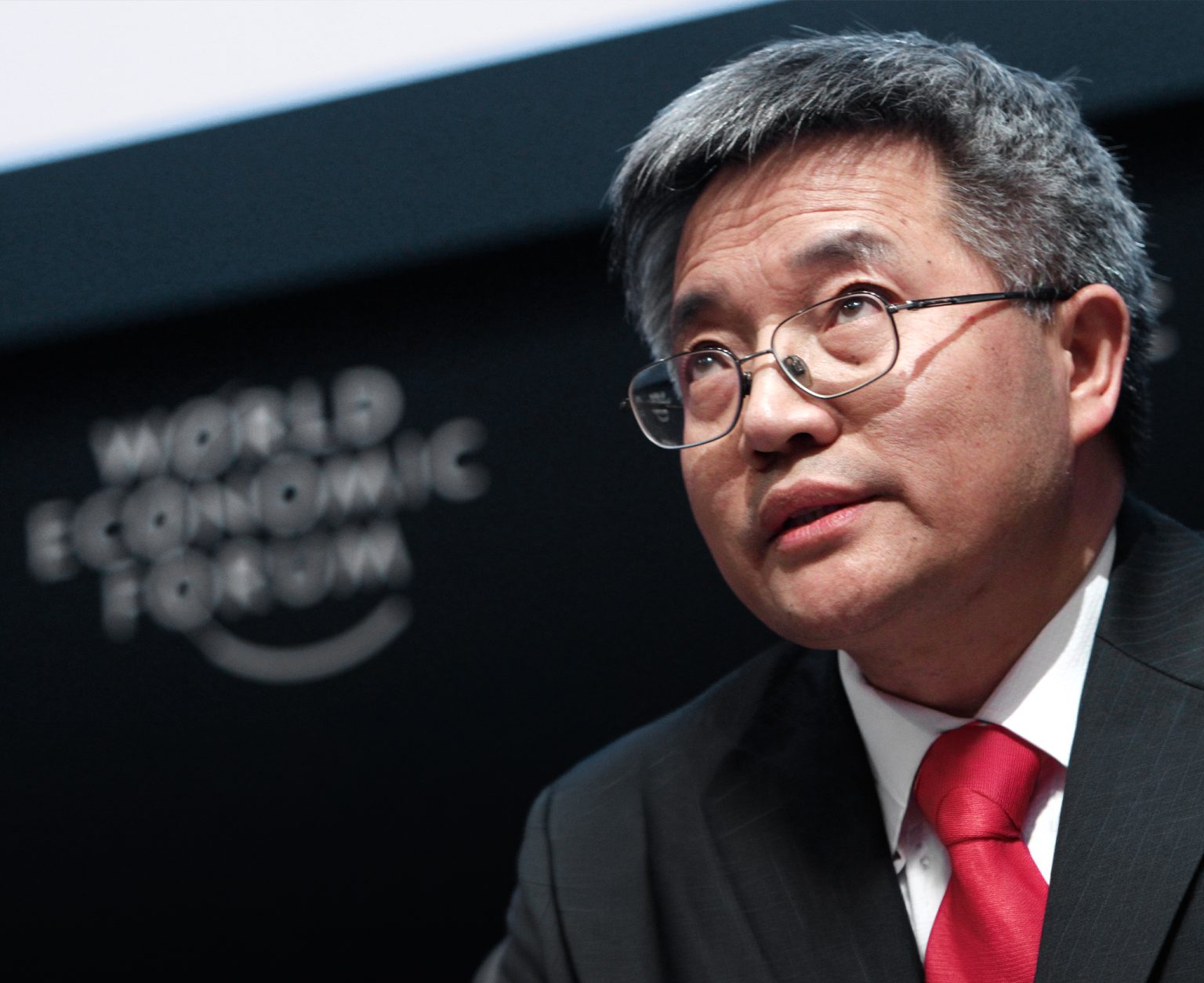
Weiying Zhang at the World Economic Forum in Davos. The Chinese economist argues that the entrepreneur, not the price, is the true driving force of economic progress. Photo: Virginia Mayo/AP/Profimedia
|
Some ideas struggle to be heard. One of them is this: price is not what matters most in a market economy. The entrepreneur is.
Weiying Zhang, Boya Chair Professor of Economics at the National School of Development at Peking University and chief economist of the China Entrepreneurs Forum, has made this idea the work of a lifetime.
In 1984, at the age of 24, he became the first Chinese economist to propose the dual-track price system, one of the cornerstones of China’s early market opening. Four decades later, he has set out the full arc of his thinking in his 2024 book Re-Understanding Entrepreneurship, published by Cambridge University Press.
In an interview with Statement, Weiying Zhang explains why economics banished the entrepreneur from its models and what it thereby failed to understand about the market itself.
From Price to Entrepreneur: An Overdue Shift in Perspective
Neoclassical economics, Zhang’s central objection runs, has focused on price as the great coordinating mechanism. It gathers dispersed knowledge, directs resources and resolves the economic calculus. All this is true, but it is incomplete. Price is not a natural phenomenon that precedes the market. For a genuinely new product, it simply does not yet exist. Whether something will sell, and at what price, depends not on a given signal but on the imagination of the person who first brings it into being.
Remove the human being from the equation, Zhang argues, and one also loses any real grasp of how markets actually work. Economics therefore needs to move from a price-centric to an entrepreneur-centric model. Only this, he contends, can properly explain the economic development of the West over the past two or three centuries and of China over the past four decades.
The neoclassical view, which essentially confines itself to the allocation of given resources by market or state, is, in his words, “very misleading”. It lacks the decisive category: the market’s capacity to bring forth something that did not exist before.
This is where Zhang makes a striking correction that goes back to Joseph Schumpeter. The textbook assumption that entrepreneurs simply maximize profit, he says, falls short. For the great entrepreneurial figures, profit is less an end than an instrument, a means of pursuing three deeper goals.
First, there is the dream of building a commercial kingdom, an organization that gives work and purpose to many people. Second, there is the will to prove oneself: to show that one can achieve what others cannot. Third, and here Zhang strikes an almost existential note, there is the sheer joy of creation itself: doing something no one has done before, or something others have tried and failed to do.
This reversal, Zhang notes, can be tested empirically. Standard economic reasoning would predict that as wealth grows, the marginal utility of additional wealth declines. Richer entrepreneurs, on this logic, should work less. Reality shows the opposite: those who become richer very often work harder. That can only be explained, he argues, if one accepts that entrepreneurs pursue a goal beyond profit.
None of this diminishes profit in Zhang’s account. Quite the opposite. It performs a second, socially indispensable function: discipline. Whoever fails to make a profit has not demonstrated the right to tie up society’s resources. Profitability shows that the value created exceeds the cost of the resources used. Zhang’s foil here is the politician or state official, who can operate without any comparable profitability constraint, on the grounds that money is not the point. That, he warns, is precisely where the danger to a society’s prosperity lies.
Management Is Not Entrepreneurship
One of the sharpest ideas in the conversation is Zhang’s distinction between managerial and entrepreneurial decisions. Managerial decisions, he says, operate with given resources, given preferences and given technology. One simply calculates the optimum.
Entrepreneurial decisions, by contrast, are directed at a future that is not given but partly shaped by the entrepreneur himself. In a company, this category may account for perhaps only 5% of all decisions. Yet it is the most consequential 5%. When successful firms collapse after years of prosperity, Zhang observes, the cause is rarely mismanagement. It is usually the loss of entrepreneurial instinct and the habit of treating entrepreneurial questions as if they were managerial ones.
By way of illustration, Zhang recounts the story, often told in the industry, of how Intel responded some 20 years ago to Steve Jobs’s request that it manufacture chips for the first iPhone. A team of engineers, marketing specialists and financial analysts produced a careful feasibility study and concluded that the project could not be made profitable. Actual sales of the first iPhone went on to exceed every such forecast many times over.
The error, in Zhang’s reading, lay not in the calculation itself, but in answering an entrepreneurial question with the tools of management: using available data to judge a future whose defining feature was that it did not yet exist in any data set.
Steve Jobs’s first iPhone features in Zhang’s account of how Intel mistook an entrepreneurial question for a management problem. Photo: Angga Budhiyanto/Zuma Press/Profimedia
Risk Can Be Calculated, Uncertainty Cannot
Here Zhang draws explicitly on Frank Knight, who in his 1921 book Risk, Uncertainty and Profit distinguished between two categories that the scientific mainstream later carelessly collapsed into one. Risk means that one knows the probability distribution of possible outcomes. One can calculate. Uncertainty, by contrast, refers to the genuinely new, for which no such distribution exists. There is a difference, Zhang insists, between what is possible and what is probable, and the two are routinely confused.
Crucially, entrepreneurial uncertainty is usually endogenous rather than exogenous. Whether it rains tomorrow is an external, independent fact one tries to forecast. Whether a new product succeeds depends on one’s own actions. Act differently, and the outcome changes.
Zhang’s example is simple: had the Wright brothers never imagined the airplane, it would never have existed. The future is not predetermined. It depends, at least in part, on our choices, and our choices in turn depend on our imagination.
Judgment, Imagination and the Limits of AI
From this distinction, Zhang develops a pointed argument about artificial intelligence. Every form of machine learning, he notes, ultimately rests on statistical regression: past data are used to extrapolate the future. But that, he warns, is precisely the logic of management, not of entrepreneurship. The common but mistaken assumption is that more knowledge and more data should reduce uncertainty. In fact, Zhang observes the opposite: as knowledge grows, uncertainty grows with it. That is why conventional education is of only limited help in this respect.
Imagination, the ability to conceive of what does not yet exist, cannot be replaced by any machine. Zhang sees the real promise of AI not as a rival to human judgment but as a means of relieving it. Since time is the truly scarce resource, AI can give people more time for encounters, experience and precisely the kind of practice from which imagination grows.
At the same time, he warns against a trap of convenience. Those who rely too heavily on machine-generated answers risk losing their own capacity for judgment. Judgment presupposes that a question has no single, clearly correct answer. If such an answer existed, judgment would not be required. Calculation would suffice.
A Cake That Grows
Neoclassical theory implicitly treats social wealth as a fixed pie that prices merely distribute among market participants. Entrepreneurs, however, create something out of nothing: added value that did not previously exist. Those who want to serve consumers and make a profit must offer them something they value. Those who want to retain employees must satisfy them. For Zhang, the true achievement of the market is therefore not the distribution of a given cake, but its expansion.
Prices are indicators of how well entrepreneurs succeed in this task. Anyone who fails to make a profit creates no added value and should not tie up resources. This way of thinking is diametrically opposed to a view now widespread in Western states, in which profit is treated as morally evil.
Zhang analyzed “first- and second-order problems”, borrowing the distinction from mathematics, in a much-discussed 2024 speech to graduates of the National School of Development. First-order problems concern principles and systems: whether a society chooses a market-oriented order governed by the rule of law, or falls back toward a planned economy and the rule of men rather than law. Second-order problems, by contrast, concern specific economic policy measures, such as fiscal and monetary stimulus, export promotion or sectoral interventions in industries such as real estate.
Zhang reduces the distinction to a concise formula: first-order questions concern the “path”, while second-order questions concern the “technique”. His central criticism of the current economic policy debate in China is that it loses itself almost entirely in technique, while the actual path remains undefined.
The famous dual-track system of China’s price reform from 1985 fits into this framework as a prime example of a pragmatic second-order instrument that served a first-order transformation. Instead of abruptly replacing planned prices with market prices, a rupture that would have directly challenged the existing system and mobilized corresponding resistance, China allowed planned and market prices for the same goods to coexist. State-owned enterprises continued to fulfill their planned delivery quotas at administered prices, while quantities produced beyond those quotas could be traded at market prices.
This structure made it possible to expand the market share gradually without abolishing the old structures at once. It was a policy of silent displacement through growth at the margins of the system, rather than through its destruction. For Zhang, that is the key point. The dual-track system was itself only a second-order question, a clever transitional mechanism. Its meaning became clear only in light of the underlying first-order decision to move toward a market economy in the first place.
Zhang justifies this priority of first-order over second-order questions by pointing, among other things, to the three major growth surges of China’s reform era: 1984, the period after Deng Xiaoping’s Southern Tour in 1992 and the period after China’s accession to the World Trade Organization (WTO) in 2001. None of these surges was triggered by monetary or fiscal stimulus. Rather, they resulted from the resolution of first-order questions.
Zhang summarizes the principle behind Deng’s opening in the formula “open to the outside, liberalize on the inside”. For him, internal liberalization was the true core: trust in individual initiative, entrepreneurial creativity and the superior capacity of decentralized decision-making over central planning in processing information.
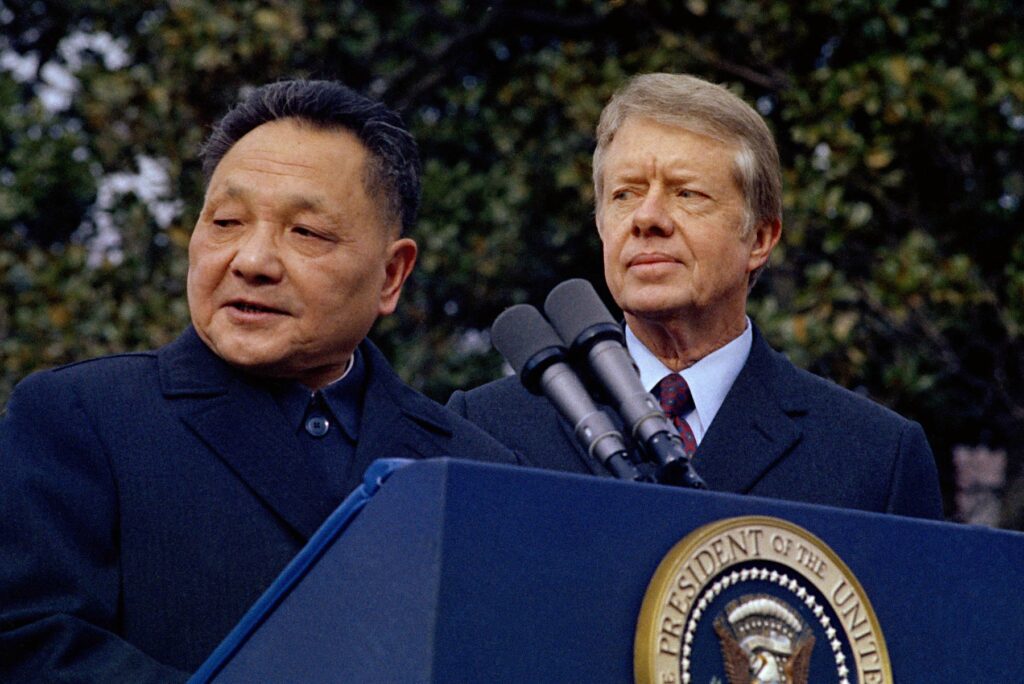
Chinese Vice Premier Deng Xiaoping with then US President Jimmy Carter outside the White House in Washington on 29 January 1979. Deng’s visit marked an early moment in China’s opening to the world. Photo: Anonymous/AP
Freedom, Property and the Direction of Reform
Here the circle closes with personal freedom and the protection of property, which for Zhang are not merely moral additions but hard economic fundamentals. According to his analysis, entrepreneurial confidence, the real resource on which growth depends, cannot be created by monetary incentives or any form of industrial policy. It can be created only by the credible and lasting assurance that property and personal freedom are protected from arbitrary state power. When freedom expands and the rule of law advances, confidence grows of its own accord. When freedom retreats and the rule of law erodes, confidence disappears as well.
If the direction is right, the pace is not decisive. If the basic direction is wrong, however, nothing can succeed.
Finally, Weiying Zhang offers a piece of advice especially to citizens of Western states: one should never confuse “because of” with “despite”. China did not become great and successful because the state intervened, but despite that intervention.
The less the state interfered, the greater the prosperity.
Welcome to the comments section of the Štandard daily. Please take note of our guidelines, comments are moderated by us. You can contact the moderators at support@statement.com.
Participate in the discussion
Comments are available to subscribers only. If you'd like to join the discussion, choose a subscription starting at €6.72 per month.
All comments 0
Register
Comments are available to registered users only. If you'd like to join the discussion, register here.