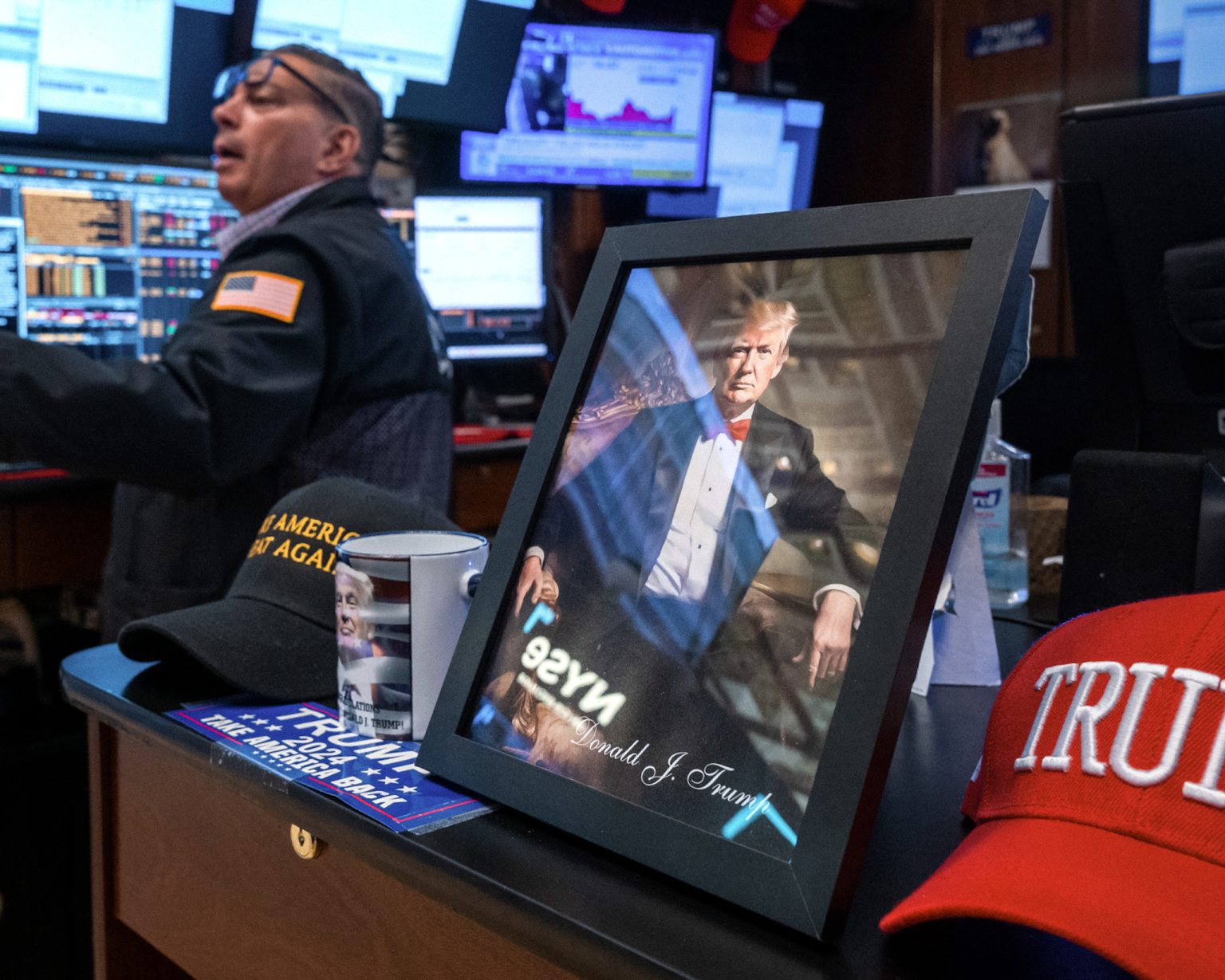
It is relatively common for American politicians to own stocks. In that respect, they are no different from many middle- and upper-class Americans who have disposable income to invest. From a European perspective, this may seem ethically problematic. Politicians are, at the very least, exposed to conflicts of interest and often have access to information unavailable to ordinary investors.
The American approach, however, has traditionally relied more on asset disclosure and transaction transparency than on banning politicians from investing altogether. As Max Weber argued, Protestant culture linked economic success with diligence, discipline and sometimes even divine favor.
Even European rules are far from foolproof. Politicians determined to conceal the true ownership of investments or circumvent disclosure requirements can usually find a way.
Tracking the investment activity of American politicians has become a favorite pastime for professional investors, amateur traders and political observers alike. Every unusually successful trade raises the same question: was it simply a shrewd investment, or did it benefit from information unavailable to the wider market?

You might be interested
New Fed Chair Tears Up the Rulebook
Political Capital on Wall Street
One of the most closely watched portfolios has long belonged to the family of Democratic politician Nancy Pelosi. The trades themselves were largely executed by her husband, Paul Pelosi, an experienced investor.
Nevertheless, Pelosi's name has become synonymous with congressional stock trading. That is due not only to the remarkable performance of some investments, but also to their timing in sectors simultaneously under consideration in Washington.
As a result, numerous databases, social media accounts and investment strategies now track the trades of members of Congress. Although financial disclosures are published only after a delay and do not, by themselves, prove the misuse of privileged information, they remain valuable because they reveal where politicians and their families are willing to invest their own money.
Trump's Investment Empire
As with almost everything Donald Trump does, his investments are defined by their scale.
While most US presidents follow the unwritten tradition of placing much of their wealth into a blind trust before taking office, Trump has chosen to retain indirect control over most of his assets.
He has also taken a markedly different approach from his first term. During his previous presidency, Trump disclosed 517 stock transactions. Joe Biden reported just 13 transactions during his entire four years in office. In 2025 alone, however, Trump disclosed more than 22,000 trades – an average of more than 60 transactions every day.
According to mandatory financial disclosures, Trump's investment accounts grew from at least $237m to $858m in 2025. His total income, excluding his presidential salary, exceeded $2.2bn. The Financial Times estimates that his stock purchases totaled between $461m and $1.4bn, while sales ranged from $138m to $433m.
Yet the biggest driver of Trump's wealth was not the stock market. Roughly $1.4bn came from cryptocurrency ventures. His real estate portfolio, hotels and golf courses – the businesses that originally made him a billionaire – generated about $575m. For the first time, those traditional assets were eclipsed by his digital token business.

You might be interested
Middle East Relief Cheers Investors, but BMW Hits a Wall
Tax Returns Beyond Further Audit?
In Trump's case, the issue is less individual trades than the sheer scale of his investment activity. Because of his political and business profile, almost everything he does has the potential to move financial markets.
Trump has shown little concern about the ethical implications. In May 2026, his Justice Department reached an agreement preventing the Internal Revenue Service from reopening older tax returns filed by Trump, his sons and affiliated companies. Although this was not a presidential pardon, critics argue that the practical effect is similar, placing years of tax filings beyond further federal scrutiny.
Trump argues that no conflict of interest exists because he does not personally execute individual trades. According to his office, his investment accounts are managed independently by outside financial institutions that make decisions without his direct involvement.
It is, of course, difficult to imagine that the president personally executes more than 60 trades a day. But that does not address the central issue. Trump remains the beneficial owner of investments whose value can be influenced by decisions made in the White House.
Trump's Explanation
Trump offers a straightforward explanation for his financial success: the US stock market has risen.
Between the November 2024 presidential election and early July 2026, the S&P 500 gained roughly 30%. Although investors faced two major shocks during that period – sweeping tariff announcements on 2 April 2025, followed by the war with Iran – US equities recovered from both setbacks and once again approached record highs.
"We're all profiting", Trump said while discussing his investment income.
The argument follows a clear logic. He publicly supports American companies, encourages citizens to invest in the domestic economy and does the same himself. From his perspective, he is not secretly enriching himself at the public's expense but openly backing America's economic success.
You might be interested
How Could Trump Cut Off Trade with Spain?
A New Relationship Between the White House and Wall Street
The controversy is that Trump does more than express general support for American business. He has also publicly praised companies whose shares he owns.
The clearest example is Dell. During the first quarter, Trump purchased roughly $5.1m worth of Dell stock before urging Americans to buy the company's computers. Dell shares rose following his remarks.
He has also publicly endorsed companies including Micron, Intel, AMD and Hewlett Packard Enterprise, highlighting their investments in semiconductor manufacturing and technological infrastructure in the United States.
His portfolio also includes Nvidia, Broadcom, Apple, Alphabet, Microsoft, Meta and numerous other technology companies. That does not automatically mean every holding becomes an investment recommendation. In many ways, that is the genius of Trump's strategy.
When the market rises, he benefits as an investor. When he praises a company, he can point to its performance as evidence that his economic policies are working. Future presidents may find it much harder to separate public office from private wealth.
Americans may soon grow accustomed to a president who is not only commander-in-chief and chief architect of economic policy, but also one of Wall Street's most influential stock pickers. The relationship between the White House and financial markets has entered entirely new territory.