Is Proportional Representation Making Europe Ungovernable?
The PR electoral systems used across Europe are designed to empower voters and ensure that every voice is heard – but is the reality, as a new Italian paper suggests, very different?
Slovenian Prime Minister Janez Jansa and his wife, Urska Bacovnik, cast their ballots in Ljubljana in 2022. Slovenia is one of many European countries that elects its parliament largely through proportional representation. Photo: Ales Beno/Anadolu Agency via Getty Images
|
The Italian Rosatellum system for elections is deeply flawed and places significant choice over who wins seats in parliament in the hands of officials, a new – and convincing – academic paper reports.
The paper, titled One Vote, Several Parliaments: An Empirical Analysis of the Algorithmic Ambiguity of the Italian Electoral Law on the 2022 General Election Data, is authored by Pablo Coppola, a former Italian MP and current data scientist, and the claims it makes are objectively remarkable. They should cast some doubt not merely on Italy’s system, but on the broader European faith that proportionality is always synonymous with democratic fairness.
To understand those claims, one must first understand the competing objectives of the Italian electoral system. That system, like many others in Europe, splits seats between constituency MPs and those elected by a national list. However, where it differs from many other systems is that it also mandates that parties must receive seats in direct proportion to their share of the national vote. What this means in practice is that constituency seats cannot be won by candidates whose victory would imperil the perfect proportionality of parliament.
Where the ambiguity in the system arises is in how the final seats are allocated: Italian law is entirely silent on what methodology should be used. It mandates only that an outcome – strict proportionality – be achieved and leaves the mechanism for deciding that outcome in the hands of officials, rather than voters.
Coppola’s research translated the statutes governing Italian elections into code and asked AI and other advanced computing tools to examine the result of the 2022 Italian general election. What he found was that, just by introducing small tweaks to the interpretation of the law by those who count the votes, more than 560 different electoral outcomes were possible. While the majority of the changes were at the margins, Coppola’s research makes clear that, for the final few seats in the Italian parliament, the decisions of the administrators and the algorithm overseeing the voting system have a vastly greater say than the actual choices of voters.
The Fascination With Proportionality
Europe has long favored proportional electoral systems over the more majoritarian systems preferred in the British Commonwealth and Anglosphere. The appeal of such systems is straightforward: they suppose that the makeup of parliament should exactly reflect the preferences of the electorate, meaning that all strands of opinion are fairly considered and represented when laws are made.
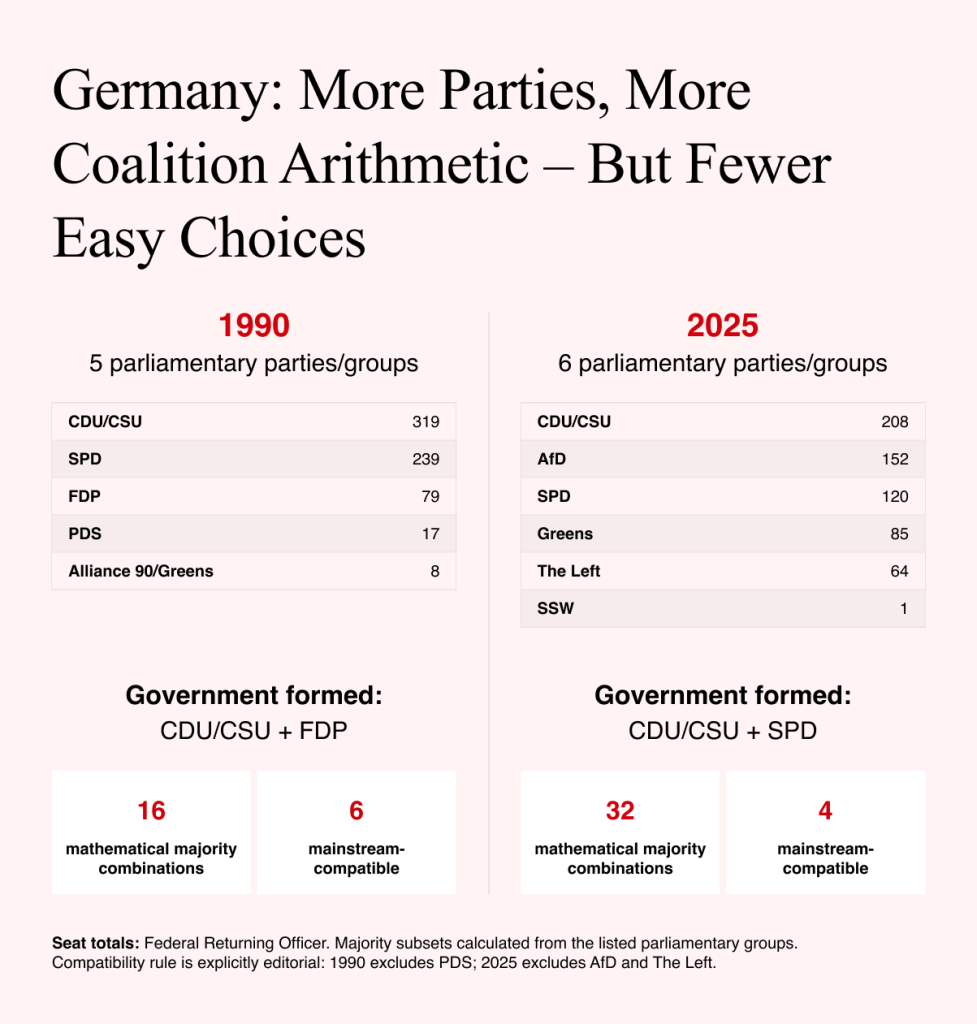
Yet, in an era where political opinion is ever more fragmented, proportional systems increasingly promote instability and fractiousness. For example, in Germany in 1990, there were 16 possible coalition governments open to voters. Today, there are at least 28 possible coalitions, mathematically.
Source: ChatGPT
The net effect of this can be oddly anti-democratic: increasingly, in Europe, the choice as to who governs is only partly in the hands of voters and is often resolved post-election by negotiations among parties who, between them, can barely muster the support of a majority of the population.
This system of fragmentation poses enough of a challenge to voters and democracy by itself, but it is also ripe for abuse. Witness, for example, the “cordon sanitaire” approach that political insiders take in many European nations to the so-called “far right”, in which all parties declare that they shall not enter government with such a party.
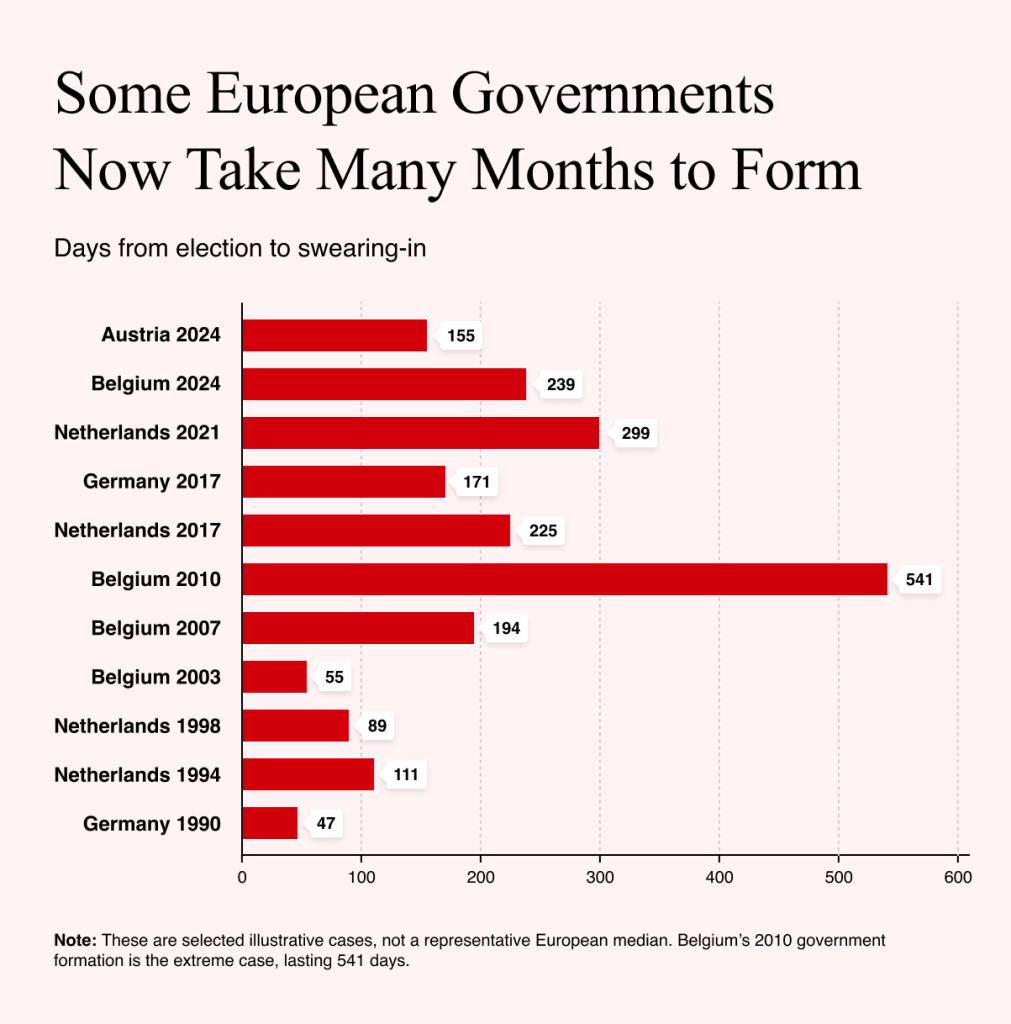
Another problem is the length of time it takes to form coalition governments, meaning that, in many cases, elections now cause instability rather than promote decisive democratic change or decision-making. An extreme example of this is Belgium after the 2010 election, when the country had a caretaker government for a year and a half.
Source: ChatGPT
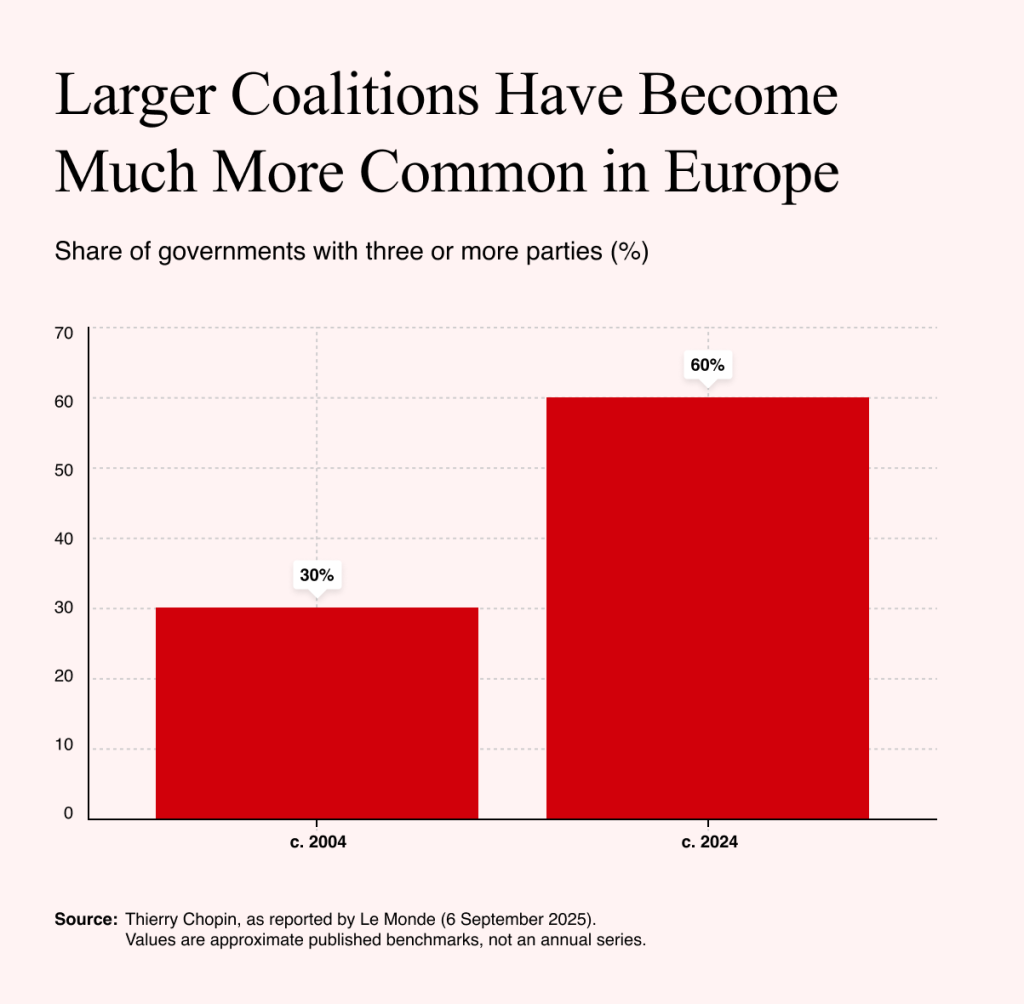
Finally, the makeup of European governments has become much more fragmented. In 20 years, the number of European governments comprising three or more parties has doubled:
Source: ChatGPT
Arbitrary Governance
The Italian paper reported above introduces another problem: that many proportional systems are designed or interpreted either in arbitrary ways or in ways that are systemically biased.
For example, under the single transferable vote system used in Malta and Ireland, voters are asked to rank candidates according to preference, with those preferences flowing from unpopular candidates toward second and third choices. Because a voter on the right will generally prefer centrists to candidates of the left in their later choices, and vice versa, the system can create a significant advantage for centrist parties, especially those capable of attracting transfers from both sides.
Limited Chances for Change
Perhaps the most damning problem, though, is this: the majoritarian systems used, for example, in the UK and the USA empower voters definitively to change the government in favor of another. The PR systems used in Europe largely deny voters that choice. Unpopular prime ministers can cling to power on less than 20% of the vote simply by assembling new coalitions. Small parties are often granted an outsized influence over policy in return for their votes.
This latter point, for example, almost certainly helps explain the disproportionate influence of Green parties across Europe, where Green politicians have adeptly turned vote shares in the single digits or low teens into sustained participation in governments in exchange for policy concessions on climate.
An Ironic Inversion
The irony in all of this is that proportional representation is supposed, on the face of it, to be the more democratic system compared to its majoritarian counterparts. It presupposes that every voter has a voice and that every voice should be represented in parliament.
Yet in Europe, this very system is increasingly producing arbitrary and undemocratic outcomes, and sustaining in power governments that many voters would rather see removed. Often, it gives professional politicians more power than voters themselves.
And now in Italy, it can be convincingly argued that the seats themselves are – in some cases – more in the gift of officials than voters.
In a time of increasing political fragmentation, it may, perhaps, be time for a rethink of the system itself.