Saint-Denis Spire: A Battle over France’s Heritage
Saint-Denis’ spire reconstruction has become the focus of a wider struggle over France’s identity, heritage and competing political visions.
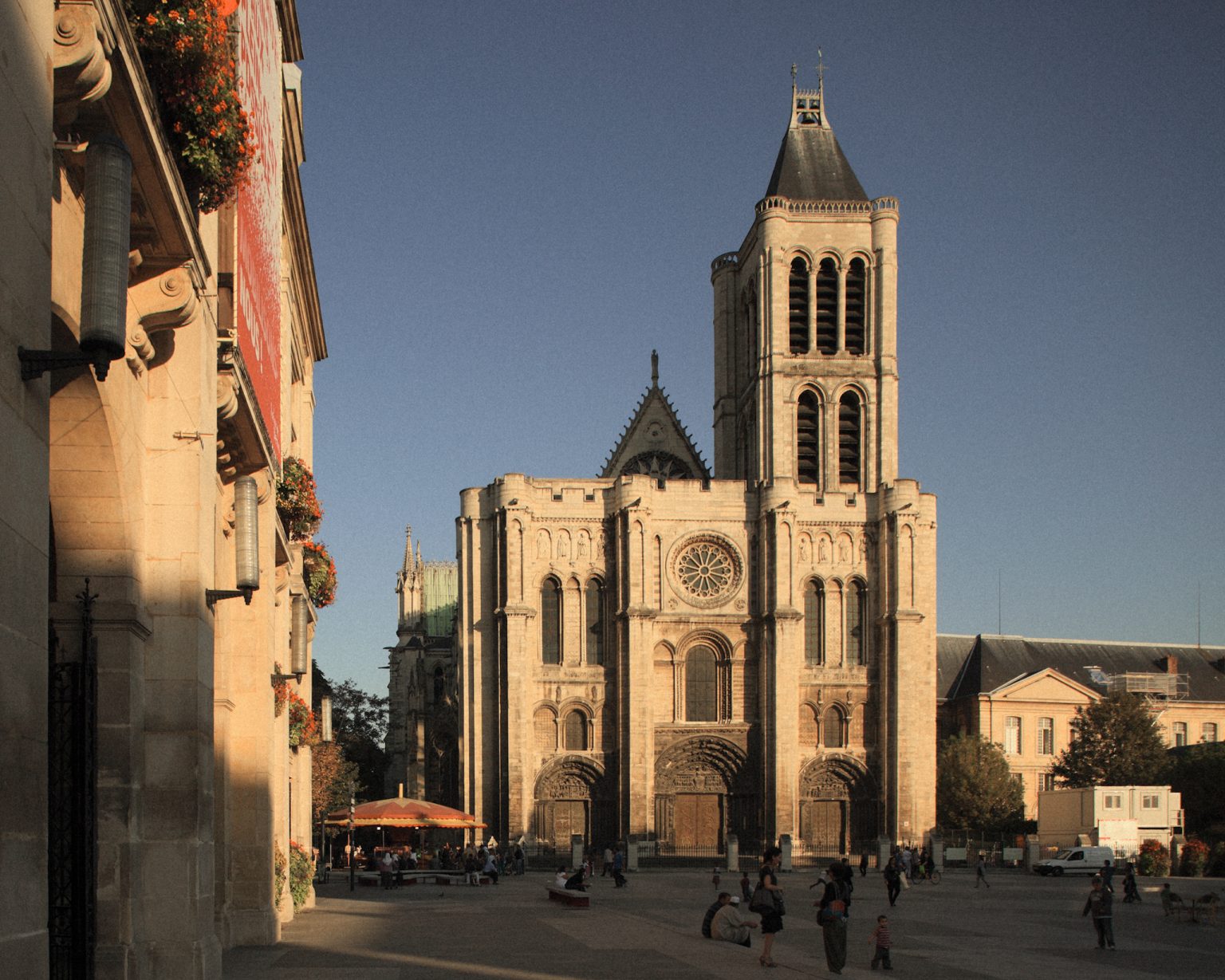
The Cathedral Basilica of Saint-Denis with the town hall in the foreground. Photo: Bruce Yuanyue Bi/Getty Images
|
The city of Saint-Denis, the former burial ground of the kings of France, has for several weeks been the scene of a symbolic struggle between past and present, cultural heritage and politics.
For the past few weeks, all eyes have been on the basilica, a landmark of France’s political and spiritual history, and on its spire – or rather, its absence.
Unlike so many other buildings that suffered damage during the French Revolution or the bombings of the two world wars, the basilica of Saint-Denis lost its spire as a result of a technical decision made in the 19th century.
A Spire Lost to History
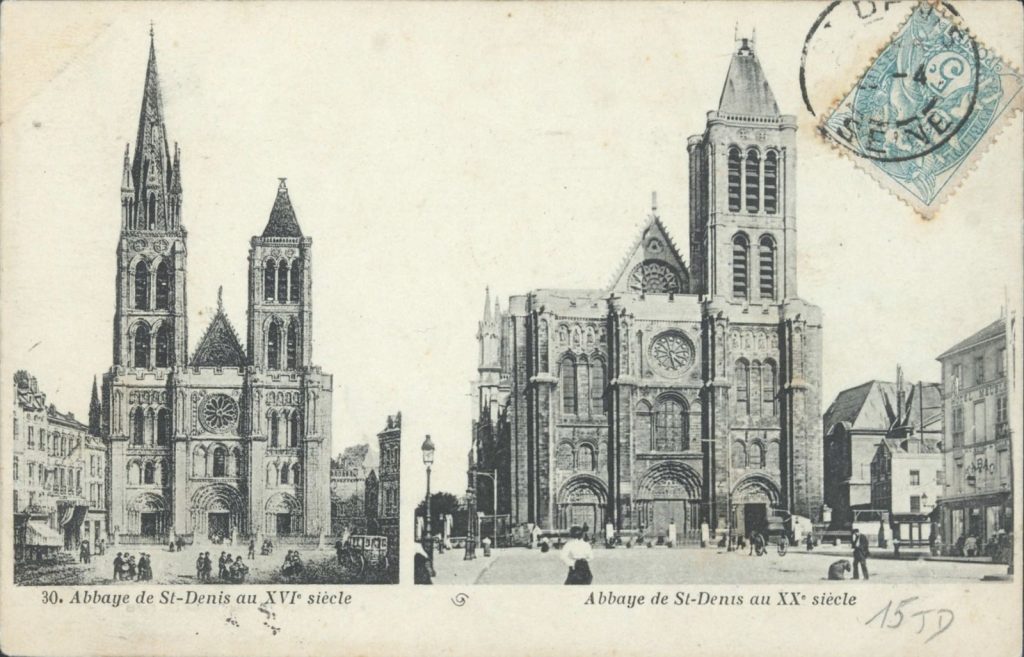
The basilica’s original north tower was completed in the early 13th century and was then adorned with a stone spire. At approximately 90 meters, it was one of the tallest monuments in Europe at the time and a symbol of the birth of Gothic architecture – of which Saint-Denis is the cradle. It is there indeed that Abbot Suger implemented, in the early 12th century for the basilica’s choir, all the elements that would form the basis of Gothic architecture – then known as opus francigenum, or French work.
For more than six centuries, this asymmetrical silhouette dominated the French plain and served as a landmark for travelers approaching Paris. During the Revolution, the basilica – which had housed the tombs of the kings of France since Merovingian times – was ransacked by the revolutionaries. But its walls stood firm. In the 19th century, the basilica underwent extensive restoration led by architect François Debret.
A historic postcard contrasts the Abbey of Saint-Denis in the 16th century with the basilica as it appeared in the early 20th century. Source: National Library
On 9 June 1837, the spire was struck by lightning. Debret had it repaired, but the work was strongly criticized by several experts. Then a series of storms and high winds once again weakened the structure. Cracks appeared in the north tower, and the stability of the entire building became a cause for concern. Faced with the risk of collapse, the decision was made to dismantle the upper tower and the spire stone by stone.
The work took place between 1846 and 1847 under the direction of architect and art historian Eugène Viollet-le-Duc. Each block was numbered, sketched and cataloged to facilitate future reassembly. Viollet-le-Duc himself planned to rebuild it once the tower’s stability was ensured. But funding was lacking, priorities shifted, and the project was abandoned. The basilica has remained without its north tower and spire ever since. The plans and surveys have been preserved to this day.
From the moment of its dismantling, the plan was for it to return to its original location. But for over a century, this promise remained unfulfilled. The project truly was revived in the 1990s, driven by elected officials from Saint-Denis and several heritage specialists. Progress accelerated in the 2010s with the creation of a support committee – which later became the association Suivez la Flèche (Follow the Spire) – followed by the signing of an agreement between the French government, Suivez la Flèche, the Centre des monuments nationaux and the Diocese of Saint-Denis.
The project benefits from an exceptional situation. Unlike many lost monuments, there are extremely precise surveys made before the dismantling. A large portion of the original stones has been preserved, and detailed knowledge of medieval techniques is available. This is therefore not a hypothetical reconstruction, but an identical reassembly, comparable in principle to a massive archaeological restoration: an exciting project.
A Long-Awaited Reconstruction
After several years of preparation, work officially began in March 2025 with the laying of the cornerstone. The construction site, expected to take about five years, is open to the public to showcase the crafts of medieval stonemasonry, carpentry and metalwork. If the schedule is followed, the basilica should regain its original silhouette around 2029–2030.
Beyond the restoration of an iconic monument, the reconstruction carries deep symbolic significance. This is not just any cathedral, nor is it just any city. For centuries, the Basilica of Saint-Denis served as the burial site of the kings of France.
The city of Saint-Denis is also the capital of the Seine-Saint-Denis department, which holds the dubious distinction of being the French department with the highest percentage of residents of immigrant origin. This past spring, a new mayor was elected there: Bally Bagayoko, of Malian origin, representing the far-left party La France Insoumise.
Bally Bagayoko, who is very popular locally, has national ambitions. With the complicity of a sympathetic media, he sees himself as a sort of French Obama, and it is rumored that he could be a rival to Jean-Luc Mélenchon within the LFI party. In May, he was named “the French left’s favorite figure” by some polls, ahead of Jean-Luc Mélenchon, but also ahead of former Socialist President François Hollande, who is toying with the idea of returning to the political spotlight.
Bagayoko has made this spire affair a personal issue. On 24 July, the association Suivez la flèche was set to elect a new president. For Bagayoko, the matter was settled. As the mayor of Saint-Denis, the position rightfully belonged to him.
But standing in his way was a formidable opponent: the wildly popular television host and heritage advocate Stéphane Bern. A history enthusiast, Bern has for several years championed the defense of France’s endangered heritage – and religious heritage in particular. With tireless energy, he aims to preserve the soul of eternal France by protecting its historic buildings, the beauty of its landscapes and its way of life.
Given Bern’s popularity, Bagayoko decided at the very last minute to withdraw his candidacy. It was a wise move, as Bern won an overwhelming majority of the votes – even though, until then, the association’s presidents had always been the mayors of Saint-Denis.
Bagayoko’s supporters are furious. The mayor is denouncing irregularities and has not ruled out legal action.
A Symbol Beyond Stone
This episode is not merely anecdotal; it sheds light on the balance of power at play. On one side is a mayor who has made the assertion of his rights and his origin the cornerstone of his political platform and imagines that he can have a national fate; on the other is a man who, for many French people, embodies the pride of a past they do not wish to see fade away – a man mobilized for a cause that lifts everyone up, both literally and figuratively.
Bern has more than one trick up his sleeve. He intends to make the reconstruction of the spire of Saint-Denis a cause that rallies the broadest possible audience. He plans to launch a large-scale campaign for people to sponsor individual stones. His ambition is to enable tens of thousands of French people to participate symbolically and financially in the reconstruction of the spire. A meaningful project: entrusting the nation, through crowdfunding, with the reconstruction of the basilica – in a city plagued by immigration.
Rebuilding a cathedral spire is no trivial matter. At the time of the fire that nearly destroyed Notre-Dame de Paris, the collapse of the spire was a moment of particularly intense emotion for those who witnessed it. And when, a few years later, it rose once again like a sharp spearhead into the Paris sky, many Parisians and French people saw it as a sign of a possible resurrection for a country that sometimes feels as though it has hit rock bottom.