Déjà Vu? Europe's Fiscal Troubles Echo the 2008 Crisis
The fiscal ground is trembling under the euro, and not even Germany is safe anymore.
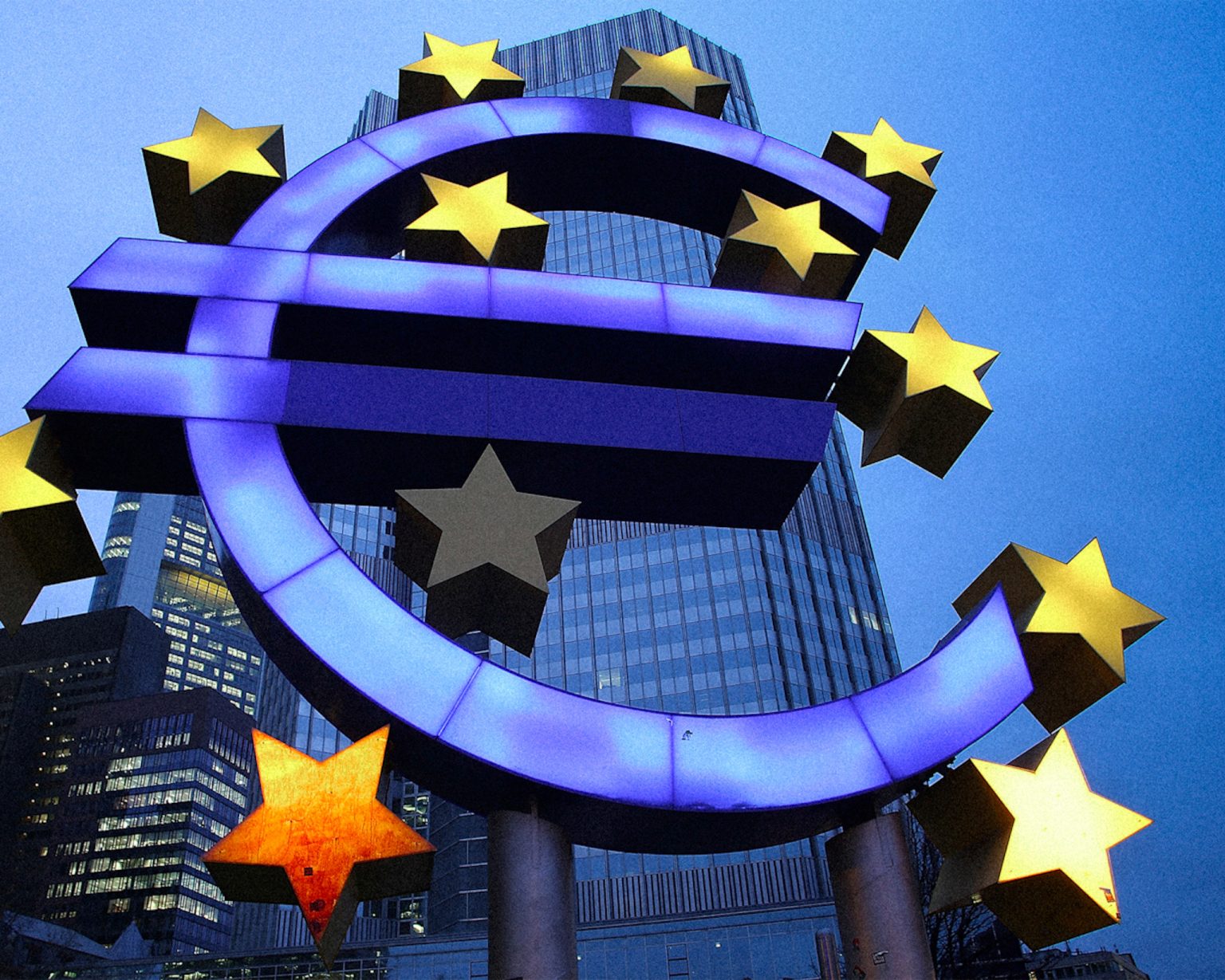
Thirteen EU member states are now running deficits above the bloc’s 3% limit. Photo: Hannelore Foerster/Getty Images
|
Economic worries are rising in the eurozone, driven in part by fiscal pressures reminiscent of those that contributed to Europe's 2008 sovereign debt crisis.
Back then, countries on the geographic and economic periphery suffered serious fiscal problems, while core economies like Germany prevailed relatively unscathed. This time is different: there is growing worry that Germany's coveted AAA credit rating is in jeopardy.
It would be sensational if the government of Europe's largest economy suffered a humiliating credit downgrade, while also taking a toll on the rest of the eurozone in the form of higher interest rates and heightened intolerance among sovereign-debt investors toward unchecked deficits.
As if to make the situation even worse, multiple EU member states are already under formal monitoring by the European Council for excessive budget deficits.
Although the Great Recession, as the 2008-2010 crisis has been called, began a year earlier in the financial sector, it rapidly spilled over into a serious fiscal crisis with ramifications across most of Europe. The question facing Europe now is whether or not the ongoing deterioration in public finances could lead to a similar crisis without the "fuse" being lit by an adverse external event.
Plainly speaking: are Europe's governments about to repeat history simply by running excessive deficits?
Widespread Deficits
The answer is not straightforward. There are important differences that make a repeat of the 2008-2010 crisis less likely. Much of today's borrowing is tied to higher defense spending, and governments have generally approached the resulting increase in debt with greater caution.
Even so, financial markets will ultimately determine how much borrowing is sustainable. If investors lose their appetite for euro-denominated sovereign debt, governments will find it much harder to finance persistent budget deficits.
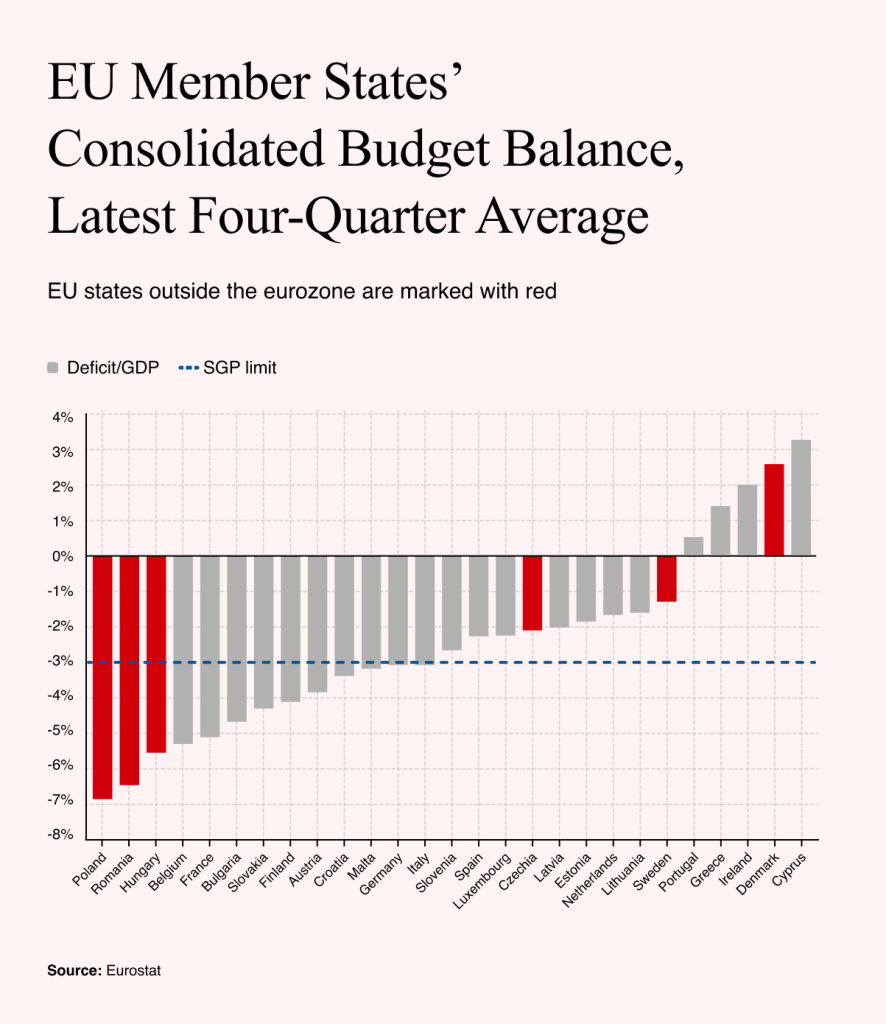
So far, this has not happened. Interest rates on euro-denominated debt have remained calm, especially in comparison to 2008-2010. At the same time, there are indications that Europe is in the prelude stage of a major fiscal crisis. As of the first quarter this year, 13 out of the 27 EU member states had an average budget deficit for the four most recent quarters that exceeded 3% of their GDP, the limit set in the Stability and Growth Pact (SGP).
Consolidated budget balance of EU member states showing the average in the four most recent quarters; Source: Eurostat
Already in 2024, the EU launched so-called excessive deficit procedures (EDPs) against seven countries: France, Hungary, Italy, Malta, Poland, Romania and Slovakia. Those seven countries are all among the 13 whose deficits currently exceed the 3% limit, and in some cases the situation has worsened in recent months.
Romania is the clearest example, having recorded a budget deficit above 3% of GDP in every quarter since the beginning of 2024. Hungary has also seen a dramatic deterioration, swinging from a surplus equal to 0.4% of GDP in the second quarter of 2025 to a deficit of 10.6% in the first quarter of 2026.
Since the European Council launched EDPs against those seven countries, Finland and Bulgaria have also been placed under the same mechanism. Their cases illustrate just how difficult it can be for governments to bring public finances back into compliance with the SGP.
After Finland was placed under special deficit scrutiny in January 2025, its budget deficit still failed to improve significantly, leading the European Council to formally open an EDP against the country in January 2026.
The EDP is taken very seriously by the Finnish government, which is making big efforts to close its large budget gap. However, its efforts are facing three hurdles: political opposition from those who worry that budget cuts may harm vulnerable citizens, concerns that the economy might destabilize due to erratic fiscal policy measures, and opposition to higher taxes.
As a measure to alleviate fears of tax hikes, the government in Helsinki is combining €4.8bn ($5.55 bn) in budget cuts with a package of small tax reductions.
There is broad consensus in Finland that returning to compliance with the SGP will be a long and politically difficult process. A key concern is the Finance Ministry's warning that further fiscal tightening could destabilize the economy. While the warning formally applies to additional spending cuts, it is aimed chiefly at calls for higher taxes.
According to Eurostat, Finland's tax-to-GDP ratio of 53.4% is the highest in the EU. Higher taxes could have detrimental effects on the international competitiveness of Finnish industry.
The situation in Bulgaria is even more dire than in Finland. The European Council announced an EDP against Bulgaria on 10 July, noting that the Bulgarian government's consolidated budget deficit will likely exceed the 3%-of-GDP limit in both 2026 and 2027.
Bulgaria joined the eurozone on 1 January this year, making it the first country to be subject to any fiscal reprisal from the EU so soon after adopting the common currency.
The outlook for Bulgaria is far from positive. Its 2026 government budget predicts the consolidated deficit to be as high as 5.7% of GDP this year, well above the 4.1% that the European Council included in its EDP. With parliamentary opposition challenging the 2026 budget as being fiscally too harsh, the political and economic conditions in Bulgaria do not bode well for the next European Council evaluation in November.
While fiscal pressures are mounting on the eurozone's periphery, there is also trouble brewing in its heartland. According to Handelsblatt, Germany's top AAA credit rating is in jeopardy due to persistently weak government finances.
Any downgrade would increase Germany's borrowing costs and leave the government with less budgetary wiggle room. Because German government bonds serve as the eurozone's benchmark safe asset, the effects could extend beyond Germany, pushing up borrowing costs elsewhere and making investors less tolerant of persistent budget deficits across the currency union.
A downgrade remains far from certain, however. Germany's public finances remain considerably stronger than those of most EU member states, and all three major credit-rating agencies continue to assign the country their highest rating.
A German credit downgrade remains far from certain. Even if it were to occur, Germany would not automatically face the same level of scrutiny as countries subject to the EU's EDP. The SGP now gives the European Commission considerably more flexibility to tailor its response to each member state's circumstances.
That flexibility is intended to avoid the rigid, one-size-fits-all approach that characterized the sovereign debt crisis of 2008-2010. Rather than applying identical remedies, the Commission now allows governments to develop country-specific paths back to fiscal compliance, subject to regular reviews and adjustments.
The Finnish and Bulgarian cases nevertheless show that a more flexible framework cannot eliminate political reality. Governments must still reconcile external demands for fiscal discipline with domestic resistance to spending cuts and tax increases.
The crucial question is: what happens when a country runs out the fiscal adjustment clock without sufficient budget improvements?
Placeholder For Topreaded Placeholder For Topreaded
Placeholder
Placeholder
Placeholder For Topreaded Placeholder For Topreaded
Placeholder
Placeholder
Placeholder For Topreaded Placeholder For Topreaded
Placeholder
Placeholder
Placeholder For Topreaded Placeholder For Topreaded
Placeholder
Placeholder
Placeholder For Topreaded Placeholder For Topreaded
Here is placeholder for Article excerpt Here is placeholder for Article excerpt Here is placeholder for Article excerpt Here is placeholder for Article excerpt
Here is placeholder for Article excerpt Here is placeholder for Article excerpt Here is placeholder for Article excerpt Here is placeholder for Article excerpt
Here is placeholder for Article excerpt Here is placeholder for Article excerpt Here is placeholder for Article excerpt Here is placeholder for Article excerpt
Welcome to the comments section of the Štandard daily. Please take note of our guidelines, comments are moderated by us. You can contact the moderators at [email protected].
Participate in the discussion
Comments are available to subscribers only. If you'd like to join the discussion, choose a subscription starting at €6.72 per month.
All comments 0
Register
Comments are available to registered users only. If you'd like to join the discussion, register here.