
In 2024, approximately 4.5 million people graduated from higher education in the European Union, including 2.6 million women. Women accounted for about 58% of all graduates. For every 100 male graduates, there were approximately 137 female graduates.
But the overall figures tell only part of the story. Eurostat’s latest statistics on the gender gap among university graduates reveal stark differences between fields of study.
Four Women for Every Man
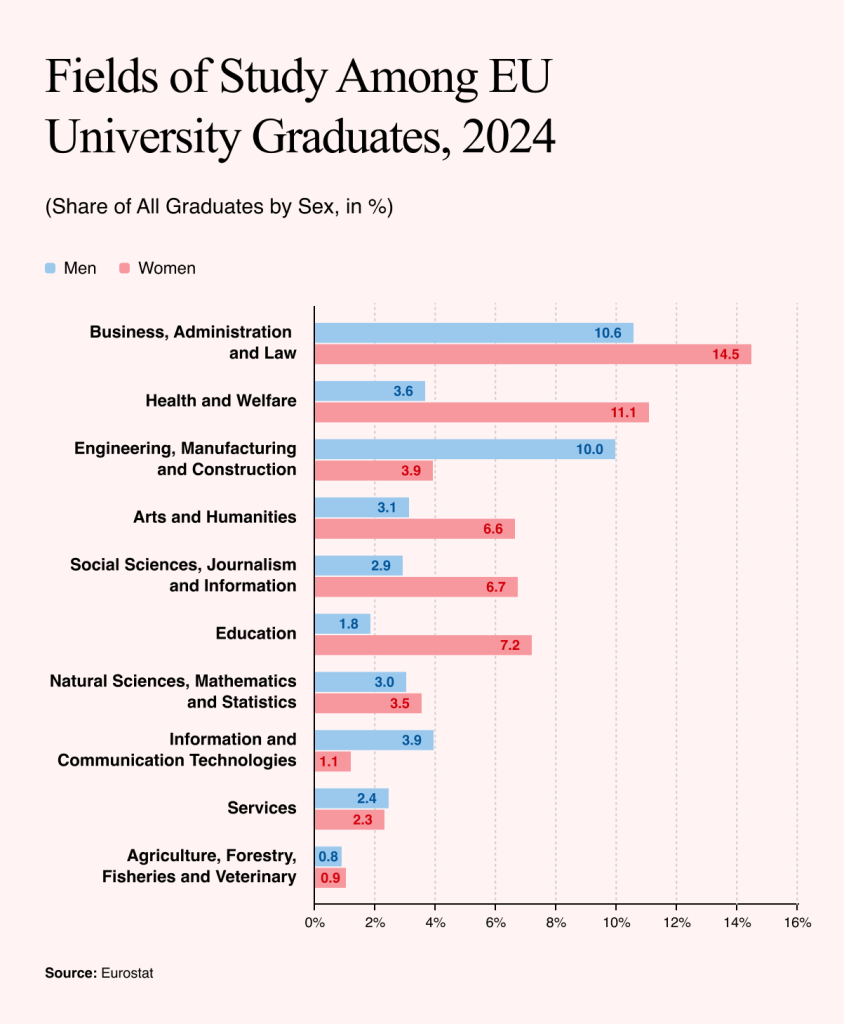
The largest disparity is in education-related fields, where there are four times as many female graduates as male graduates. Put simply, of every five people who graduate with a degree in education, approximately four are women and one is a man.
In information and communication technologies (ICT), the ratio is almost exactly reversed. For every female graduate, there are approximately 3.7 male graduates.
The overall predominance of women in higher education masks stark differences between individual fields. Women may graduate from college in greater numbers overall, but they remain underrepresented in ICT, one of the key sectors of today’s economy.
The disparity does not begin at graduation. It is already visible in the lecture halls. In 2023, women made up nearly four-fifths of students in education-related fields. In information and communication technologies, the opposite was true, with men accounting for 79.7%.
The same pattern is evident among graduates in other technical fields. Men accounted for more than 70% of graduates in engineering, manufacturing and construction.
The imbalance therefore runs in both directions. Yet women in ICT are discussed far more often than men in education.
The divide is much smaller elsewhere. Men and women are relatively evenly represented in agriculture, forestry, fisheries and veterinary fields, as well as in the service sector. So while not every field can be neatly labeled “male” or “female”, some clearly stand out.
Higher Education Alone Did Not Close the Gap
These figures offer a different perspective on the debate about men and women in education. Men may be in the minority among college graduates overall, but significant disparities remain. From an economic standpoint, that matters.
Not every degree opens the same doors. Fields of study offer different levels of demand, career opportunities and earning potential. The overall number of people with a college degree therefore does not tell the full story.
ICT is a good example. In 2024, women accounted for only 17.9% of employed people in the EU with at least an upper-secondary qualification in the field. Employment prospects are strong: more than nine out of 10 people with an ICT qualification at this level are employed.
The gender divide in education therefore has consequences beyond the classroom.
STEM Remains Predominantly Male
The gender divide is particularly pronounced in science, technology, engineering and mathematics (STEM) fields. These disciplines are closely linked to technological development, research and innovation.
In 2023, there were 29 STEM graduates per 1,000 men aged 20 to 29 in the EU, compared with just under 16 per 1,000 women of the same age. Relative to the population, there were therefore nearly twice as many male STEM graduates as female graduates.
The imbalance does not appear to be simply a matter of aptitude. The European Commission points out that girls generally perform better than boys in computer and information literacy at a young age, but are less likely to choose these fields later.

Germany and Austria Stand Out
Germany and Austria have some of the highest proportions of graduates in technical fields in the EU. In Germany, mechanical engineering, manufacturing and construction accounted for 22% of all graduates in 2023, the highest share in the EU. Austria followed at 19.3%, compared with an EU average of 14.1%.
At the same time, Germany and Austria are among the countries with particularly low proportions of women among STEM graduates. According to comparable data for 2021, women accounted for 27.7% of STEM graduates in Germany and 28% in Austria, compared with an EU average of 32.8%. Only Belgium had a lower proportion, while Spain had the same proportion as Germany.
Yet women do not generally lag behind in higher education in Austria – quite the opposite. The imbalance is specific to STEM rather than university education as a whole.
It Is Mainly About Choice
The figures show clear differences in the fields men and women choose, but they cannot explain what drives those choices. Personal preferences, future earnings, family background, social expectations and professional role models may all play a part. Eurostat’s data cannot show which factors matter most.
One thing is clear: women now make up the majority of university graduates in Europe, but men and women remain concentrated in different fields of study.
The question is therefore no longer simply who goes to college. It is also what young men and women study – and where those choices lead after graduation.