Climate shocks and rising Asian demand are turning Arabica coffee into an increasingly scarce luxury. Photo: Getty Images
Is Coffee Becoming a Luxury Item?
Climate shocks, constrained supply and booming Asian demand are reshaping the coffee market. Arabica beans may increasingly become a luxury product.
For millions of Europeans, coffee is an integral part of the day, whether it is an espresso at the bar in Italy, a café crème in France or a cappuccino on the way to work. Despite rising prices and pressure on household budgets, Europe’s appetite for coffee remains remarkably resilient.
What has changed is how much that daily habit costs. Coffee has become considerably more expensive across Europe. In the EU, consumer prices for coffee, tea and cocoa rose by around 34% between the beginning of 2019 and the beginning of 2025. The increase has accelerated more recently, with coffee alone costing EU consumers 20.4% more in August 2025 than a year earlier.
Today, a cappuccino in a European café costs around €3.50 ($4.10) on average, according to an analysis of nearly 4,700 venues across 28 European capitals. Prices vary considerably across the continent: the same study found that an average cappuccino cost €2.86 ($3.30) in Rome but €5.88 ($6.80) in Copenhagen.
Yet the rising price of a cup in a café can be misleading. The coffee itself typically accounts for only around 5% of the final price. Most of what customers pay covers labor, energy, rent and other operating costs, all of which have also risen substantially in recent years.
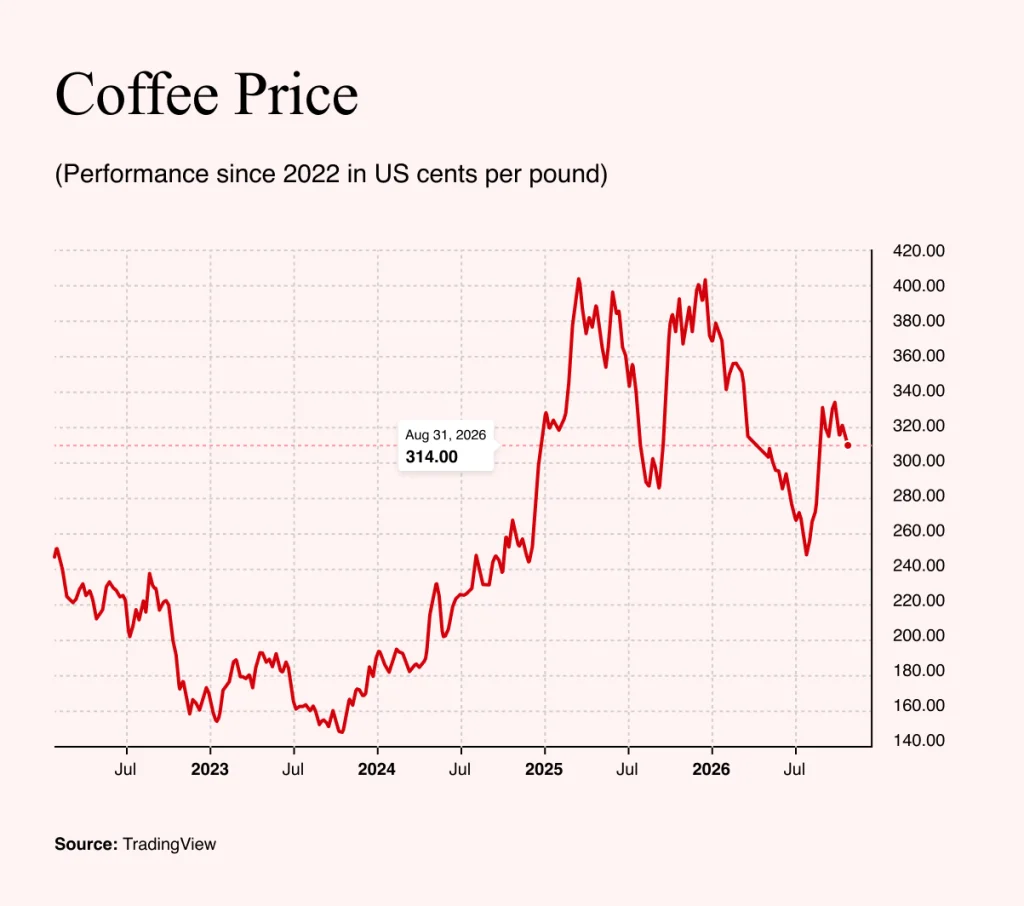
Source: TradingView
The divergence becomes even clearer when looking at commodity markets over the past three years. Arabica futures have more than doubled, rising by around 118%, while Robusta has increased by roughly 32%. By comparison, wheat futures are up about 33% over the same period.
Coffee prices have therefore risen strongly even by the standards of other agricultural commodities. But the pressure is far from evenly distributed. Arabica has risen much faster than Robusta, suggesting that something more specific than general food inflation or higher agricultural costs is driving the market.
The main reason lies in how Arabica is grown. It is generally considered the higher-quality of the two main types of commercial coffee, but it is also considerably more demanding than Robusta. Arabica prefers cooler temperatures and is typically grown at higher altitudes, limiting the areas suitable for cultivation.
Production is also highly concentrated. Brazil is by far the world’s largest Arabica producer, accounting for roughly half of global output, with Colombia and Ethiopia following far behind. That leaves the market particularly vulnerable to Brazilian weather.
The consequences became clear in 2020 and 2021, when drought followed by severe frosts damaged Brazil’s coffee-growing regions. The resulting shortfall, equivalent to around 6% of global production, helped drive coffee prices sharply higher.
This exposes a fundamental weakness in the coffee market: lost production cannot quickly be replaced. Farmers growing crops such as wheat can respond to higher prices by planting more the following season. Coffee growers cannot.
A newly planted coffee tree takes around three years to produce its first meaningful harvest and six to eight years to reach full production. Even when soaring prices encourage farmers to expand, it can therefore take years for additional beans to reach the market.
That makes coffee supply highly inelastic in the short term. When drought, frost or other shocks reduce production in a major growing region, there is little that producers elsewhere can do to fill the gap quickly. The result is precisely what the market has experienced in recent years: relatively small disruptions to supply can produce disproportionately large movements in price.
On the demand side, Europe is a mature coffee market. Consumption remains high, particularly among younger consumers, but there is relatively little room for the kind of rapid growth seen in emerging markets. The same is broadly true of the US, where coffee is already firmly embedded in everyday life.
The more significant change is happening in Asia. Rising incomes, urbanization and changing consumer habits are creating new coffee drinkers in markets traditionally dominated by tea. Nowhere is this shift more apparent than in China, which is emerging as an increasingly important source of global coffee demand.
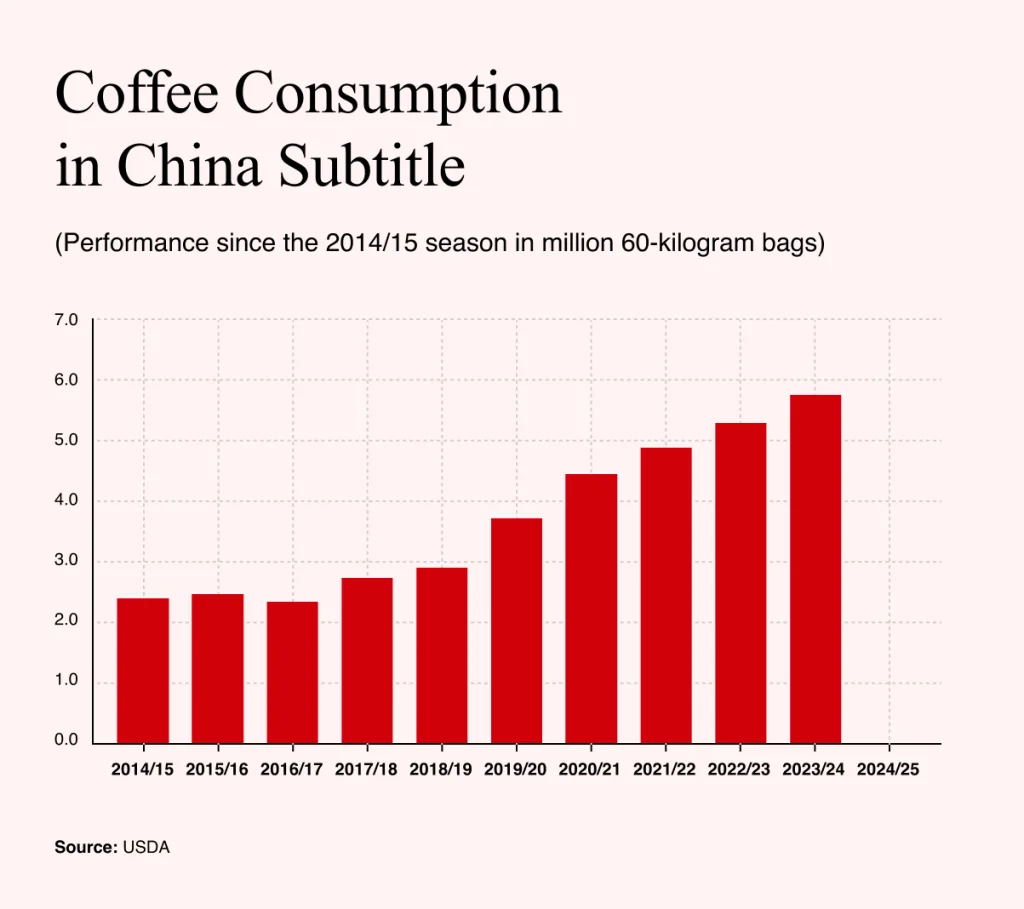
Source: USDA
Coffee consumption in China has risen by nearly 150% over the past decade. More importantly, the nature of that demand is changing. A decade ago, the market was dominated by cheaper coffee destined for instant drinks. Today, imports of higher-quality beans are growing, while thousands of new coffee shops are opening every year in China’s major cities.
China therefore exposes a fundamental imbalance in the global coffee market. Demand can grow relatively quickly, while supply cannot. Coffee plantations take years to mature and production remains vulnerable to drought, frost and other weather shocks.
That does not mean coffee is destined to become a luxury that Europeans can afford only as an occasional treat. What may change, however, is the coffee we drink. Cafés could increasingly turn to blends containing more Robusta rather than relying on pure Arabica, while high-quality Arabica gradually moves further into the premium segment.
Nor does this mean that consumers should start hoarding bags of Arabica in their basements. A strong harvest is expected for the 2026/2027 season, which should ease some of the immediate pressure on prices.
The longer-term structural problem nevertheless remains. Production is concentrated in relatively few countries, new plantations take years to reach full capacity and Arabica is particularly vulnerable to unfavorable weather.
Coffee itself is therefore unlikely to become a luxury. But high-quality Arabica served in an upmarket European café could increasingly become one. Rather than making coffee unaffordable altogether, these pressures may widen the gap between an ordinary everyday cup and the premium coffee experience.
Welcome to the comments section of the Štandard daily. Please take note of our guidelines, comments are moderated by us. You can contact the moderators at support@statement.com.
Participate in the discussion
Comments are available to subscribers only. If you'd like to join the discussion, choose a subscription starting at €6.72 per month.
All comments 0
Register
Comments are available to registered users only. If you'd like to join the discussion, register here.