
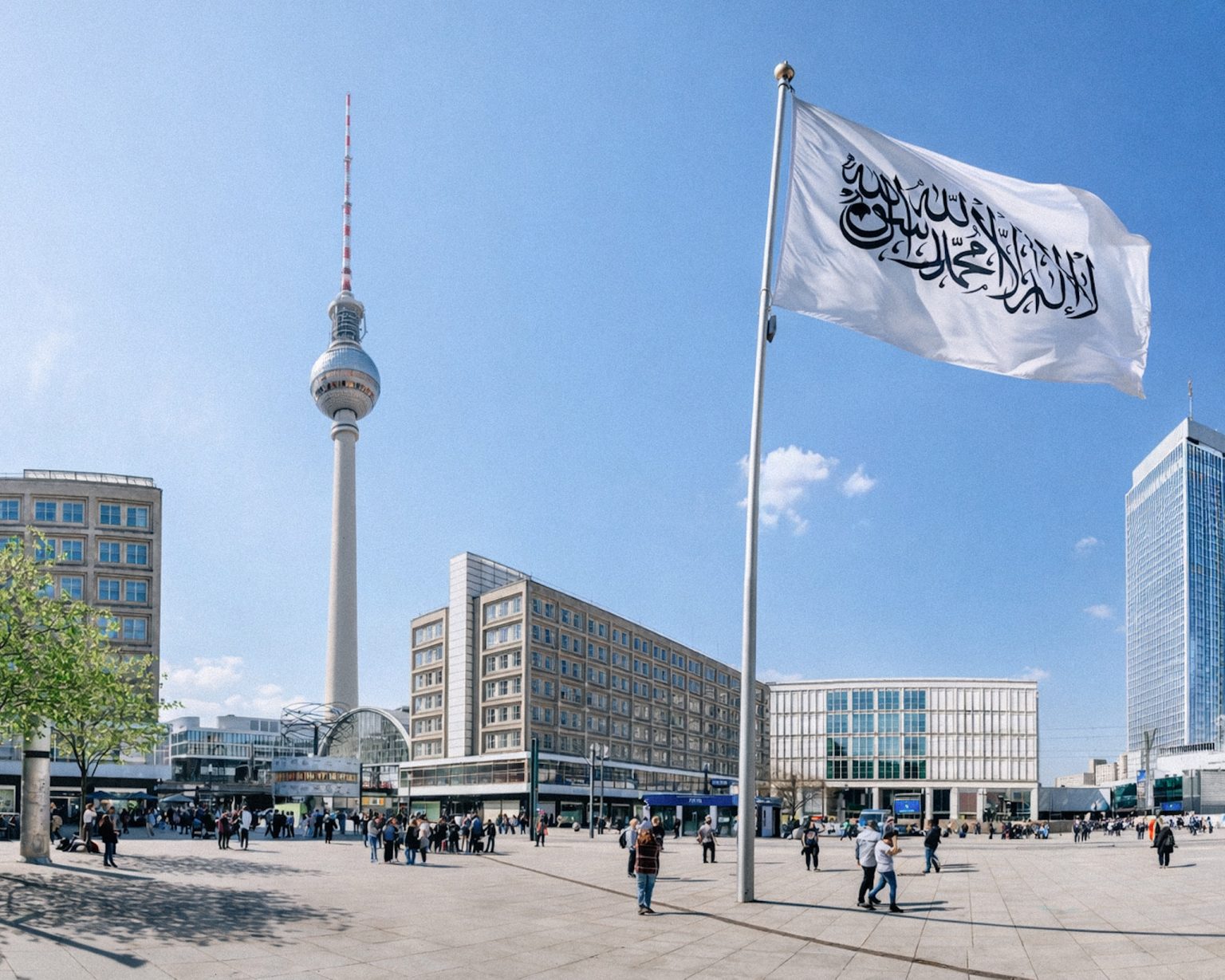
Let us recall: in September 2024, Germany’s then foreign minister Annalena Baerbock firmly rejected any talks with the Afghan Taliban on deporting migrants to Afghanistan. At the time, she said: ‘No, that is precisely what we must not do. And we will not. … No democracy in the world has recognised the Taliban. Why should we court them, when they are effectively confining women to their homes, if there are other options?’
Today, the mood in Germany appears more relaxed. Nebrasul H., a member of the Taliban, has become the new head of the Afghan embassy in Berlin – without the German federal government being informed. It is a remarkably swift ascent: the man arrived in Berlin in July 2025 as a junior consular official, tasked with preparing the deportation of rejected asylum seekers and offenders to Afghanistan. Yet he appears to have arrived with a far broader mandate – namely, to take over the leadership of the embassy. He is thus the first Taliban ambassador in an EU state.
The German authorities would scarcely have agreed to any of this had they known in advance. According to the public broadcaster ARD, the Taliban skilfully sidelined the previous ambassador, the diplomat Abdul Baqi Popal, while leaving him in place at his official residence. He is even said to retain use of his diplomatic car.
Only the federal government appears to have been unaware of the change. Germany still does not formally recognise the Taliban as the legitimate government of Afghanistan and insists that Afghan missions be ‘headed by individuals accredited before the Taliban took power’.
Since November, the diplomatic mission has also changed its designation. It now refers to itself not simply as the embassy of Afghanistan, but as the ‘Embassy of the Islamic Emirate of Afghanistan’, adopting the Taliban’s terminology following their return to power in 2021 and their deliberate replacement of the name ‘Islamic Republic of Afghanistan’. The Afghan consulates-general in Bonn and Munich are likewise now described as representations of the same Islamic Emirate. Matters may come to a head the first time the Taliban’s white flag is raised above the embassy building in Berlin’s Grunewald district.
What, then, would Germany do?
A calculated provocation – and a threat to Afghans in exile
Such conduct can only be described as a deliberate provocation. How has the Federal Foreign Office responded? Apparently not at all. Perhaps because it cannot. ‘There is no real legal basis for preventing a sovereign state with which one maintains diplomatic relations from displaying its symbols, flying its flag or choosing its name,’ says the international law scholar Markus Kotzur of the University of Hamburg. Germany could, of course, sever diplomatic relations and declare individuals at the embassy persona non grata, but that would almost certainly be politically unwelcome and would entail serious diplomatic fallout.
For Afghans in exile, however, the situation is both deeply troubling and fraught with risk. Many fled precisely because of the Taliban. For women such as Zarah Mousawy, who is reportedly on a Taliban blacklist, the situation is acute: her passport has expired. Is she now expected to turn to an embassy effectively controlled by the Taliban? It is, she says on German television, like voluntarily going to one’s enemy and declaring, ‘here I am’ – a sentiment shared by many Afghans who now find themselves unable to resolve even routine administrative matters.
Those most at risk are not only regime opponents in Germany, but above all their relatives in Afghanistan. Diplomatic files may contain passport copies, addresses, details of family members and even information on the activities or engagements of those seeking protection. For many, it is a nightmare.
Understandably, many Afghans in exile are reluctant to approach an embassy now operating under Taliban authority. Yet without valid documents, they remain in a legal limbo: travel is impossible and dealings with authorities or employers become fraught with difficulty.
Obtaining substitute documents through German immigration offices is, in principle, possible. In practice, however, Afghan civil status documents are often required for permanent residency, naturalisation proceedings or marriage. For many, this amounts to a trap with no obvious exit.
And yet, cooperation continues
For all the rhetoric about a feminist foreign policy, concerns over terrorism and the defence of women’s rights, Germany is in practice already cooperating with the Taliban, a reality that in effect amounts to a form of recognition. What perspective, then, is offered to those Afghans, whether genuine or merely presumed ‘local staff’, who are still waiting to be evacuated to Germany, as once promised by the previous government?
The federal government has for the time being suspended its admission programme, especially as it could by no means always be said that those described as genuine ‘local staff’ had in fact worked for the Germans in Afghanistan before 2021. Of the 2,308 Afghans who, at the time of Friedrich Merz’s assumption of office, were living in Pakistan with admission commitments from the previous administration, nearly half are now reportedly no longer to be admitted to Germany.
From a German perspective, that may appear understandable. In recent years, around 350,000 Afghans have entered Germany irregularly to seek asylum. They are overrepresented in certain categories of crime, particularly violent and sexual offences, while remaining underrepresented in the labour market. Security vetting and the verification of civil status documents were often neglected. Instead, despite warnings from its own security services, Germany relied for years, under a left-green government, on the assessments of NGOs as to which candidates from Afghanistan were allegedly at risk. These individuals were then flown to Germany at taxpayers’ expense, often together with their families.
To this day, a visa scandal linked to the former foreign minister remains unresolved and without consequences. Despite knowledge within her ministry of invalid documents and questionable claims by numerous applicants, visas were nonetheless issued. Germany is therefore suspected of having airlifted Islamists into the country itself.
All of this is the result of a policy of regime change that the predecessors of the Donald Trump administration have saddled us with. At least in one respect, there is hope: Germany’s experience with Iranians seeking exile here has by and large been more positive.
Even so, the grand promises of the past have now been broken, and their consequences will linger. So too will the Taliban ambassador in Berlin. He is here to stay.