
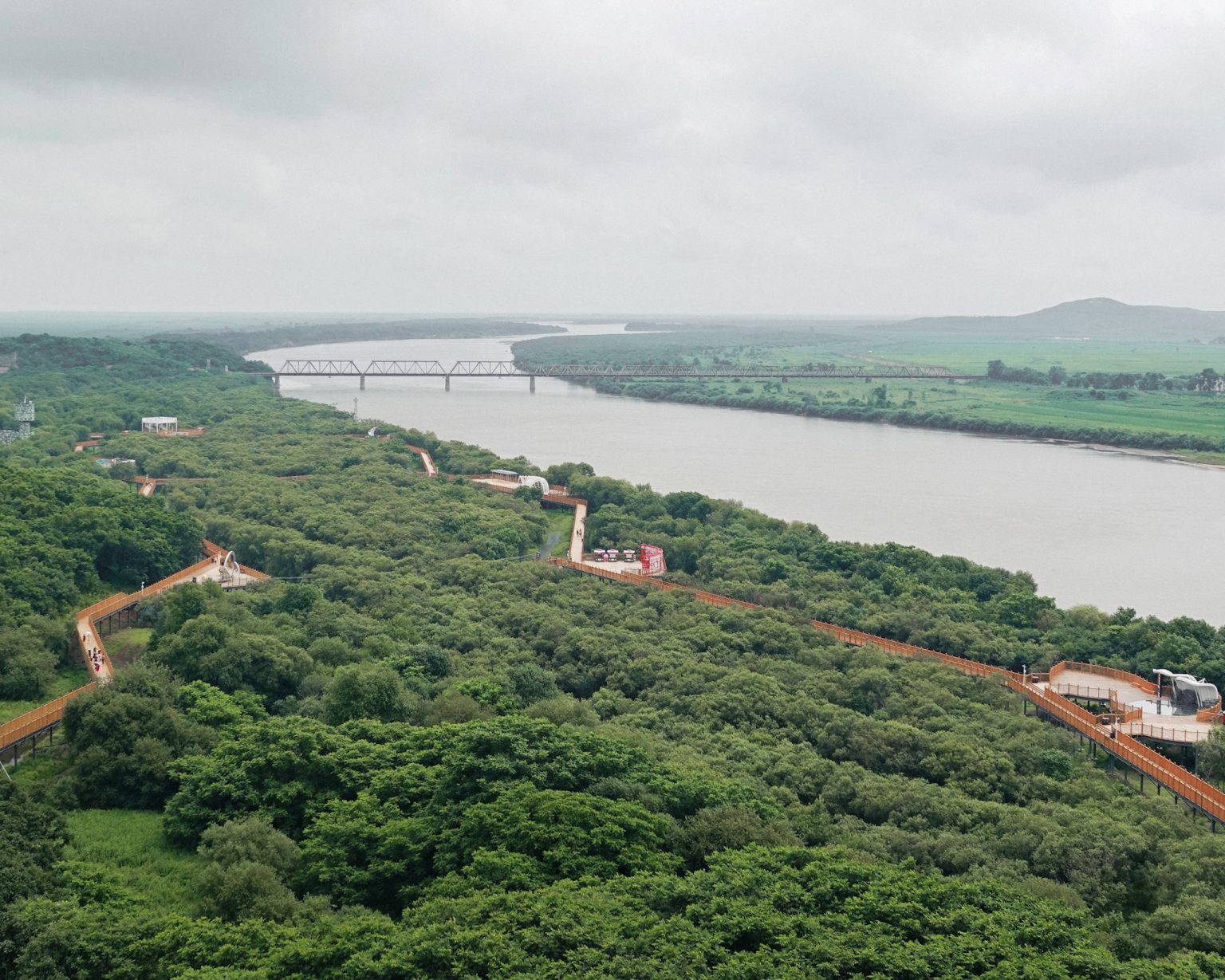
Russia and North Korea are set to open a road bridge over the Tumen River in the near future, creating the first permanent road link along their short shared border. In reality, the project goes far beyond transport infrastructure. The new crossing is a visible sign of a closer axis between two isolated regimes and at the same time a signal to China.
Several analyses, including those cited by the Epoch Times, point in that direction. What stands out is not only how far Moscow and Pyongyang have expanded their military and economic cooperation since Vladimir Putin’s visit to North Korea in 2024. More important, however, is the impact the bridge is likely to have.
A Strategic Bottleneck at the Tumen River
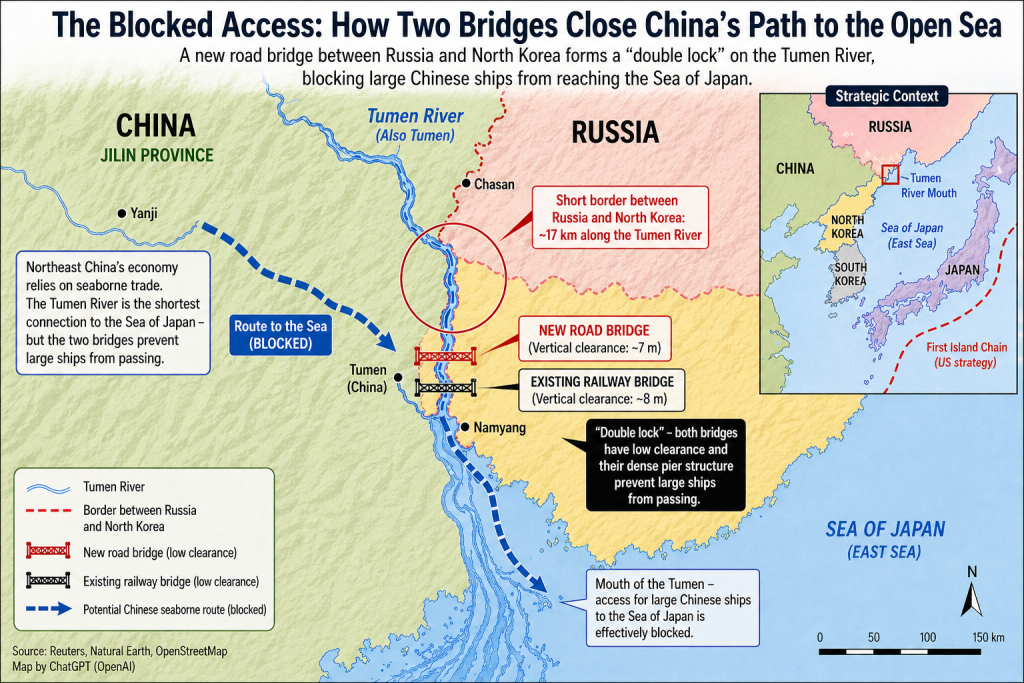
The structure is being built at a strategically sensitive location. The Tumen River marks the border between Russia and North Korea over a short stretch before flowing into the Sea of Japan. It is precisely here that China has long sought improved maritime access for its northeastern provinces. The region remains structurally less developed than the coastal areas in the south and relies on shorter trade routes to the Pacific to become more competitive.
Access is already effectively constrained. An existing railway bridge with low clearance prevents larger vessels from navigating the river. The new road bridge appears to follow a similar design and is likely to entrench that limitation. Chinese observers describe it as a dual constraint, effectively sealing off a potential route to open sea through infrastructure.

What appears technical has a clear political dimension. Two states that are themselves under sanctions are limiting the room for maneuver of their most important strategic partner. At a time when China, Russia and North Korea are often seen in the West as a cohesive bloc, that sends a notable counter-signal. It shows that cooperation and competition can coexist closely.
An Alliance of Outsiders With Diverging Interests
That is precisely what makes the project significant. While China supports Russia economically and uses North Korea as a geopolitical buffer, Moscow and Pyongyang appear to be developing their own operational partnership. Arms supplies, political backing and now joint infrastructure projects point in that direction.
The bridge therefore acts as a strategic signal. Russia and North Korea are not only cooperating in response to Western pressure, but are increasingly pursuing shared interests of their own. Those do not necessarily align with Beijing’s long-term objectives.
For China, that represents a strategic setback. Direct access to the Sea of Japan would bring significant economic advantages and expand its strategic options. At a time of rising tensions in the Indo-Pacific, maritime flexibility is a critical factor. The fact that such access is now becoming even more constrained is more than a technical limitation.
Some analysts therefore interpret the move as a deliberate attempt to limit Chinese influence. Russia is securing control over a sensitive corridor, while North Korea is reinforcing its role as an independent actor. Both are sending a signal that they do not intend to fully integrate into a China-dominated order.
The timing is also notable. Beijing is under increasing foreign policy pressure and depends on stable partnerships. At the same time, Russia and North Korea are visibly intensifying their bilateral cooperation, shifting the balance within this constellation.
More Than Just a Bridge
The new link is also likely to strengthen Russia’s Far East strategy. Improved connectivity with North Korea opens additional options for trade, logistics and potentially military cooperation. For Moscow, it is a tool to expand its position in Northeast Asia and act more independently of other partners.
For North Korea, the bridge means more than infrastructure. It creates direct access to Russia and reduces dependence on China, giving Pyongyang greater political flexibility and strengthening its negotiating position.
A structure of just a few hundred meters thus takes on far greater significance. It reflects a shift in power dynamics within an already fragile geopolitical landscape. Russia and North Korea are drawing closer while simultaneously setting limits for China.
That is why the project goes beyond regional infrastructure. It shows that even within seemingly cohesive alliances, competition, mistrust and strategic self-interest prevail. Sometimes, a single river crossing is enough to make that dynamic visible.