
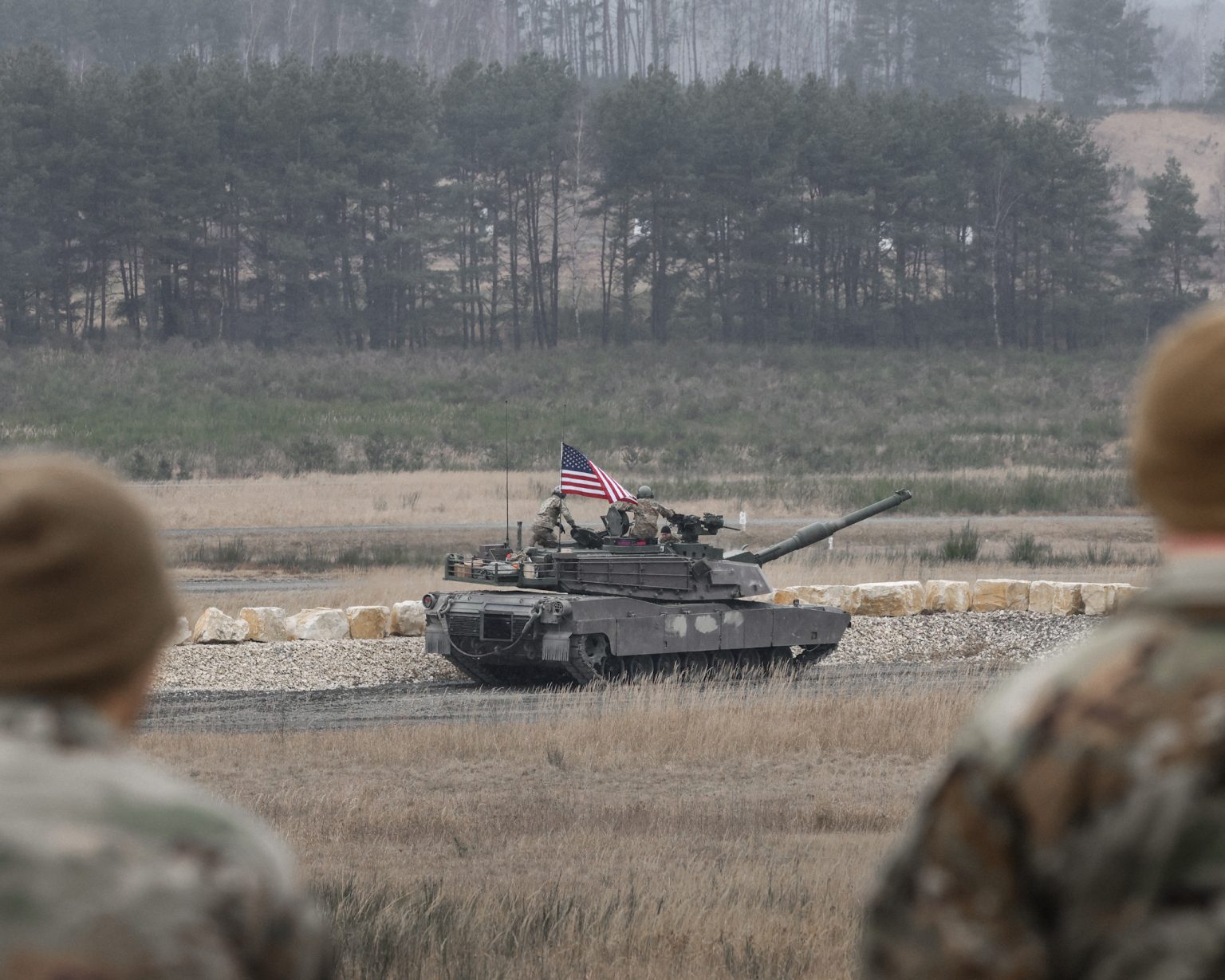
Donald Trump knows how to stage a theatrical threat. He has announced that he wants to withdraw US troops from Germany. In doing so, he has touched a nerve that reaches deep into the history of the Federal Republic. With liberation from Nazi tyranny and the end of World War II, a bridge was built between Washington and Germany that paved the defeated country’s way back into the community of nations.
By the time NATO was founded, former occupiers had become friends. In the international architecture of peace, that bridge across the Atlantic played a decisive role. Relations between Germany and the United States, however, were by no means always free of tension. Anti-Americanism also has an unpleasant tradition, especially on the German left. Yet the relationship has not been this strained for a long time.
Where are Helmut Kohl and Ronald Reagan, or George Bush, when one needs them?
Trump Blusters, the Boys Stay
For all the tension and all Trump’s bluster, one fact remains: the boys from the States are still there. According to the latest official figures from the Defense Manpower Data Center, published in December, 36,436 active US soldiers were stationed in Germany at the end of 2025. They were joined by 1,486 reservists and National Guard personnel, as well as 11,416 civilian Pentagon employees. That brings the US presence to just under 49,400 military personnel and civilian staff. Family members are not included in that figure. Germany remains the most important overseas base for US forces after Japan.
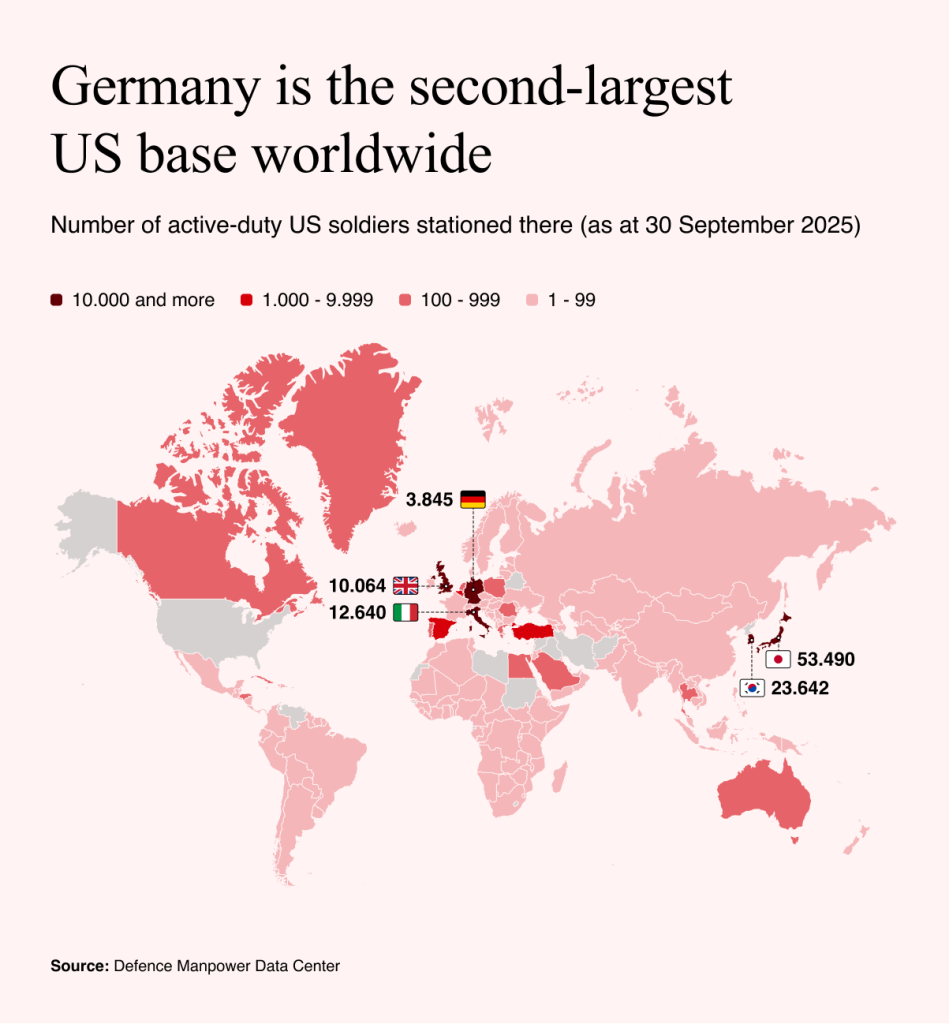
There are historical reasons why those forces are not distributed evenly. The main deployments are in Rhineland-Palatinate, Bavaria, Baden-Württemberg and Hesse. Ramstein, Landstuhl, Kaiserslautern, Baumholder and Spangdahlem, all in Rhineland-Palatinate, are familiar names to anyone with even a passing knowledge of the US military presence in Germany. Grafenwöhr, Vilseck and Hohenfels are the major training and maneuver sites in Bavaria. Stuttgart is home, among other things, to the regional commands for Europe and Africa. Wiesbaden hosts the headquarters of US Army Europe and Africa.
Ramstein Is More Than an Airport
Ramstein shows both the role of the US Army in Germany and the importance of German bases for American forces. The base in the Palatinate region is not simply a large airport with aircraft painted green or gray. Ramstein is America’s air hub for Europe, the Middle East and parts of Africa.
The US Air Force itself describes Ramstein as the “Global Gateway” to Europe and beyond. From there, the 86th Airlift Wing conducts the only airlift, airdrop and aeromedical evacuation operations of US Air Forces in Europe. It is joined by the 521st Air Mobility Operations Wing, with more than 2,700 personnel at 18 sites in 13 countries. The wing is responsible for command, maintenance, air transport and handling for strategic mobility missions in Europe and Southwest Asia.
Closing Ramstein would in no sense be a victory for Washington over Berlin. Winding down the base would mean a massive self-imposed reduction in US influence across large parts of the world. From there, American power is projected not only into Europe, but also into the crisis zones south and east of the continent.
Nor can Ramstein be understood without Landstuhl, which complements it. Landstuhl Regional Medical Center is the largest US hospital outside the United States. It serves more than 205,000 people in Europe, the Middle East and Africa. It is the only Level II Trauma Center verified by the American College of Surgeons outside the US. Since 2001, more than 100,000 wounded personnel have been treated there.
European Security Architecture
For European security, Ramstein is not merely infrastructure. Since 2022, the name has also stood for the Ukraine Defense Contact Group, in which more than 50 partners coordinate military support for Kyiv. The first meeting took place there on 26 April 2022. The format now meets more often in Brussels, but the political term Ramstein remains shorthand for the West’s capacity to act against Russia’s war of aggression in Ukraine.
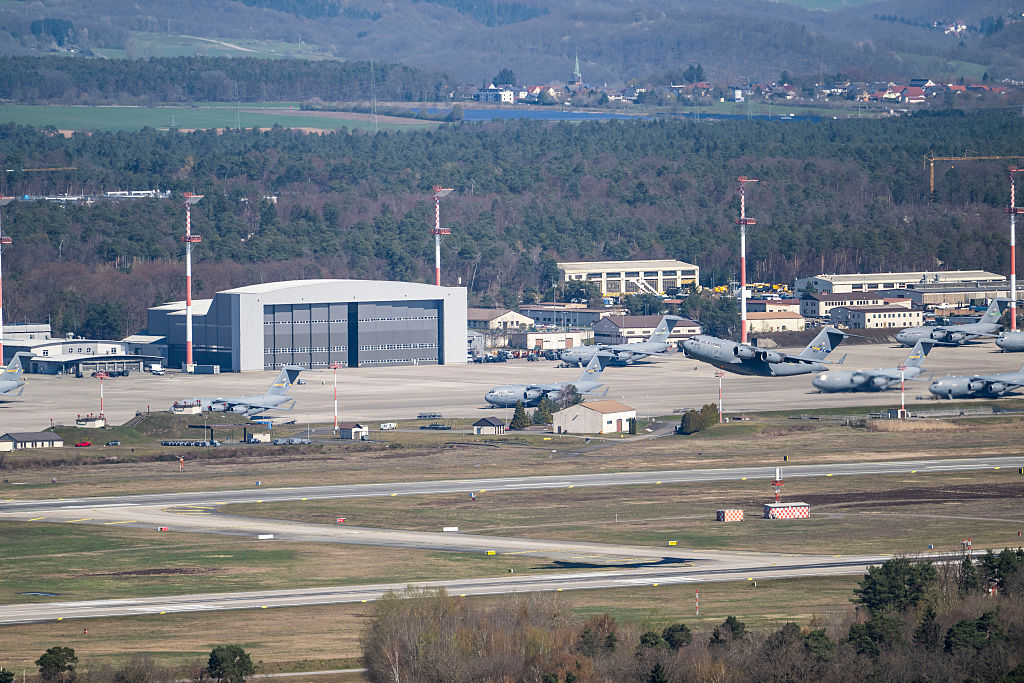
The base also has a NATO dimension. Ramstein is home to central air force structures, including NATO’s Allied Air Command. That makes it part of the alliance’s air defense and deterrence, including against Russia.
Anyone who weakens Ramstein weakens more than a German base used by the US military. Such a move would put at risk a key link between the United States, NATO and European defense planning. Ramstein and Landstuhl together show that the American presence in Europe and in Germany cannot be shaken by short-term punitive measures. Even so, the president of the United States can generate a great deal of political noise and trigger tremors of confidence in the US Army.
Withdrawing the announced 5,000 soldiers would be painful, but it would not mean the end of the US presence in Germany or Europe. As AP reports, the withdrawal is expected to take place within six to 12 months. In scale, it would amount to about one seventh of the roughly 36,000 active US soldiers in Germany. There is also resistance in Washington across the Democratic and Republican camps, because such a step could be read as the wrong signal to Vladimir Putin.
Who Would Go?
That raises the question of who would be considered for withdrawal. So far, there is only speculation. The units most likely to be moved are those not tied to unique infrastructure. One possibility would be a formation stationed in Bavaria. Vilseck is home to the 2nd Cavalry Regiment, the only US Army brigade combat team permanently stationed in Germany. Media reports identify that Stryker brigade as a possible core of the 5,000-troop withdrawal. That would be militarily noticeable, but organizationally feasible.
The situation in Rhineland-Palatinate looks very different. Long-term and costly expansion projects are under way there, which argues against any broader retreat. In Weilerbach, a new US military hospital is currently being built on 47 hectares near Ramstein. It is intended to replace the existing military hospital in Landstuhl as the largest military hospital outside the US. Depending on the source, the cost is put at just under $1.6bn to $1.83bn.
In Baumholder, according to current reports, the US Army is investing around $1bn in modernization, housing and expansion. Special forces are also being moved from Stuttgart to Baumholder. By 2029, the American community there is expected to grow to around 10,000 people. That does not sound like withdrawal either.
The Army Is Building
Trump is threatening withdrawal. The American security apparatus, by contrast, is building. The president can, of course, move troops, cancel rotations, withhold new weapons systems or pull out symbolically important units. He can humiliate Germany with such actions and sharpen the debate about European responsibility in military affairs. The latter may even make sense.
One thing, however, even a President Trump cannot do with the stroke of a pen: rewrite at will the military geography that has taken shape over recent decades. Ramstein, Landstuhl, Stuttgart and Wiesbaden are strategic hubs built up over decades. Replacing them would take years, cost billions and reduce US operational reach in Europe. Any attempt to do so would also raise a further question: where else in Europe, or elsewhere in the world, would such a move be logistically feasible, and which country would want to negotiate such a far-reaching US deployment on its soil?
None of this is in Donald Trump’s interest either. For Germany, however, a partial withdrawal would still be more than symbolic politics. In security terms, confidence in the American backstop would erode further. On NATO’s eastern flank in particular, what counts is not only the number of soldiers, but also the political credibility behind each unit. If Washington moves troops out of political irritation, or because of conflicts over Iran and defense burdens, Moscow, Beijing and Tehran are watching. Deterrence is also psychology. An alliance that publicly argues over the withdrawal of its strongest power looks more vulnerable than a bloc that stands united.
Financial Losses Locally
Financially, a withdrawal would hit the regions around the bases hardest. Ralf Hechler, the mayor of Ramstein, puts the economic value of the US military presence at more than $2bn a year. That includes wages, rents and contracts with local companies. In the municipality of Ramstein-Miesenbach alone, almost 8,000 Americans live with their families. If 5,000 soldiers were withdrawn, 10,000 to 12,000 people could leave once their relatives are included. German Bundestag documents put annual turnover by regional companies with US forces and families at Ramstein and Spangdahlem at around €220m, roughly $250m, with significant effects on construction, retail, hotels, restaurants and property.
Germany’s greatest loss, however, would not lie in any single figure in a state or municipal budget. Wherever it took place, the withdrawal of US troops would be felt in a mixture of regional prosperity, security reassurance and political weight. Rhineland-Palatinate, Bavaria, Baden-Württemberg and Hesse benefit from jobs, rental demand and contracts. Germany as a whole benefits from the fact that the United States is not merely a guest here, but an actor tied to the country through its own infrastructure. That bond, which goes beyond the purely military, makes American security guarantees more credible.
A limited withdrawal, especially of mobile Army units, is certainly realistic. It is also plausible that Trump is using it to put pressure on Berlin and Europe. The complete abandonment of sites such as Ramstein, Stuttgart or Wiesbaden is far less likely. They are much too deeply embedded in America’s warfighting, logistics, medical and alliance architecture to be treated as short-term political assets.
At the same time, Ramstein, Stuttgart and Wiesbaden are not Germany’s bargaining chip against America. They are, and remain, America’s European power center on German soil. That is precisely why their loss would be costly for Germany, dangerous for Europe and strategically unreasonable for the United States.