
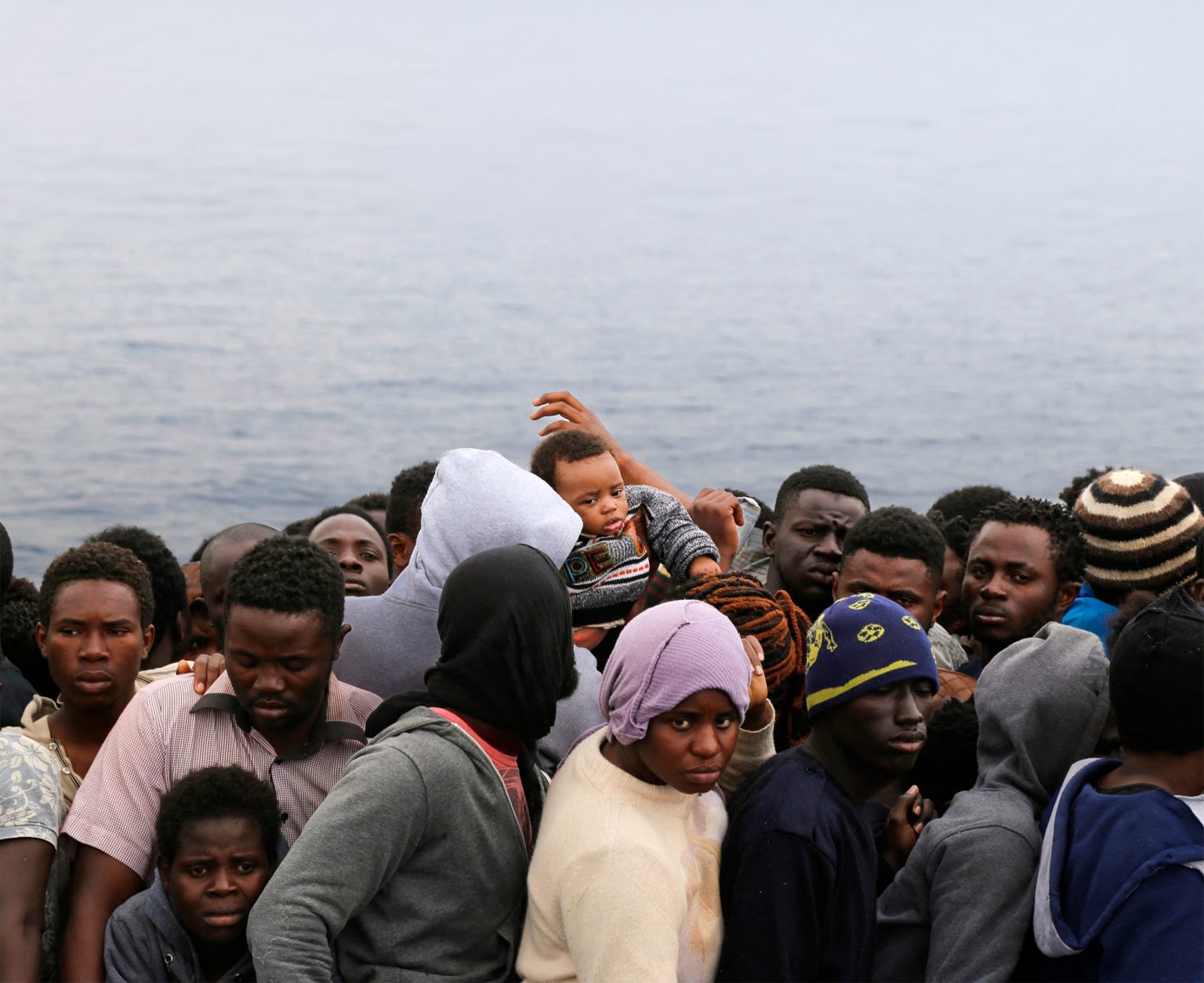
International organizations confirm the demographic decline across Europe. The World Bank expects the working-age population in Western Europe to shrink by 14% between 2020 and 2050. The European Parliament’s analysis of demographic change says so explicitly: migration cannot reverse aging in the EU.
Germany shows what that means in practice. Under former Chancellor Angela Merkel, migration was sold to Germans as a universal remedy for the country’s deepest structural problems. That included its massive demographic challenge.
A critical look at the figures shows that immigration can cushion Germany’s workforce shortage, itself partly a result of demography, only to a limited extent. It is not a solution. Above all, it cannot solve the birth-rate crisis or halt the graying of society. Measurably small effects on employment are set against high integration, welfare and security costs.
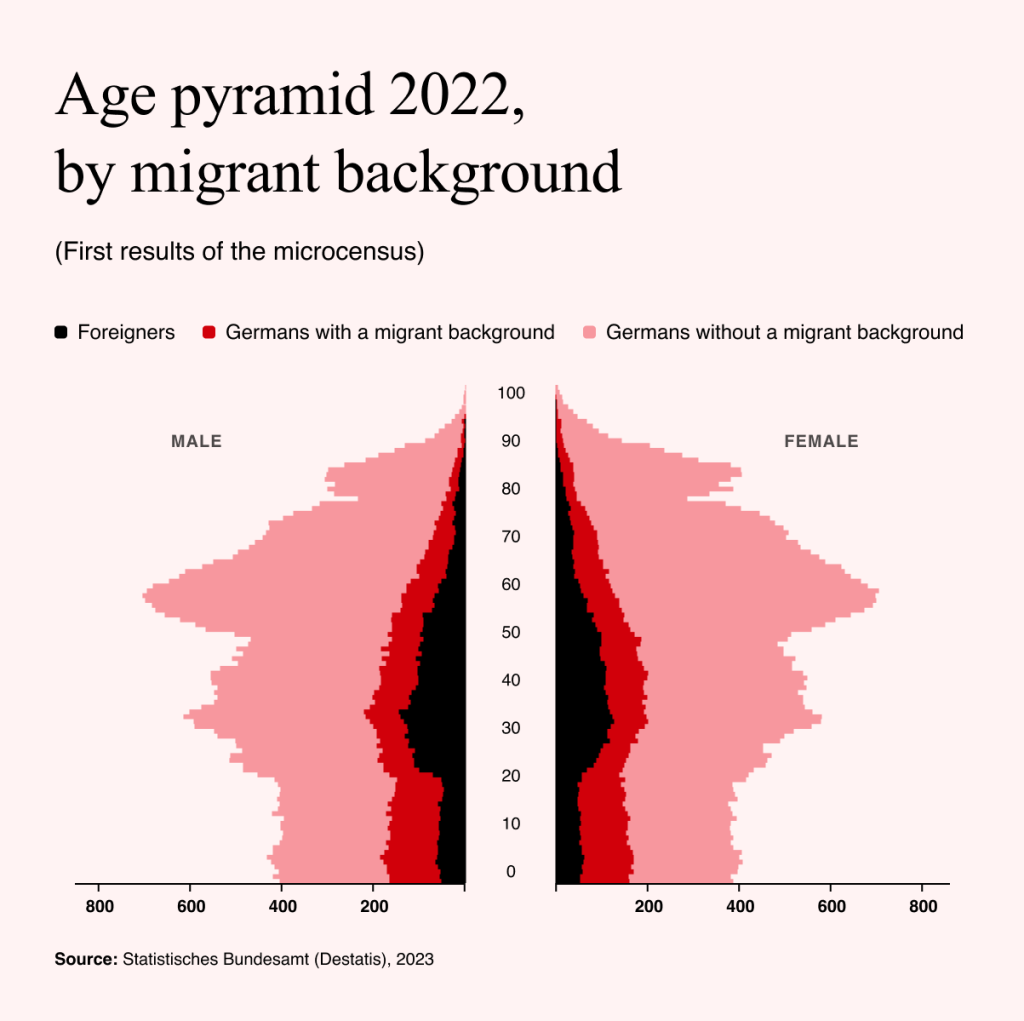
That is especially true when refugee arrivals come with low initial qualifications. When young male groups enter the country but can barely be absorbed into the existing jobs market, the end result is simply to overwhelm the welfare system. In demographic terms, it also creates a long-term male surplus in society.
Too Few Births
That still does not reach the core of the migration debate. In Germany, the drama is intensified by the fact that the discussion was long conducted in highly moralized terms and with an economic naivety bordering on recklessness. Since 2015, immigration has been sold as the answer to an aging society. Germany needed people, the argument went, because Germans were having too few children, because businesses needed staff and because care, agriculture, construction, logistics and hospitality could no longer function without foreign labor.
The diagnosis is correct. The conclusion that every form of immigration works like a demographic repair program is wrong.
Demographic analysis sensibly begins with fertility. In Germany, the rate fell to just 1.35 children per woman in 2024. That is far below the replacement level of 2.1 children per woman. Broken down further, the figure was 1.23 for women with German citizenship and 1.84 for women with foreign citizenship.
Birth rates among foreign women have also been falling continuously since 2017. Immigrant women, too, will therefore not have more children in the long term. Destatis, Germany’s Federal Statistical Office, reported around 677,000 births in 2024. With or without immigration, every generation in Germany remains smaller than the one before it.
Migration Does Not Reverse Aging
That sets the framework. To say that Germany needs immigration is easy, but not every form of immigration serves the intended purpose. Quite often, the opposite is the case. Anyone who wants to close the demographic gap would need a steady influx of large numbers of workers with suitable qualifications. That would require a high employment rate, sufficient income within a short period and the lowest possible dependence on welfare. The figures show that this is not a realistic option, but wishful thinking and, in the worst case, ugly propaganda.
In 2024, Germany registered some 1.69 million arrivals and 1.26 million departures. Net migration was therefore about 430,000 people. A year earlier, it had still been around 663,000. The inflow remains high, but it depends heavily on countries of origin, wars, internal EU movement and special political circumstances. Its composition matters more than the total. The European Commission speaks of growing labor and skills shortages in the EU. Almost two thirds of small and medium-sized companies reported in 2024 that they could not find the skilled workers they needed, despite migration.
Eastern Europeans in the Labor Market
Germany is a good example. Care, transport, construction, hospitality, agriculture and parts of industry do benefit from foreign workers. Eastern Europeans have long worked in seasonal harvesting, the meat industry, nursing, construction and logistics. Yet the country has recently become less attractive compared with several Eastern European EU states.
That is a problem for businesses, which were long able to rely on workers from Poland, Romania and Bulgaria, but can no longer do so to the same extent. When it comes to targeted labor migration from non-EU countries, the numbers are much smaller than the general immigration debate suggests.
According to the Federal Office for Migration and Refugees (BAMF), some 72,400 non-EU nationals received a residence permit for employment in 2023 in the year of their arrival. A little more than half were skilled workers with recognized qualifications. That is not insignificant, but it is far below the scale needed to absorb demographic pressure on the labor market.
The refugee cohort of 2015 shows a mixed picture. The Institute for Employment Research (IAB) reported in 2025 that 64% of those who arrived at the time were employed by 2024. The rate was 76% for men, but only 35% for women. The rest did not move into work, but into the welfare system.
Asylum Is Young and Male
Asylum migration is different again. It is significantly younger and more male than the overall population. Data from the European Union Agency for Asylum (EUAA) on asylum applications in Europe shows that age and sex are structurally unevenly distributed in this form of migration. German BAMF statistics for 2024 reported a very high share of young people among first-time applicants and a clear majority of men.

In the short term, that could mean labor-market potential if there were a willingness to work. But it also means that integration costs arise first in schools, language courses, housing, training, the justice system and social administration. Experience has shown that, among those who have so far entered through the asylum system, a majority have ended up in social transfer systems such as citizen’s benefit.
Foreigners are disproportionately represented among recipients of citizen’s benefit. Parliamentary and media analyses for 2024 speak of around 5.5 million so-called regular benefit recipients, meaning people who receive the standard rate of state social benefits, usually citizen’s benefit. Just under 48% of them do not have a German passport. Every second euro of citizen’s benefit therefore goes to foreigners who are supposed to solve Germany’s demographic problem, but in reality make it worse.
The rate is particularly high among individual groups. According to data from the Federal Employment Agency, it was more than half among Syrian nationals. Refugee and humanitarian migration demonstrably creates considerable transfer costs over years and, in many cases, permanently. A long time passes before employment, training and income take sufficient effect, and even then they do not create any real demographic gains in the receiving country.
Old Europe, Old Germany
The fact is that Europe is aging, and Germany is doing so especially fast. Migration alone will not make that disappear. Immigration helps permanently only if it leads to employment, qualifications, command of the language, tax payments and lasting social attachment.
Since all the figures so far show precisely the opposite, supporters of migration have yet to prove that it can work. A country with a low birth rate can import labor within limits. But it cannot simply bring in trust, common norms, educational qualifications, language skills and social order.
One aspect that clearly shows the demographic problem is the pension system. Ever fewer young people have to support a growing number of older people. That is true of a pay-as-you-go system such as Germany’s pension insurance and, ultimately, of a funded model as well. In the latter, too, young workers must generate the economic output on which returns on invested capital depend. Immigrants would therefore have to be willing to finance the pensions of the elderly in their new country.

No statistics are needed to see the logical flaw. Only a vanishing minority of people possess that much altruism. The problem becomes even more acute when migrants come from countries where the idea of solidarity in the sense of Catholic social teaching is wholly alien, or when newcomers are already old themselves and immediately claim old-age provision without ever having paid into the system.
No Solution
No one should imagine that religious and cultural aspects can be completely ignored in demographic questions. Europe’s economic and welfare system developed in a culture shaped by Christianity. No other culture has produced such a system to date. Migration will not stabilize it, but endanger it through overload. Immigration is no substitute for family-friendly policy, good education policy, productivity gains through qualifications and innovative technologies, or longer working lives.
The consistent, targeted recruitment of workers may be the form of migration that can buy Germany and other aging societies some time if done properly. It cannot save demography, the economy and certainly not the welfare state that depends on a healthy demographic structure.