
Donald Trump’s move to raise tariffs on cars and trucks imported from the European Union to 25% marks a new escalation in trade tensions between the US and the EU. For smaller European economies built around exports and cross-border supply chains, the impact could be less visible at first, but still painful.
Slovakia offers a clear example. The country is not the main target of the tariffs. But as a small, open economy closely tied to German industry, it is unusually exposed to any shock hitting European car production.
The tariffs target one of the central pillars of European exports: the automotive industry. Although Slovakia is unlikely to be hit first, the consequences could be felt quickly through Germany, its largest trading partner and the hub of many of its industrial supply chains.
According to several assessments, the tariffs represent a serious blow to transatlantic trade relations. Markets reacted immediately, with shares in European carmakers weakening as analysts warned that manufacturers’ annual profits could fall by 9%–21%.

Germany at the Center of the Shock
Germany, one of the main exporters of cars to the US, will be hit hardest. The automotive industry is one of the pillars of the German economy, meaning any restriction on exports has wider consequences. The new tariffs could disrupt trade relations and slow the performance of Europe’s largest economy.
For Slovakia, that matters directly. Germany takes around a fifth of Slovak exports, while Slovak factories are deeply embedded in German production chains. If German carmakers cut production or exports, orders for Slovak subcontractors are likely to fall as well.
The automotive sector accounts for around a tenth of Slovakia’s gross domestic product (GDP) and close to half of its industrial output. That makes the country highly sensitive to any shift in the sector. The impact of the US tariffs would not arrive mainly through direct exports, but through weaker demand in Europe and pressure on German industry.
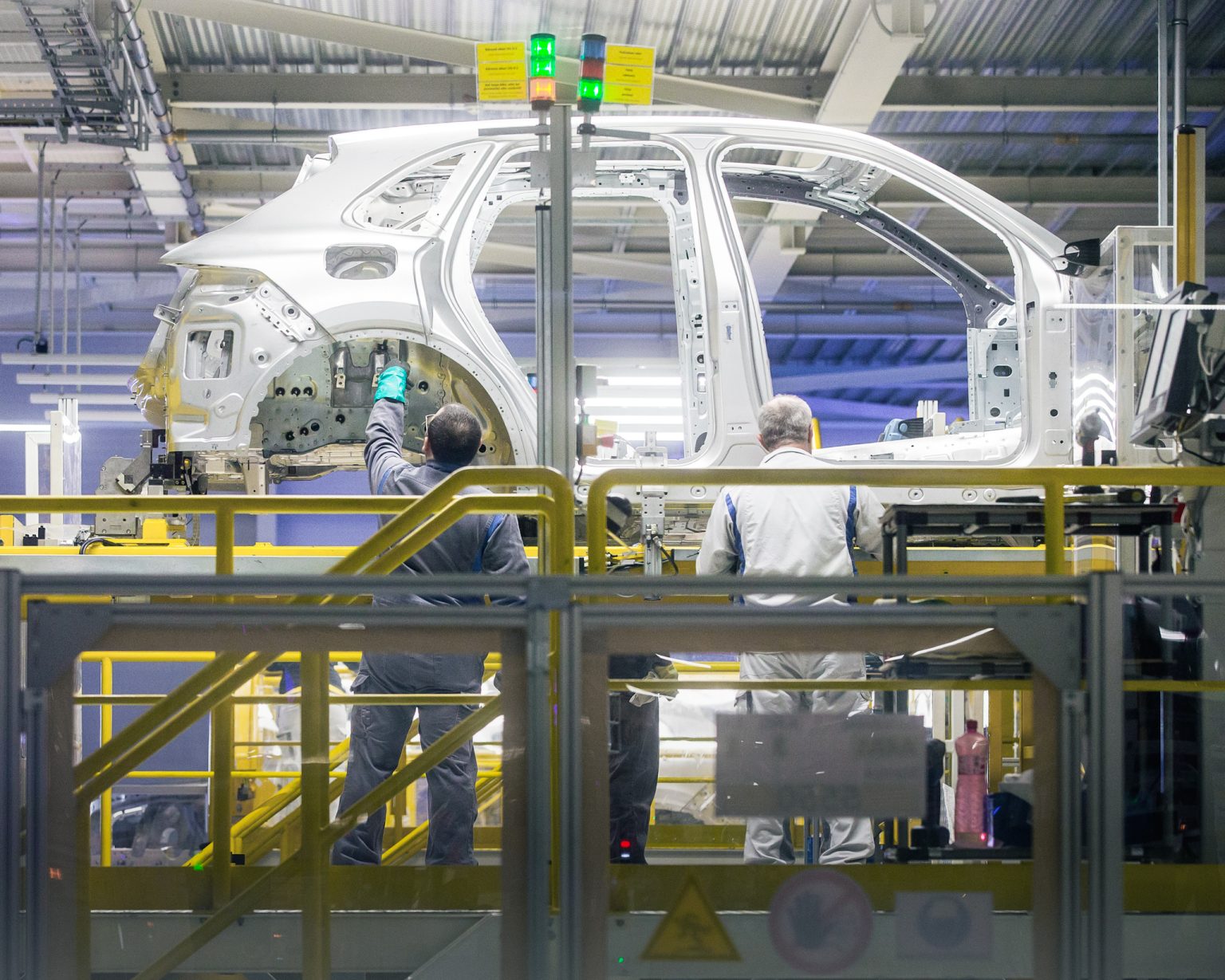
The most exposed plants are those linked to export-oriented and premium segments. Volkswagen in Bratislava produces high-end models that are sensitive to global demand. If US tariffs restrict exports of German-made cars, production could slow and pressure on supply chains could increase.
Jaguar Land Rover in Nitra is also active in the premium segment and heavily export-oriented. If the trade conflict escalates, part of the production could shift closer to the US market, weakening the role of European plants.
Kia in Zilina and Stellantis in Trnava are more focused on the European market and smaller models. Their direct exposure to US tariffs is lower, but they are not immune. A broader slowdown in the European economy and weaker demand would still reach them.
Two Possible Scenarios
The next phase will depend on whether the conflict remains contained or escalates into a broader trade war. In a milder scenario, tariffs would remain at 25% but no further escalation would follow. European economies would then have to absorb a fall in exports, but the consequences would probably be gradual and manageable. Slovakia would face slower growth and pressure on industry, but not a sudden shock.
An escalation would be far more serious. If the EU responded with countermeasures and the trade conflict deepened, the consequences would spread across the economy. A fall in global trade, disruption to supply chains and recessionary pressure in Germany would be transmitted directly to Slovakia.
That could mean lower exports, threats to jobs in the automotive industry and a more significant hit to economic growth.

Small Economy, High Sensitivity
Slovakia is one of the European countries most vulnerable to the new US tariffs on cars. The issue is not only direct exports to the US, but the country’s dependence on the German car industry. According to the Institute for Financial Policy (IFP), US demand supports around 70,000 jobs in Slovakia, including 30,000 in manufacturing and almost 9,000 directly in automotive production.
The National Bank of Slovakia has pointed out that cars and components account for up to three quarters of Slovak exports to the US. Marian Kocis, an analyst at Slovenska sporitelna, one of Slovakia’s largest banks, put that at around 4% of GDP or just under €5bn ($5.9bn). In other words, cars and components alone account for around €3.7bn ($4.4bn) in trade with the US.
The economic impact would not be negligible. The IFP estimates that a tariff conflict between the US on one side and the EU and China on the other could, in an extreme case, reduce Slovak GDP by 0.5% a year. With the Slovak economy worth around €130bn ($153bn), that would mean about €650m ($765m) a year.
Kocis put the cumulative loss even higher, at 1.5 percentage points of GDP growth over three years, or around €2bn ($2.4bn).
The labor market would be the most sensitive point. According to Kocis, Slovakia has the highest share of workers exposed to the automotive industry in the whole EU, at up to 16%.
The Association of Industrial Unions and Transport has already warned that, even under a lower-tariff scenario, lost exports could reach €150m–€300m ($177m–$353m) a year. A 4% drop in exports could increase unemployment by 0.2–0.5 percentage points. In practice, that would mean thousands, and possibly more than 10,000, additional people out of work.
Slovakia is not the direct target of the trade barriers. But its dependence on cars, exports and German supply chains makes it unusually vulnerable. For Europe’s smaller export economies, it is a warning sign. The next phase of the dispute between the US and the EU will determine whether the damage remains manageable or turns into a more serious economic shock.