

Over the weekend, oil prices began rising again, a clear sign that hopes for a quick resolution to the conflict had faded.
Donald Trump is now unlikely to arrive in Beijing holding a diplomatic breakthrough on Iran. After failing to destabilize the regime through strikes on the country’s senior leadership, Washington appears to have no broader strategy beyond containing immediate crises.
The collapse of negotiations was not difficult to foresee. Both sides have now taken positions from which retreat will be politically difficult.
Israeli Prime Minister Benjamin Netanyahu stated over the weekend that the war would not end while uranium enrichment continued on Iranian territory. Tehran is unlikely to accept such a demand because it would amount to a surrender of sovereignty.
The second major dispute concerns the Strait of Hormuz. Iran insists on charging transit fees for passage through the strait. Beyond disrupting global trade, Tehran sees the measure as a future source of revenue for post-war reconstruction. Here too, compromise appears unlikely.
For the United States, a military solution would be extremely difficult. Securing the Strait would probably require a ground operation. Even then, relatively simple drone attacks could still disrupt shipping routes. Insurance companies would also be unlikely to cover vessels operating in what would remain a permanent war-risk zone.
Without a political settlement of the conflict, the strait is effectively becoming impassable. The crisis may therefore continue for a very long time.
For now, financial markets remain largely unconcerned. Yet the underlying question has not changed: how long can investors continue ignoring the economic consequences of the conflict?

The AI Boom Spreads Beyond Nvidia
One reason markets can still overlook geopolitical risks is the continued enthusiasm surrounding artificial intelligence.
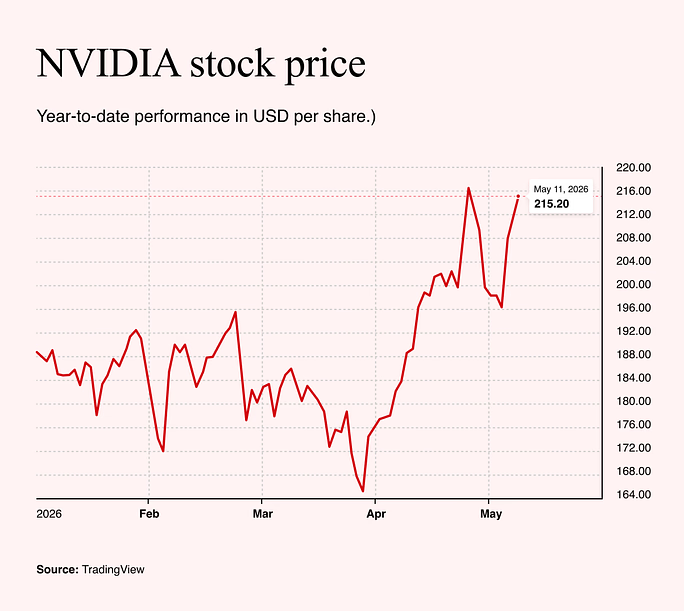
For the past two years, the dominant investment strategy was simple: buy Nvidia stocks. The company became the central beneficiary of the AI revolution because its chips formed the backbone of modern AI infrastructure.
Nevertheless investor enthusiasm is spreading across the broader sector.
Since the beginning of 2026, Nvidia shares have risen by “only” 13.9%. During the same period, AMD has surged 103% while Intel has climbed 207%. Investors are once again chasing quick profits.
Even though the AI boom no longer revolves around chipmakers alone, markets increasingly understand that building AI data centers requires far more than processors.
Micron is benefiting from rising demand for HBM memory. Corning is gaining from the need for optical infrastructure in AI data centers. France’s Soitec is profiting from growing demand for photonics technology.
Investors are therefore beginning to seek opportunities among smaller, more specialized firms.
For Nvidia, this creates a more complicated environment. The company is likely to capture a smaller share of overall AI spending as the ecosystem expands. The number of firms involved in designing and supplying data centers is growing rapidly and these companies are now driving much of the market’s enthusiasm for artificial intelligence.
Rather than deflating, the AI investment bubble is widening as more companies become part of the story.
America’s Labor Market Contradiction
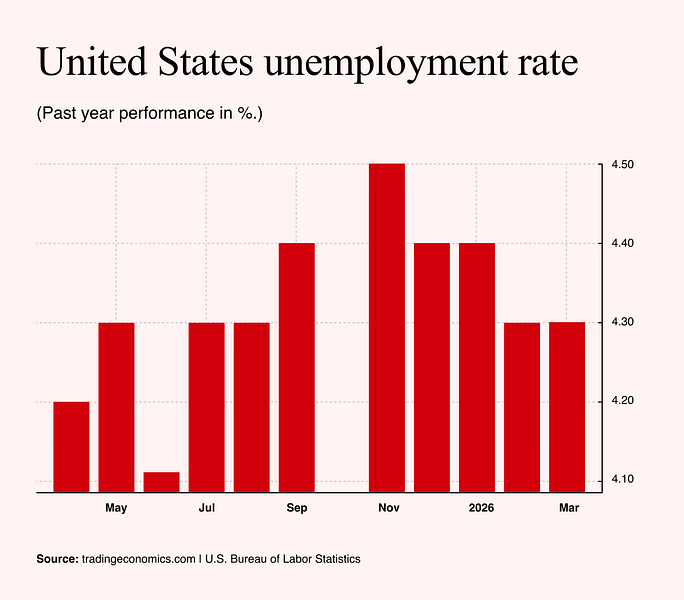
Last week also brought one of the most important economic indicators of the month. The US unemployment rate remained at just 4.3%, while the economy added 115,000 jobs in April.
At first glance, the numbers appear strong.
Neither artificial intelligence nor higher fuel prices have yet produced a visible dent in the US labor market. Yet this is exactly what makes the situation increasingly difficult to interpret.
Official statistics still look healthy, but the growing wave of layoffs across major American companies tell a different story.
Cloudflare announced plans to eliminate roughly 1,100 jobs, nearly one-fifth of its workforce, as part of its transition toward so-called agentic AI.
Coinbase is cutting around 700 positions or 14% of its workforce. Chief executive Brian Armstrong said the company needed to become “lean, fast and AI-native”.
The trend is even more visible at the largest technology firms.
Meta is reportedly planning to cut roughly 8,000 jobs while leaving another 6,000 vacancies unfilled.
Microsoft has meanwhile begun offering voluntary buyouts to employees. Combined, the measures at both companies could affect as many as 23,000 positions even as spending on artificial intelligence and data centers continues to rise.
The result is a strange dual reality within the US economy.

A Slow-Moving Transformation of Work
Official figures still suggest that the labor market remains resilient. Beneath the surface, however, companies are restructuring in ways that could prove painful for many professions.
Artificial intelligence has not yet caused a sharp rise in unemployment. But it has already begun changing how corporations think about labor. Employees are increasingly viewed not as untouchable assets, but as costs that can in some areas be reduced through software, automation and smaller teams.
This is the logic behind Upwork chief executive Hayden Brown’s remark that “two-pizza teams are dead”. Even the once-celebrated ideal of a small tech team that could be fed with two pizzas is beginning to look inefficient in the AI era.
The direction is becoming clearer. Companies may continue hiring, but where they once needed dozens or hundreds of workers, they may increasingly require only small teams equipped with powerful technological tools.
For financial markets, this is encouraging because it promises higher productivity and lower costs.
For employees, however, it may be the first warning that AI’s real impact on the labor market will emerge gradually rather than suddenly, company by company, department by department.
Until these changes become visible in official unemployment figures, investors are likely to continue ignoring the risks.
In 2026, financial markets still seem convinced that asset prices can move in only one direction: higher.